

When building or fixing up a covered porch, most homeowners spend a lot of time picking the right flooring, railing, and paint colors. But there’s one part of the porch people often overlook: the ceiling.
A beautiful porch ceiling can completely change the look of your outdoor space. It can make a basic porch feel warm and inviting or give a new home a clean, modern look.
Two of the most popular choices are PVC porch ceiling planks and natural wood tongue and groove ceiling boards.
Both have their advantages. However, after more than 20 years in the lumber and building materials industry, I’ve learned that the best choice often comes down to your budget, the look you want, and how much upkeep you’re willing to do.
Let’s take a closer look at how these two materials compare.
What Is a PVC Porch Ceiling?

PVC porch ceiling planks are made from polyvinyl chloride, a type of plastic building material. Unlike natural wood, PVC doesn’t absorb water the same way wood does.
That makes it a popular choice for covered porches, especially in humid areas or places where moisture can be a problem. Most PVC ceiling planks come in a tongue and groove design. Each board fits into the next, creating a smooth ceiling with very few visible gaps.
PVC porch ceilings are often available in white and other factory finished colors. Some products also offer wood look finishes.
Advantages of PVC porch ceilings:
- Won’t rot from moisture
- Resistant to termites and other wood eating insects
- Doesn’t need regular staining or sealing
- Easy to clean with mild soap and water
- Great for humid climates
- Can provide a clean, modern appearance
Of course, PVC isn’t perfect. It can expand and shrink as temperatures change. Some products may also sag if the ceiling framing is spaced too far apart. That’s why it’s important to follow the manufacturer’s installation instructions.
What Is a Wood Porch Ceiling?
Wood porch ceilings have been around for generations. Walk through an older neighborhood with beautiful front porches, and there’s a good chance you’ll see natural wood overhead.
Traditionally, builders used pine, cedar, or other softwoods. Today, homeowners have many more options.
At AdvantageLumber.com, we offer premium wood ceiling materials such as:
- Plantation Teak: A beautiful hardwood with warm golden brown colors and natural moisture resistance.
- Western Red Cedar: A lightweight wood known for its rich color, natural beauty, and resistance to decay.
- Thermally Modified Wood: Real wood treated with heat to improve its stability and resistance to decay.
- Ipe: An extremely dense tropical hardwood known for its strength and long life.
- Cumaru: A durable hardwood with rich brown and reddish tones.
- Tigerwood: A striking hardwood with dark stripes and bold grain patterns.
Many of these woods are available in tongue and groove profiles that create a beautiful, finished ceiling.
Unlike PVC, real wood has natural grain, color changes, and character. No two boards look exactly alike.
For homeowners who want a warm, high end appearance, that’s a big advantage.
PVC vs. Wood Porch Ceilings: Side by Side Comparison
Before getting into the details, here’s a quick look at how the two materials compare.
| Feature | PVC Porch Ceiling | Wood Porch Ceiling |
|---|---|---|
| Appearance | Clean, uniform finish | Natural grain and rich colors |
| Moisture resistance | Excellent | Depends on wood species |
| Rot resistance | Won’t rot | Varies by species |
| Maintenance | Very low | Low to moderate |
| Painting or staining | Usually not needed | Optional, depending on wood |
| Heat movement | Expands and contracts with temperature | Moves with moisture changes |
| Installation | Lightweight and easy to cut | Depends on wood density |
| Lifespan | Often decades | Often decades with proper care |
| Cost | Varies by product | Varies widely by species |
| Natural appearance | Simulated wood look | Authentic wood |
Now, let’s look at what really matters when choosing a porch ceiling.
1. Appearance: Natural Wood Is Hard to Beat
This is where I believe real wood has the biggest advantage.
There’s something special about looking up at a beautiful teak or cedar ceiling. The natural grain adds warmth and character that plastic materials have a hard time matching.
For example, plantation teak has a rich golden color that works well with both modern and traditional homes. Western Red Cedar gives you a more rustic look, while thermally modified wood can provide a beautiful brown finish.
Want something more dramatic? Tigerwood has bold stripes that can turn a plain porch ceiling into a real conversation piece. PVC, on the other hand, works well if you want a smooth, painted look.
White PVC ceilings are especially popular on coastal homes and traditional front porches.
Some PVC products try to copy the look of natural wood. Although these finishes have improved over the years, they still don’t offer the same grain and color changes you get with real lumber.
My take: If you want a ceiling that looks like natural wood, I’d choose real wood. If you prefer a simple white ceiling, PVC may be the better fit. We do offer Azek Alpine PVC ceiling planks that feature some nice wood grain options but in my opinion it’s very hard to match the aesthetics of real wood.
2. Moisture Resistance: PVC Has an Advantage
Even though your porch has a roof, the ceiling can still face moisture. Humidity, wind driven rain, and condensation can all affect the materials overhead.
This is especially true in coastal areas and humid climates like Florida. PVC handles moisture very well because it doesn’t absorb water like wood.
It also won’t rot, making it a good choice for porches where damp conditions are common. However, don’t assume all wood ceilings will rot just because they’re outside.
Certain wood species naturally resist decay much better than others. For example, teak, Ipe, and Cumaru contain natural compounds that help them resist moisture and decay. Western Red Cedar also offers natural decay resistance, especially in its heartwood.
Thermally modified wood is another great option. During the heat treatment process, the wood changes in ways that reduce how much moisture it absorbs. As a result, it tends to move less as humidity changes.
Still, even durable wood needs proper airflow and installation.
My take: PVC wins for moisture resistance, but high quality hardwoods and thermally modified wood can also perform very well under a covered porch.
3. Maintenance: How Much Work Will Your Ceiling Need?
Nobody wants to spend every weekend maintaining a porch ceiling. Fortunately, both PVC and certain wood products can be fairly easy to care for.
PVC Ceiling Maintenance
PVC is about as low maintenance as it gets. Most of the time, all you need to do is wipe away dust, dirt, or spiderwebs.
You won’t have to worry about sanding or applying wood stain. However, PVC can still get dirty, and some finishes may fade or discolor over time.
Wood Ceiling Maintenance
Wood requires a little more thought. If you want to keep the original brown or golden color, you may need to apply a suitable finish from time to time.
How often depends on the wood, the finish, and how much sunlight or moisture reaches the ceiling. But here’s something many homeowners don’t realize.
You don’t always have to finish a wood porch ceiling.
Many durable hardwoods can be left unfinished, allowing them to slowly develop a natural silver gray color. Under a covered porch, this color change often happens much more slowly than it would on an open deck.
If you like the natural weathered look, you may not need to do much beyond occasional cleaning.
On the other hand, homeowners who want their ceiling to keep its rich original color should plan for some upkeep.
My take: PVC is the clear winner for homeowners who want the least possible maintenance. Still, a natural wood ceiling doesn’t have to become a major chore.
4. Cost: Which Porch Ceiling Is More Affordable?
Cost is usually one of the first questions homeowners ask. Unfortunately, there’s no simple answer because both PVC and wood come in different price ranges.
Basic PVC ceiling planks may cost less than premium hardwoods such as teak or Ipe. However, some high end PVC products can cost more than certain natural wood options.
Wood prices also vary quite a bit. For example, Western Red Cedar and thermally modified pine may be more affordable than premium tropical hardwoods.
Meanwhile, plantation teak and other exotic hardwoods such as Tigerwood can cost much less than people think and offer a beautiful appearance and excellent durability.
Don’t forget about installation costs. PVC is usually lightweight and easy to cut. Dense hardwoods may require carbide tipped blades, predrilling, and more labor.
You should also consider finishing costs. If you plan to stain or seal your wood ceiling, add those materials and labor to your budget.
Don’t Judge a Porch Ceiling by Price Alone
I’ve seen homeowners save a little money on materials, only to regret their choice a few years later.
A porch ceiling is something you’ll look at every time you sit outside. Spending a little more for the appearance you really want may be worth it.
5. Durability: How Long Will Each Ceiling Last?
A properly installed PVC porch ceiling can last for decades. Since PVC doesn’t rot or attract termites, moisture and insects are usually less of a concern.
However, PVC can become brittle or change color over time, depending on the product and how much sunlight it receives.
Temperature changes can also cause problems if installers don’t leave enough room for expansion. Natural wood has a different set of strengths.
Premium hardwoods such as Ipe, Cumaru, and teak are known for their long service life. In fact, some of these species can last for many decades in demanding outdoor applications.
A covered porch ceiling usually faces much less wear than a deck because nobody walks on it, and the roof protects it from direct rain. That means a properly installed wood ceiling may last a very long time.
Of course, the exact lifespan depends on the species, moisture conditions, installation, and maintenance.
My take: Both materials can last for decades. I wouldn’t choose PVC over a premium hardwood based on lifespan alone.
6. Installation: PVC and Wood Need Different Methods
At first glance, installing PVC and wood tongue and groove ceilings looks pretty similar. Both use boards that fit together to create a finished surface.
However, there are some important differences.
Installing PVC Porch Ceiling Planks
PVC is generally easy to handle because it’s lightweight. Most installers can cut it using common woodworking tools.
The biggest concern is temperature movement. PVC expands when it gets hot and contracts when it cools.
If you install the boards too tightly or use the wrong fasteners, you may end up with buckling or other problems.
Some PVC products also require closer framing support to prevent sagging. Always check the manufacturer’s requirements before installation.
Installing Wood Porch Ceiling Planks
Wood also expands and shrinks, but moisture is usually the main cause. For this reason, proper storage and acclimation are important.
Don’t leave your ceiling boards sitting uncovered in the rain before installing them.
Instead, keep the material dry and protected while allowing it to adjust to the conditions at the jobsite according to the supplier’s instructions.
Some hardwoods are extremely dense, so you may need to predrill holes and use stainless steel fasteners. Tongue and groove ceiling boards can often be blind fastened for a clean look without visible screw heads.
Be sure to leave the proper expansion space around the edges.
Also, remember that tongue and groove wood ceiling boards are intended for protected ceiling applications. They’re not a substitute for roofing or waterproofing.
My take: PVC is often easier for a DIY homeowner to install. Wood takes a little more planning, especially when working with dense tropical hardwoods.
7. What About Heat and Temperature Changes?
This is one area homeowners don’t always think about. Even though your porch ceiling sits in the shade, it can still get pretty hot during summer.
PVC reacts to heat by expanding. On a long porch ceiling, that movement can add up. Without the proper gaps and fastening methods, the boards may buckle or develop waves.
Wood behaves differently. Most wood movement happens as the boards gain or lose moisture. Temperature alone usually has a much smaller effect.
Thermally modified wood is especially interesting because the heat treatment makes it more stable when humidity changes. That can be a big benefit for covered outdoor ceilings.
However, no material is completely free from movement. Good installation matters just as much as the material you choose.
8. Which Material Is Better for Coastal Homes?
If you live near the ocean, salt air and high humidity can make outdoor building projects more challenging.
PVC is a popular option for coastal porches because it doesn’t rot and handles damp air well. However, teak is another excellent material to consider.
Teak has a long history of use in boats and other marine environments because of its natural durability. That’s one reason I like plantation teak for high end coastal homes.
It offers the warmth of natural wood while providing strong resistance to moisture and decay. Western Red Cedar and thermally modified wood can also work well in protected outdoor spaces.
Keep in mind that coastal homes need corrosion resistant fasteners regardless of which ceiling material you choose. Even the best ceiling planks won’t help much if the fasteners begin to rust.
9. Is PVC or Wood Better for a Screened In Porch?
Screened in porches are a little different from open porches. Screens block insects and some blowing debris, but they don’t stop humidity.
During heavy storms, wind can also push rain through the screens. PVC is a practical choice because it handles damp conditions with little maintenance.
Still, natural wood can make a screened porch feel much more like an outdoor living room. I’ve always liked the look of a warm wood ceiling paired with a stone fireplace, comfortable furniture, and a nice ceiling fan.
It’s a simple detail that can make the entire space feel more expensive. For homeowners who want that look without frequent maintenance, thermally modified wood or plantation teak may be worth considering.
Just make sure the porch has proper ventilation and the roof doesn’t leak.
10. Best Wood Species for Covered Porch Ceilings
If you’ve decided to go with real wood, you have plenty of great options. Some offer a clean, modern look, while others bring out the natural character of the wood.
Here are a few of my favorites.
Plantation Teak

Teak is one of my favorite choices for luxury porch ceilings. It has beautiful golden brown coloring and natural resistance to moisture and decay.
It’s also a great fit for coastal homes, covered patios, and outdoor living spaces. At AdvantageLumber.com, we offer plantation teak ceiling products, including prefinished options that can help save time during installation.
Western Red Cedar

Western Red Cedar is a classic porch ceiling material. It’s lightweight, easy to work with, and naturally resistant to decay.
The warm reddish brown color looks great on cabins, traditional homes, and modern outdoor spaces. Cedar is also easier to cut and fasten than very dense tropical hardwoods.
Thermally Modified Wood
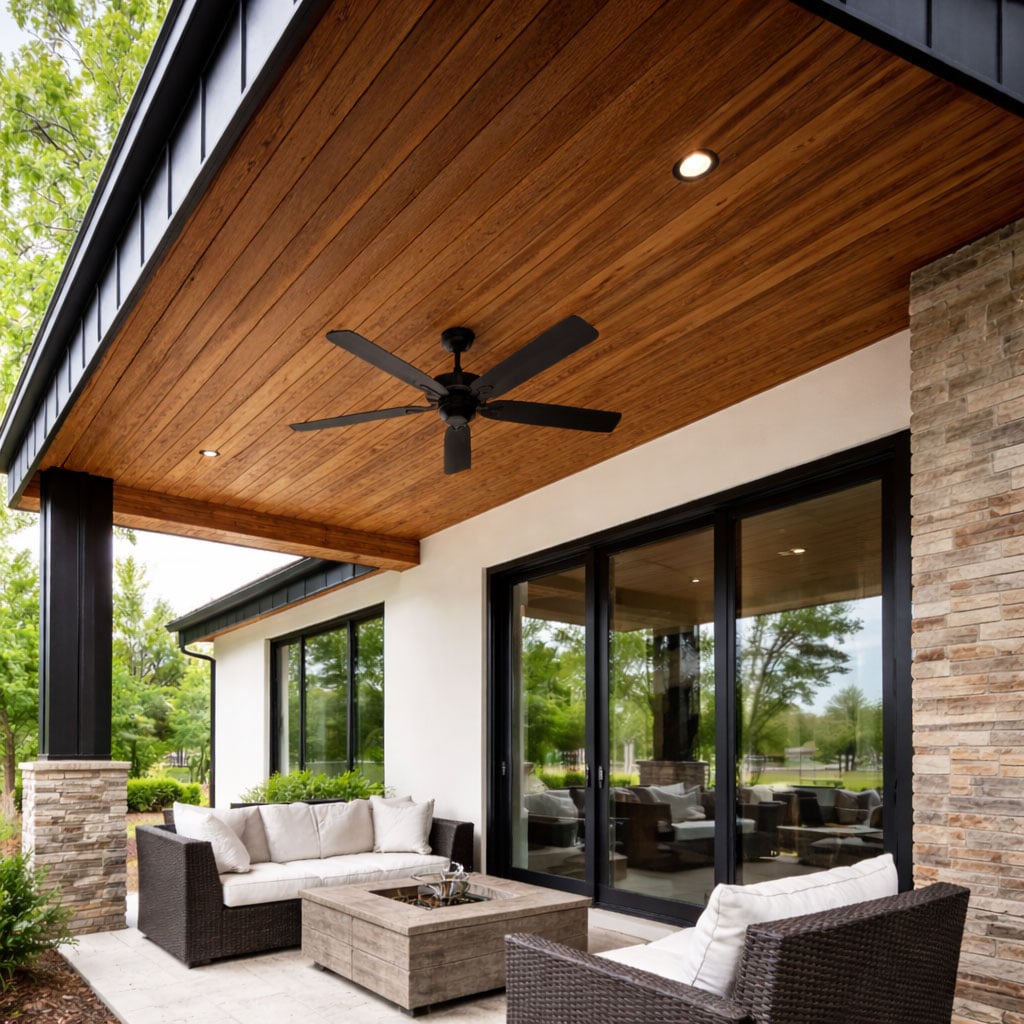
Thermally modified wood has become one of the more exciting options in outdoor building materials.
The wood goes through a special heat treatment process that improves its stability and resistance to decay without relying on traditional chemical preservatives.
Thermally modified pine and ash can offer a rich wood appearance at a more affordable price than some premium tropical hardwoods.
For a covered porch ceiling, they’re definitely worth a look.
Pecky Bolivian Walnut
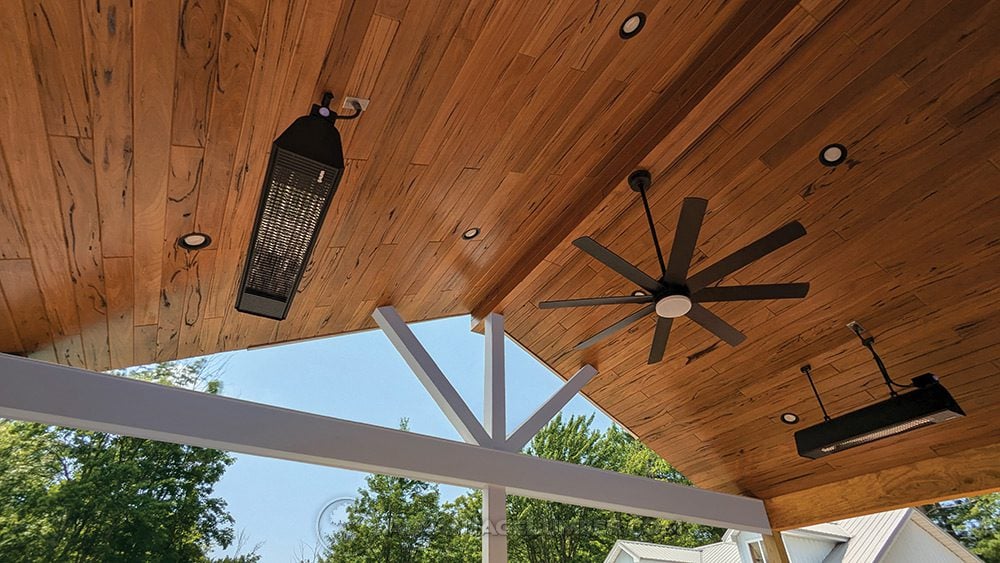
If you want a porch ceiling that really stands out, Pecky Bolivian Walnut is worth a look.
This beautiful hardwood has a unique appearance thanks to the natural pockets and grooves found throughout the wood. These irregular patterns create a rustic, textured look you simply can’t get from PVC.
In fact, every board has its own character. Some have small pockets, while others feature larger patterns that give the ceiling a bold appearance.
I’ve always liked this type of wood for covered patios, outdoor kitchens, and luxury homes where the ceiling is meant to be a major design feature.
Pecky Bolivian Walnut looks especially impressive when paired with exposed beams, stone walls, or warm outdoor lighting.
Since the natural pockets can collect dust and debris, occasional cleaning may take a little more effort than with a smooth ceiling.
For homeowners who want something different from the typical tongue and groove ceiling, Pecky Bolivian Walnut is a beautiful option.
Synergy Wood Southern Knotty Pine
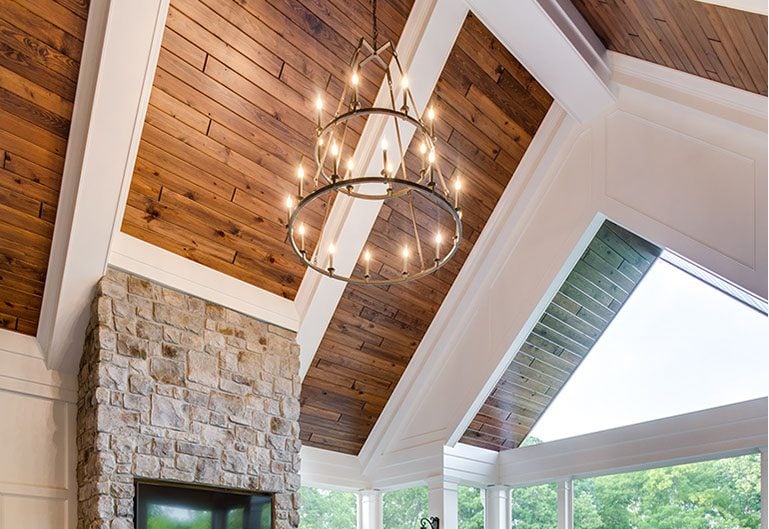
Want the warm look of a traditional wood porch ceiling without having to stain every board yourself?
Synergy Wood Southern Knotty Pine is a great option.
These prefinished tongue and groove wood ceiling planks offer the classic charm of knotty pine with the convenience of a factory applied finish.
The natural knots and grain patterns give the ceiling a cozy, welcoming appearance. I particularly like this look for farmhouse style homes, mountain cabins, covered porches, and outdoor living areas.
One of the biggest advantages is the time saved during installation.
Instead of installing unfinished boards and then applying stain overhead, you can install planks that already have their finish.
That’s a big deal when you’re working above your head all day.
Keep in mind that Southern Knotty Pine is a softwood. It doesn’t have the same natural decay resistance as teak or Ipe, so proper protection from rain and moisture is important.
For a well protected porch ceiling, however, Synergy Wood Southern Knotty Pine can deliver a beautiful finished look with less work.
Synergy Wood Red Grandis

If you prefer a cleaner, more refined wood ceiling, Synergy Wood Red Grandis is another excellent choice.
Red Grandis is a plantation grown hardwood known for its attractive grain and relatively uniform appearance. Compared to knotty pine, it generally has fewer visible knots and offers a smoother, more modern look.
Synergy Wood takes this material a step further by offering prefinished tongue and groove ceiling planks. That means you get the beauty of real hardwood without having to stain and finish the boards after installation.
Red Grandis works especially well for modern homes, upscale covered patios, and porches where you want a clean, finished appearance. It’s also a nice option for homeowners who want natural wood but don’t like the heavy knot patterns found in rustic pine ceilings.
As with other wood ceiling products, make sure the selected finish and installation method are approved for your covered outdoor space.
Ipe and Cumaru
If you want a premium hardwood ceiling, Ipe and Cumaru are excellent choices. Both are extremely dense and naturally durable.
Ipe typically has rich brown tones, while Cumaru can range from golden brown to reddish brown. These woods are often used for luxury decks, but they can also create stunning covered ceilings when the proper profiles are available.
Keep in mind that their density makes installation more demanding.
So, Is PVC or Wood Better for a Covered Porch Ceiling?
After more than 20 years working with outdoor building materials, here’s how I’d make the choice.
Choose PVC if:
- You want a simple white or painted looking ceiling.
- Low maintenance is your top priority.
- Your porch faces frequent moisture or high humidity.
- You prefer a lightweight material that’s generally easy to install.
- You don’t mind a manufactured appearance.
Choose natural wood if:
- You love the look of real wood grain.
- You want a warm, high end outdoor living space.
- You prefer natural building materials.
- You’re willing to do some occasional maintenance.
- You want a wide range of natural colors and wood species.
For my own covered porch, I’d lean toward natural wood, especially plantation teak or thermally modified wood.
Why?
Because a porch ceiling is protected from much of the weather, and I think it’s a great place to enjoy the beauty of real wood.
You get the rich grain and warm colors without exposing the material to the same abuse as an open deck.
However, if I were building a traditional porch with a bright white ceiling and wanted almost no maintenance, PVC would be high on my list. There’s no single material that’s best for every home.
Final Thoughts: Don’t Overlook Your Porch Ceiling
A covered porch is one of the best places to relax, enjoy a meal, or spend time with family.
And while the ceiling might not seem like a big deal at first, it can have a huge impact on how the finished space looks.
PVC offers excellent moisture resistance and very little maintenance. Natural wood brings warmth, character, and a timeless appearance that manufactured products struggle to match.
The right choice depends on your style, budget, and how you plan to use the space.
At AdvantageLumber.com, we specialize in premium wood ceiling materials, including plantation teak, Western Red Cedar, thermally modified wood, and tropical hardwoods.
With more than 30 years of experience in hardwood building materials and four U.S. warehouse and manufacturing locations, we can help homeowners and contractors find the right wood for their projects.
Whether you’re building a new covered porch or replacing an old ceiling, our team can help you compare wood species, choose the right tongue and groove profile, and estimate how much material you’ll need.
A beautiful porch deserves a beautiful ceiling. And sometimes, the best finishing touch is right above your head.
