
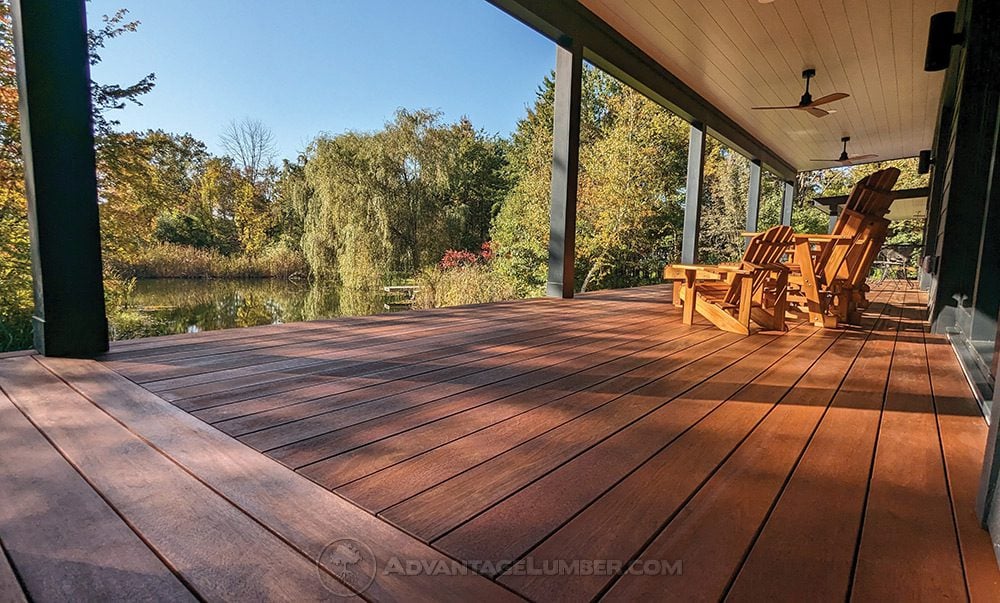
When homeowners picture a high-end outdoor space, wide-plank hardwood floors are often part of that vision. The clean lines and bold scale feel refined, intentional, and timeless.
That naturally leads to a common question: Can the same wide-plank look work on a deck? While 1×8 deck boards can deliver strong architectural appeal, they behave very differently outdoors—especially when made from dense exotic hardwoods like Ipe and Cumaru. Understanding those differences is key to choosing a deck that stays flat, stable, and beautiful over time.
Understanding the Real Size
Deck boards are sold using nominal names, but the actual finished width is what matters when it comes to layout, spacing, and long-term performance.
| Nominal Size | Actual Width | Common Use |
|---|---|---|
| 1×4 | 3.5 inches | Traditional / High Stability |
| 1×6 | 5.5 inches | The Industry Standard |
| 1×8 | 7.25 inches | Architectural / Wide Plank |
Even small differences in width can significantly affect airflow, fastening strategy, and how wood responds to seasonal moisture changes.
The Pros: Why Homeowners Love Wide Boards
Architectural Cleanliness
Fewer boards mean fewer seams. On larger decks, 1×8 planks create a grander sense of scale and a less “busy” visual field
Modern Aesthetic
Wide planks reflect interior flooring trends, helping create a seamless transition from indoor living spaces to an exterior hardwood deck.
Installation Efficiency
A 1×8 covers nearly 30 percent more surface area than a 1×6, which can reduce layout time on larger projects and minimize material waste.
Shop Wide Deck Boards
- 5/4×8 Ipe Decking
- 5/4×8 Cumaru Decking
- 1×8 TimberTech Vintage Decking
- 1×8 TimberTech Harvest Decking
- 1×8 Deckorators Surestone Voyage Decking
The Cons: The Science of Stability
Wide deck boards are visually striking, but they are less forgiving than narrower boards. Three key performance challenges should be considered before choosing a full 1×8 layout.
The Risk of Cupping
Wood is a natural material that responds to moisture. When a wide board is exposed to sun and rain, the top surface often dries faster than the underside. Over time, that imbalance can cause the edges of the board to lift, a condition known as cupping.
Because a 1×8 spans more width than a 1×6, this effect is more pronounced, especially with dense hardwoods installed in exposed environments.
Fastening Limitations
Hidden fasteners create a clean surface, but they are generally not recommended for 1×8 hardwood deck boards. Wide planks experience greater seasonal movement, and clip systems often do not provide enough holding power to keep them flat over time.
For a 7.25-inch-wide Ipe or Cumaru board, face-screwing provides the most reliable long-term performance. When installed using DeckWise® hardwood plugs, fasteners are concealed and the finished surface maintains a clean, refined appearance.
Airflow and Drying Considerations
Wide boards also reduce the number of gaps across the deck surface. While this enhances the visual appeal, it means moisture takes longer to dry after rain.
To perform well, wide-plank decks need good airflow beneath the structure so moisture can escape rather than linger against the boards. Without adequate ventilation, even premium hardwoods are more likely to cup or warp over time.
What about Narrow Boards?
In some situations, the downsides to wide boards outweigh the benefits. So how do narrow boards, like 1x4s, compare?
The Pros
Greater Dimensional Stability
Narrower boards are naturally more stable because they have less surface area exposed to moisture. Since all wood expands and contracts with changes in humidity and temperature, wider boards experience more dramatic movement across their width. A 1×4 board, by comparison, undergoes less seasonal stress — helping your deck stay flatter and more consistent over time.
Reduced Risk of Cupping
Cupping happens when one side of a board dries faster than the other, causing the edges to lift. Because 1×4 boards are narrower, there’s less internal tension across the width, making them far less likely to cup — especially in climates with humidity swings or strong sun exposure.
Lower Cost per Linear Foot
Narrow deck boards typically cost significantly less per linear foot than wider boards. Although you’ll use more boards to cover the same square footage, the lower per-board price can reduce upfront material costs and minimize financial risk if you ever need to replace individual boards.
Easier Handling and Installation
1×4 boards are lighter and easier to maneuver on the jobsite. This can simplify installation, reduce installer fatigue, and make them especially attractive for DIY deck projects.
Shop Narrow Deck Boards
- 1×4 Ipe Decking
- 1×4 Cumaru Decking
- 1×4 TimberTech Vintage Decking
- 1×4 Deckorators Surestone Voyage Decking
The Cons
More Fasteners and Installation Time
Because you’ll need more boards to cover the same space, narrow decking requires more fasteners and slightly more installation time. Labor costs can increase if you’re hiring a contractor.
More Seams and Visual Lines
Narrow boards create more visible seams across the deck surface. While some homeowners prefer the traditional look, others may prefer the cleaner, more modern appearance of wider planks.
Slightly Higher Overall Fastener Cost
With more boards comes more hardware. Even though the boards themselves cost less per linear foot, the total project cost may balance out depending on fastening systems and labor rates.
The Best of Both Worlds: Mixed-Width Decking
For homeowners who want the visual impact of wide boards without the added risk, a mixed-width deck layout is an excellent alternative.
By alternating 1×4 and 1×6 boards, you achieve a custom, architectural look while maintaining better airflow, improved stability, and compatibility with hidden fastening systems. This approach delivers visual interest without compromising long-term performance.
The Verdict
Wide deck boards can be a striking design choice, but they are not a forgiving one.
For most residential projects, 1×6 or 5/4×6 decking offers the best balance of appearance, stability, and ease of installation. These sizes perform consistently, manage moisture movement more predictably, and work well with a wider range of fastening options.
If a wide-plank look is your priority, 1×8 boards can work when the details are handled correctly. Proper framing, good airflow, and an installer experienced with face-screwing and hardwood plug systems are essential. With the right approach, wide deck boards can be beautiful—but the details matter.

Speaking as a contractor who deals with painting and staining , caulking, and wood repairs, also masonry repairs, I believe that Advantage Lumber is making some very good points in their discussion of this topic on deck boards. I would add two things: 1) it is important to give the homeowner a deck, or repair and restoration project – that makes the homeowner happy. If at the end of the day, the homeowner prefers the wider boards, so be it – try and use them. However, you can explain the pro’s and con’s of wide vs. narrow. 2) I would point out that if you use deck boards that are good strong wood, and you affix them with high quality screws (not clips), the deck boards become a structural support for the deck, much like well-attached plywood sheathing does for the framing of a house. Once the plywood sheathing is attached to the walls and/or roof, the wall or roof becomes structurally a lot stronger. For wall, if you don’t use plywood sheathing, you’re supposed to add support with blocking and/or bracing. Similar aspect to attaching on the deck boards. Your deck may or may not need the additional support, but there is no doubt about it – if you use good strong wood, that holds fasteners well, once it is solidly screwed on – it becomes a very significant structural support for the framing and overall structure of the deck.
One other thing – regarding deck drainage. Most of the drainage for rainwater, or if you’re somewhere where there is snow and ice – most of the drainage isn’t from water going off the ends or edges of the deck, it’s from the water going through the gaps between the deck boards. So – if make your deck with narrower decking, you are “building in” more drainage for rainwater, or water from melting snow and ice if that’s relevant to your location. The narrower the boards, the more gaps creating more drainage for your deck. Something to keep in mind as well.