
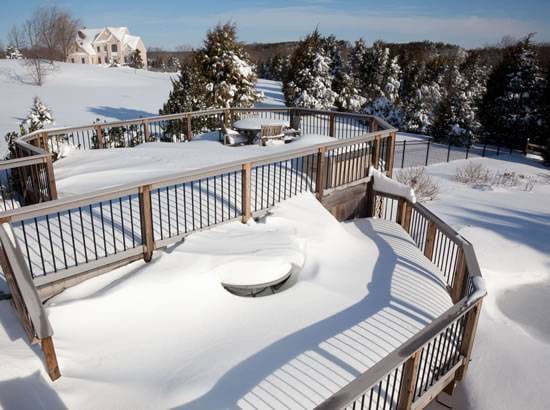
Most people think of deck building as a spring and summer job. Then, once the temperature drops, the tools go into the garage, the ground freezes, and deck season seems to end.
But does it really have to? Well, not necessarily.
And I’ll tell you, I’ve never been a big believer in letting the calendar make construction decisions for me. Conditions matter more than whether the month happens to be January or June.
In fact, you can build a deck in cold weather, and winter may even work well for some projects. Although cold temperatures create challenges, the decking itself usually isn’t the biggest problem. Instead, frozen ground, snow, ice, adhesives, finishes, and seasonal board movement often create more trouble.
So, the important part is knowing how wood, composite, and PVC behave when you’re installing them at 30°F instead of 75°F.
With that in mind, here’s what I would consider before starting a cold weather deck project.
Is There a Minimum Temperature for Building a Deck?
First, no single temperature makes every deck project impossible.
Wouldn’t it be nice if there were one number? Below 25°F, pack up the truck. Above 25°F, get to work. Unfortunately, construction rarely works that neatly.
In fact, you can frame and install many decks below freezing. For example, manufacturers publish specific instructions for cold weather installation. Trex calls for different end gap dimensions above and below 40°F. Likewise, TimberTech changes spacing requirements as temperatures change.
Although those instructions show that cold weather installation is possible, “can” and “should” don’t always mean the same thing.
Personally, once temperatures drop into the teens or single digits, I start asking whether pushing through the job makes sense. After all, frozen lumber, icy framing, snow covered joists, cold hands, brittle materials, and slippery conditions can turn a simple deck job into a frustrating one.
I’ve worked outside in weather where your fingers stop cooperating with the screws and drill bits. At some point, you’re not proving anything by staying out there. You’re just making an easy job harder.
So, rather than relying on one magic cutoff temperature, look at the material you’re installing and the conditions you have on site.
Building a Hardwood Deck in Cold Weather
Fortunately, tropical hardwoods such as Ipe, Cumaru, Tigerwood, Garapa, Brazilian Redwood, Teak, and Mahogany don’t suddenly become unusable when the weather turns cold.
I’ve worked with dense hardwoods enough to know they can handle a wide range of conditions.
Frankly, that’s one of the things I like about these woods. Ipe doesn’t care that you wanted a nice 65°F day and got 34°F instead.
However, wood behaves differently from composite and PVC.
For one thing, wood moves mainly as it gains or loses moisture. Although temperature can affect jobsite conditions, moisture usually matters more when you’re thinking about board movement. As a result, you shouldn’t choose hardwood spacing by temperature alone.
For example, a board you install during a cold, dry winter may react differently once warm, humid summer weather arrives.
I’ve seen people obsess over the thermometer while ignoring moisture entirely. In my opinion, they’re watching the wrong number.
So, don’t look at your phone, see 28°F, and choose a gap from temperature alone.
Instead, consider the deck boards moisture content, whether the boards are air dried or kiln dried, your local climate, ventilation below the deck, and the spacing guidance for the product you’re using.
Frozen Boards Are Another Matter
That said, frozen boards are another matter.
Cold wood isn’t necessarily a problem.
However, wood covered with snow or frozen moisture is.
Although the boards themselves may tolerate low temperatures, I would rather wait until they’re clean and dry before installing them. After all, you still need to make accurate cuts, drill clean holes, seat fasteners correctly, and keep the spacing consistent.
Obviously, ice doesn’t help with any of that.
And really, what’s the rush? If waiting until late morning gives the sun enough time to dry the framing, I’d rather drink another cup of coffee and start with a clean work surface.
At the same time, the same goes for the framing.
Although you may feel pressure to keep the job moving, laying expensive hardwood over icy or snow covered joists rarely makes sense.
I certainly wouldn’t do it on my own deck.
Pre-Drilling Hardwood Becomes Even More Important
Likewise, with dense hardwoods such as Ipe and Cumaru, I already recommend proper pre-drilling wherever the fastening system calls for it.
Certainly, cold weather doesn’t give me a reason to get less careful.
Ipe is extremely dense. As a result, if you try to force screws through it with the wrong drill bit or fastener, you may snap screws, strip heads, or create a lot more work for yourself.
If you’ve ever snapped a stainless screw halfway into an Ipe board, you already know how much fun that is. Now you’ve got to stop what you’re doing and deal with a broken screw instead of installing decking.
If you’re face fastening, drill the correct pilot hole and use the proper stainless steel fastener. On the other hand, if you’re installing grooved decking with an Ipe Clip hidden fastener system, follow the instructions for that system.
Although experienced installers often develop a routine, cold weather isn’t the time to improvise.
I’ve always looked at it this way: the harder and more expensive the decking, the less interested I am in experimenting on it.
Can You Install Composite Decking in Cold Weather?
Yes.
Generally, composite decking can go down in cold weather, though temperature matters because the boards expand and contract as conditions change.
Trex provides a good example.
For current Trex decking, the minimum side to side gap remains 3/16 inch in both warm and cold weather. However, Trex changes its end to end and abutting gaps based on installation temperature.
Above 40°F, Trex calls for a 1/8 inch end to end or end to width gap. Below 40°F, however, that gap increases to 3/16 inch. Likewise, where decking meets a solid object, Trex specifies 1/4 inch above 40°F and 1/2 inch below 40°F.
So, why does Trex call for more room in cold weather?
Simply put, the boards contract when they get cold. Then, as temperatures rise, they expand.
Although the boards may look fine when you install them tightly in winter, they can run out of room once summer arrives.
And that’s the part people sometimes forget. You’re not only building the deck for today’s temperature. You’re building it for the 90°F afternoon that’s coming six months from now.
TimberTech Composite Decking in Cold Weather
Similarly, TimberTech changes its spacing guidance as temperatures change.
For TimberTech composite decking, current guidance calls for a 3/16 inch butt joint gap at 32°F and below, 1/8 inch from 33°F through 74°F, and 1/32 inch at 75°F and above.
At the same time, cold weather affects drilling requirements too.
For example, TimberTech recommends pre-drilling its composite products in certain situations, including some installations below 45°F.
Although that detail may seem small, it’s exactly the kind of thing installers can miss.
For instance, a contractor who installs thousands of square feet of decking during summer may have a routine that works perfectly in July. Put that same contractor on a January job, though, and the manufacturer may expect a different procedure.
I’ve seen this happen plenty of times in construction. You get comfortable doing something one way because it’s worked for years, and then one little condition changes. Suddenly, the old routine isn’t quite right anymore.
Therefore, always check the current installation guide for the exact collection you’re using.
I know reading an installation manual isn’t anyone’s idea of an exciting morning, but ten minutes with the instructions can save hours of aggravation later.
What About Deckorators?
Likewise, Deckorators accounts for temperature during installation, although the requirements vary by product line.
That distinction matters because “Deckorators decking” doesn’t describe one single material.
For example, Deckorators Surestone mineral based composite products behave differently from conventional wood plastic composites. Deckorators says its Surestone technology moves relatively little with temperature, while other collections require different end gaps as temperatures change. In addition, the company recommends letting the decking acclimate on site for 48 hours before installation.
For example, current Deckorators Altitude instructions call for a 5/16 inch end to end gap at 32°F and below, 1/4 inch from 33°F through 79°F, and 1/8 inch at 80°F and above.
So, although two decking products may both carry the “composite” label, they may need very different spacing.
That’s why I cringe a little whenever somebody says, “It’s all composite. Just install it the same way.” No, it isn’t, and no, you shouldn’t.
For that reason, read the instructions for the actual product you’re installing.
Can You Install PVC Decking in Freezing Temperatures?
Meanwhile, PVC deserves its own discussion because temperature has a noticeable effect on it.
Unlike wood, which moves mainly as moisture conditions change, PVC expands and contracts more directly as temperature rises and falls.
Although that movement matters, it doesn’t automatically mean you can’t install PVC decking in cold weather.
For example, TimberTech Advanced PVC accounts for thermal movement through its installation requirements. Specifically, TimberTech notes that its Advanced PVC decking expands and contracts as temperatures change and gives installers specific fastening and spacing instructions.
Interestingly, TimberTech currently says its Advanced PVC decking requires no butt joint gap regardless of temperature, while its composite products use temperature based butt joint gaps.
So, that’s a good reason to avoid broad rules such as, “PVC needs a quarter inch gap in winter.”
After all, which PVC?
Which collection?
Which fastening system?
Which joint?
See what I mean? One simple rule sounds convenient until you start asking a few questions.
Although the materials may look similar from a distance, those details matter.
Therefore, follow the manufacturer’s current instructions instead of applying one generic rule to every synthetic board.
Cold Weather Can Affect Fasteners, Too
Of course, the decking gets most of the attention, but the fastening system matters just as much.
For instance, some composite materials become less forgiving as temperatures fall. As a result, manufacturers may require or recommend pre-drilling under colder conditions.
TimberTech, for example, recommends pre-drilling composite decking below 45°F in certain fastening situations. Its Advanced PVC products, however, generally don’t require pre-drilling with approved screw systems.
Likewise, Trex provides special fastening guidance for areas where temperatures swing widely within a 24 hour period.
Although experienced builders may know their tools and fasteners inside and out, the installation guide still wins.
Indeed, I’ve seen plenty of problems start with someone saying, “I’ve built decks before. I know how this works.”
Maybe.
I’ve probably said some version of that myself over the years. Then a product changes, a fastener changes, or you run into some odd jobsite condition and get reminded why instructions exist.
However, manufacturers change products, profiles, fasteners, and instructions. So, spending ten minutes reading the latest guide costs a lot less than replacing boards later.
The Bigger Problem May Be the Framing
At the same time, here’s something people often overlook.
Your deck boards may handle 30°F just fine, but what are you fastening them to?
For example, if you’re building with pressure treated lumber, you still need straight, stable framing with clean surfaces. Although the lumber itself may be usable, snow and ice can interfere with layout, blocking, fastening, and joist tape.
Speaking of joist tape, it deserves special attention.
Personally, I like protecting the tops of wood joists because those horizontal surfaces can trap moisture beneath the decking. As a result, keeping water away from the framing may help the substructure last much longer.
I’ve torn apart enough old decks to see where water likes to sit. Once you’ve pulled decking off and found rotted joist tops underneath boards that still had plenty of life left, joist protection starts making a lot more sense.
However, pressure sensitive tapes and adhesives often have minimum application temperatures. So, check the instructions for whichever tape you’re using before trying to bond it to a frozen joist.
Although the tape may appear to stick at first, covering it with decking won’t fix a weak bond.
And if you already know the adhesive isn’t bonding properly, why bury the problem where nobody can see it?
Steel and Aluminum Framing Can Be Attractive for Cold Weather Projects
On the other hand, metal framing removes some of the moisture related movement you get with wood framing, although steel and aluminum come with their own installation requirements.
For that reason, steel deck framing and aluminum deck framing systems can make a lot of sense under premium hardwood, composite, and PVC decking, especially for owners who want the frame to last closer to the lifespan of the deck boards.
Personally, if I’m spending the money for premium decking that may last decades, I want to think pretty seriously about what’s underneath it. Nobody gets excited about tearing perfectly good deck boards off because the framing underneath gave up first.
Still, metal framing doesn’t make winter conditions irrelevant.
After all, you still need to deal with snow, ice, frost, fastener requirements, footing work, and jobsite safety.
And, frankly, a steel joist covered with frost isn’t exactly my favorite place to work.
Frozen Ground Can Stop the Project Before Decking Temperature Does
However, this may be the biggest practical issue with winter deck construction.
Footings.
First, your local building department sets footing depth and structural requirements, and footings usually need to extend below the local frost depth. Although you can excavate frozen soil with the right equipment, the work may become difficult and expensive fast.
Anyone who’s tried digging seriously frozen ground knows exactly what I’m talking about. Sometimes you put the shovel in, hit the ground, and quickly realize the ground has other plans for your afternoon.
Then, concrete creates another set of problems.
Certainly, you can pour concrete in cold weather, but you need to protect it properly while it cures. Cold temperatures slow the process, and freezing can damage fresh concrete if you don’t handle it correctly.
So, if you’re replacing decking on an existing code compliant frame, winter may not create much trouble.
If you’re starting a brand new elevated deck and need to excavate and pour a dozen footings in January, though, you’re dealing with a very different project.
Could you still do it? Sure. The better question is whether the extra work makes sense for your particular job.
Don’t Install Decking Over Snow or Ice
At this point, this should probably go without saying, but I’ve been around construction long enough to know that somebody will eventually try it.
Don’t trap snow under your deck boards.
Instead, clear the framing and let the surfaces dry as conditions allow.
Although snow and ice can slow the schedule, they also create a serious fall hazard. Remember, you’re carrying 12, 16, and 20 foot boards around a structure while using saws and drills.
I’ve carried enough long deck boards around jobsites to know they’re awkward enough when the ground is dry. Add ice under your boots and, well, you’re not improving the situation.
So, there’s no prize for finishing the deck Tuesday instead of Thursday.
Seriously, sometimes the most professional decision you can make is packing up early and coming back when conditions improve.
Be Careful With Hardwood Oil and Sealers in Cold Weather
Meanwhile, you may be able to install hardwood decking when it’s cold, although finishing the deck may need to wait.
That distinction matters.
For example, DeckWise currently specifies a surface temperature range of 45°F to 90°F for Ipe Oil Hardwood Deck Finish. In addition, the wood needs to be dry and properly prepared.
Likewise, DeckWise WiseCoat shouldn’t go on when the air or surface temperature falls below 45°F or rises above 95°F.
So, you may finish installing an Ipe deck on a 35°F day, though you may need to wait for warmer weather before applying a finish.
Fortunately, that’s perfectly fine.
I know it’s tempting to finish everything, clean up, take the pictures, and call the job done. But there’s no sense ruining the last step because you didn’t want to wait for a warmer afternoon.
In other words, don’t force the finishing step just because you want to call the project complete.
Although a cold weather coating may look acceptable at first, applying a finish outside its recommended range can cause poor penetration, slow drying, tackiness, or uneven color.
In fact, we’ve dealt with enough sticky hardwood decks over the years to know that following the finish manufacturer’s directions can save a lot of aggravation.
And believe me, explaining why somebody’s beautiful new hardwood deck feels sticky isn’t a conversation anyone wants to have.
What Temperature Is Too Cold to Build a Deck?
Ultimately, no single number works for every deck. Still, as a practical guideline, here’s how I look at it.
Above 45°F: Generally, most deck projects are fairly straightforward. Even so, you still need to follow the manufacturer’s normal instructions.
32°F to 45°F: Deck construction is usually very workable, although you should pay closer attention to gapping, pre-drilling, adhesives, joist tapes, sealers, and finishes.
20°F to 32°F: Installation may still be possible, though jobsite conditions matter more. In particular, expect contracted synthetic decking, frozen ground, ice, snow, and harder working conditions.
Below roughly 20°F: At that point, I’d seriously question whether pushing ahead makes sense unless you have a good reason and the product manufacturer allows the installation. After all, tools, materials, batteries, hands, snow, ice, and frozen surfaces all become more troublesome.
Could I build a deck below 20°F? Probably. Would I choose that day if I had the option of waiting? Probably not.
However, those aren’t manufacturer limits.
Instead, they’re practical jobsite guidelines.
For the real installation limits, follow the manufacturer of the decking, fastening system, adhesive, tape, coating, or other product you’re using.
Cold Weather Decking Cheat Sheet
| Material | Can You Install It in Cold Weather? | Main Concern |
|---|---|---|
| Ipe | Yes | Moisture, board spacing, snow or ice, pre-drilling |
| Cumaru | Yes | Moisture, spacing, dense material |
| Tigerwood | Yes | Moisture and seasonal movement |
| Garapa | Yes | Moisture and seasonal movement |
| Teak | Yes | Moisture and proper spacing |
| Trex Composite | Yes | Temperature dependent end gaps |
| TimberTech Composite | Yes | Gapping and pre-drilling in colder weather |
| Deckorators | Yes | Product specific movement and spacing |
| TimberTech Advanced PVC | Yes | Thermal movement and correct fastening |
Overall, the pattern is pretty simple: cold weather usually changes how you install decking instead of automatically preventing the work.
That’s really the takeaway here. Winter doesn’t suddenly rewrite the rules of deck building, but it does make some of those rules more important.
Should You Build a Deck During Winter?
So, should you actually build during winter?
Sometimes, yes.
For example, if the footings and framing are already complete, installing decking during cooler weather can make perfect sense.
Additionally, winter can help you get ahead of the spring rush. Contractors may have more scheduling flexibility, and you can have the deck ready when warm weather arrives instead of starting construction when everyone else suddenly wants one.
I’ve always liked the idea of having outdoor projects finished before you actually want to use them. Who wants to spend the first beautiful weekends of spring listening to saws and stepping around lumber piles?
However, I wouldn’t build through bad conditions just because the schedule says the project should move forward.
For instance, if the joists are covered with ice, the ground has frozen solid, or an adhesive needs 45°F while today’s high is 27°F, wait.
Although your deck may last 25, 40, or even 50 plus years depending on the materials you choose, delaying the work for a few days won’t matter much.
Installing something incorrectly, however, might.
I’ve never looked at a well built deck and thought, “Boy, I wish they had rushed this a little more.”
The Bottom Line
Ultimately, yes, you can build a deck in cold weather.
For example, you can install Ipe and other tropical hardwoods in cold conditions when the boards stay dry and you space them correctly. Likewise, you can install composite decking in cold weather, although Trex, TimberTech, and Deckorators may call for different gaps or fastening methods as temperatures change. Similarly, PVC can work in cold weather too, though you still need to follow the manufacturer’s rules for thermal movement and fastening.
Still, the number on your weather app tells only part of the story.
Instead, look at the decking, moisture, snow and ice, framing, footing conditions, fasteners, adhesives, tapes, and finishes.
Most importantly, pull up the current installation guide for the exact decking collection you’re using.
That’s what I’d do on my own deck.
And really, that’s usually the best test. If you wouldn’t take the shortcut on your own house, why take it on somebody else’s?
In the end, although a cold day doesn’t necessarily mean you need to stop building, it does mean you should pay closer attention to the materials and the conditions around you.
