
What Really Stays Cool in the Sun?
If you live in a hot, sunny climate like Florida, Texas, Arizona, or anywhere in the southern U.S., you already know one thing: not all decking materials handle heat the same. A deck that looks great can quickly become unusable if it gets too hot to walk on barefoot—especially for kids and pets.
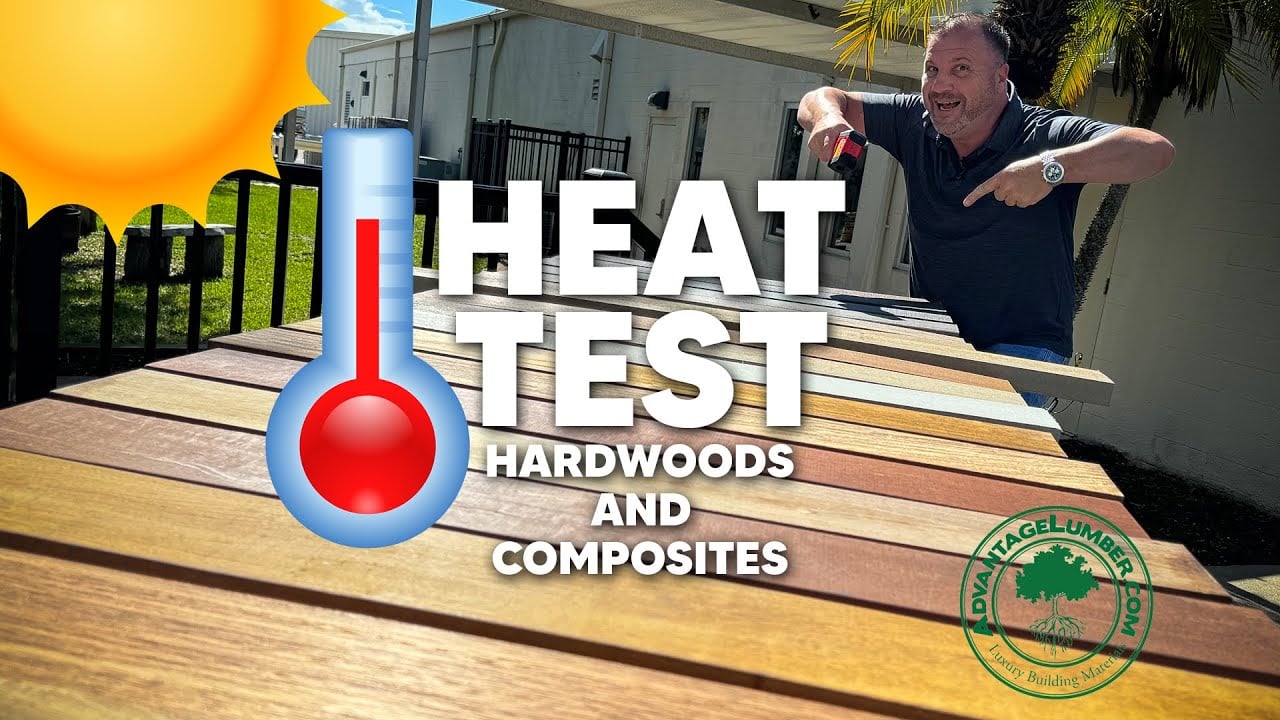
At AdvantageLumber.com, we don’t just rely on manufacturer claims. We put decking materials to the test ourselves. At our Sarasota, Florida factory, we performed a real-world surface temperature test comparing popular composite decking brands with natural hardwood decking species to find out which decking performs best in extreme heat.
Below, we break down the results and explain why some decking materials stay cooler than others.
Why Decking Gets Hot in the First Place
Deck surface temperature is influenced by several factors:
- Material composition
- Color (darker colors absorb more heat)
- Density and heat dissipation
- Direct sun exposure
Many homeowners are surprised to learn that synthetic decking materials often retain more heat than natural wood, even when marketed as “cool” or “heat-mitigating.”
That’s why we decided to test it ourselves—under real Florida sun, not laboratory conditions.
Our Sarasota, Florida Decking Heat Test
We tested a wide range of decking materials side-by-side in direct sunlight, including:
Composite & Modified Decking Tested
Hardwood Decking Tested
Surface temperatures were measured after prolonged sun exposure to simulate actual deck conditions.
The Results: Teak Was the Coolest Decking Material
The results were eye-opening.
Composite & Modified Decking
Many composite and modified decking boards reached surface temperatures of 140°F or higher, which is uncomfortable and potentially dangerous for bare feet, pets, and children.
Even products marketed as “heat resistant” still absorbed and retained significant heat in real-world conditions.
Hardwood Decking Performed Better Overall
All hardwoods tested performed noticeably cooler than composite decking, but one species stood out above the rest:
Teak Decking – Lowest Surface Temperature
- Teak recorded the lowest surface temperature at just 120°F
- That’s 20+ degrees cooler than many composite boards
- A difference you can absolutely feel underfoot
This makes Teak one of the best decking materials for hot weather climates.
Why Teak Stays Cooler Than Composite Decking
Teak’s superior performance isn’t an accident—it’s a result of its natural properties:
- Natural oils that help regulate temperature
- Lighter, golden-brown color that reflects heat
- Dense but breathable wood fiber structure
- No plastic content, unlike composite decking and PVC Decking
Unlike composite decking, which traps heat due to its plastic components, natural hardwoods dissipate heat more efficiently.
How Other Hardwood Species Compared
While Teak was the clear winner, other hardwoods also performed well and stayed significantly cooler than composites:
- Ipe – Extremely dense and durable with good heat performance
- Cumaru – Comparable to Ipe
- Tigerwood – Attractive grain with solid heat resistance
- Brazilian Redwood (Massaranduba) – Dense and durable
- Mahogany – Lighter weight and naturally cooler than synthetics
All of these hardwoods remained more comfortable than composite decking in direct sun.
The Truth About “Cool Decking” Claims
Many composite decking brands promote heat-mitigating technology, but our real-world testing shows:
- Dark and medium-colored composites still get extremely hot
- Plastic content retains heat longer
- Marketing claims don’t always match real conditions
That’s why seeing real tests—like ours in Florida—matters.
So, What’s the Best Decking for Hot Weather?
Based on real-world testing in one of the hottest climates in the U.S.:
Best Overall: Teak Decking
- Coolest surface temperature
- Comfortable for bare feet
- Naturally beautiful and long-lasting
Best Alternatives
- Ipe
- Cumaru
- Tigerwood
- Brazilian Redwood
- Mahogany
Use Caution With
- Composite decking
- Dark-colored synthetic boards
- Plastic-heavy materials in full sun
See the Test for Yourself
We encourage homeowners, builders, and designers to watch the test and judge for themselves:
Watch the full decking heat test on YouTube:
Shop Cool Decking at AdvantageLumber.com
At AdvantageLumber.com, we specialize in premium hardwood decking proven to perform in hot climates. If you’re building a deck in a sunny region and want something that’s:
- Cooler underfoot
- Longer lasting
- Naturally beautiful
Contact our experts today for product recommendations, samples, and project planning help.
