
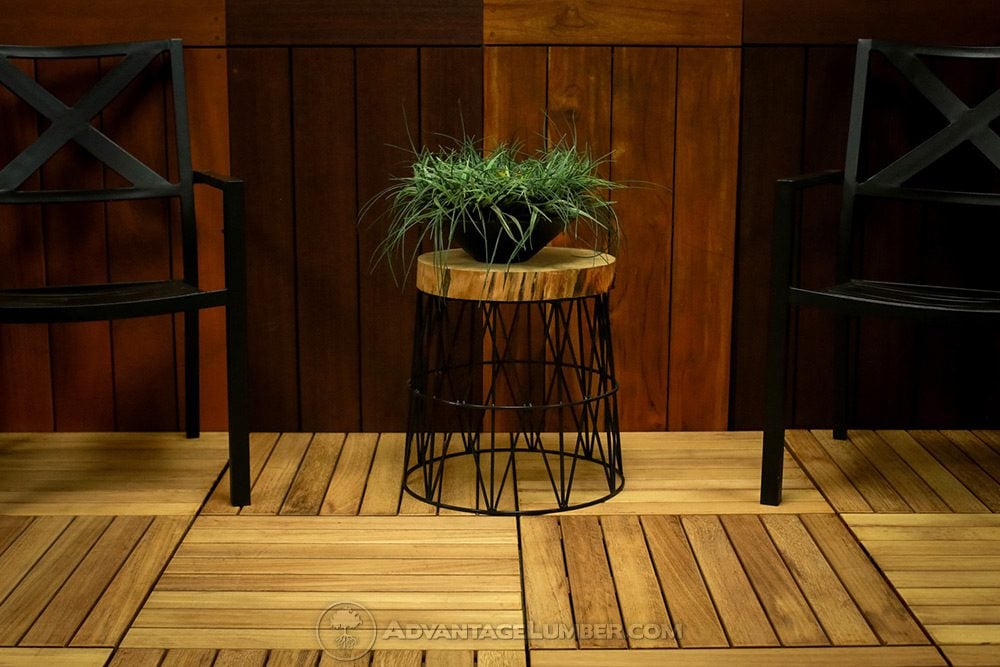
People ask for teak because they want warm golden brown color and a floor that can live outside without falling apart. Fair enough. Teak earned that reputation. It also costs more than most budgets like.
Iroko is the wood many of those same people actually use. Sellers often call it African teak, and that nickname helps as long as you treat it as a nickname. Iroko is not Tectona grandis. It is Milicia excelsa (and sometimes Milicia regia), a West and East African hardwood. It looks a lot like teak, holds up outdoors, and costs a lot less.
On deck tiles and other outdoor floors, that mix matters more than the botanical name.
What Iroko Actually Looks Like
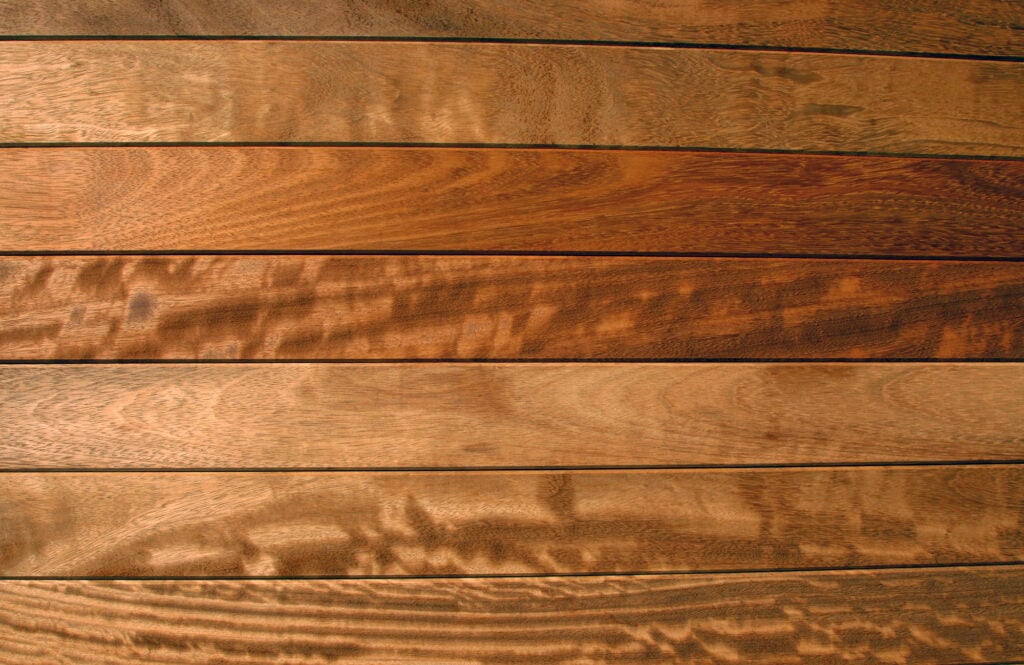
Fresh Iroko runs from golden yellow to medium brown. Leave it in the sun and it darkens to a medium brown as shown in the picture above. If you never oil it, it weathers to silver gray, the same way teak does.
The grain feels a little coarser and more interlocked than true teak. Some boards shift in color more than others. If you want every tile to match like boards from one perfectly uniform yacht deck, teak still wins. If you want a warm hardwood floor that still looks like wood instead of printed composite, Iroko does the job.
How It Compares to Real Teak
Teak became famous because it holds natural oils and silica. Those oils help it shrug off water, insects, and rot. That is why builders put it on boats.
Iroko is not as oily. It still resists decay well outdoors, and published Janka numbers usually put it a bit harder than teak, around 1,260 lbf versus about 1,070 lbf for typical teak. Hardness is not the same thing as outdoor life, although it does mean Iroko takes foot traffic well.
The honest ranking looks like this:
- True teak is still the benchmark for marine work and for people who want the most stable, most oily hardwood they can buy.
- Iroko lasts well outdoors, stays stable enough for tiles and patio floors, and treats the budget more kindly.
- Neither one stays maintenance free if you want to keep the original color.
For a balcony, rooftop, pool surround, or patio over concrete, Iroko tiles usually give you more for the money. You are not building a ship. You are covering a floor.
Why Tiles Instead of Long Deck Boards
Traditional decking wants ventilation. We like about 18 inches of clearance under the boards so air can move and moisture can dry out. Ground level decks, rooftop membranes, and old concrete patios do not give you that.
That is where Iroko deck tiles earn their keep. Makers build them from narrow slats and fasten those slats into a panel, so the tiles cup less than a wide board that sits on a damp slab. You can set them on a reasonably flat surface that drains without building a full framed deck.
Typical uses:
- Concrete patios that look tired
- Balconies and rooftop terraces
- Pool decks where you want wood underfoot instead of hot synthetic or hot concrete
- Ground level outdoor rooms where a framed deck would trap too much moisture
Tiles also go down faster. Most of the work is layout, cutting the last row, and keeping the surface able to drain. You can take them with you if you move, although you cannot say the same about a screwed down Ipe deck.
What You Give Up
Tiles are not a miracle product.
They follow the surface under them. A slab that slopes badly or puddles will still puddle. Standing water still hurts wood, even dense hardwood.
Iroko’s interlocked grain can fight you if you start ripping and routing a lot of custom pieces. For stock 24×24 tiles, that rarely matters. If you cut a lot of notches around posts and drains, expect the wood to act a little less politely than straight grained teak.
And color care is the same story we tell with Ipe, Cumaru, and the rest of the tropical wood species. Oil it if you want the golden brown look. Leave it alone if you are fine with gray. Rinse off dirt and leaves either way. Do not let debris sit in the gaps.
Installation That Actually Lasts
Keep the job simple and dry.
Start with a surface that drains. Concrete should pitch away from the house. On a rooftop, confirm the membrane is sound before you set a single tile. Tiles give you a walking surface. They do not replace a roof.
Use DeckWise tile connectors so the panels lock together and do not creep. On sloped roofs or uneven terraces, pedestal systems let you level the floor without pouring new concrete.
Leave room at the edges so the field can move and water can leave. Do not jam the tiles tight against a wall and hope water finds a way out.
If you want to keep the color, oil every face you can reach before the tiles go down, then maintain the top with a penetrating hardwood oil. Wipe off the excess. A tacky floor means too much oil stayed on the surface, not that the wood refused the finish.
When I’d Still Spend the Money on Teak
Buy teak tiles if the project is a showpiece, a marine adjacent deck, or a client who specifically wants genuine teak and will pay for it. The look is a little finer. The wood holds more oil. The name on the invoice matches the name in the brochure.
For most outdoor floors, Iroko is the smarter buy. You get the teak color family, a hard wearing surface, and tiles builders designed to sit close to the ground.
That is the trade most people want: the look, although they do not pay teak prices to get it.
