

If you’ve ever installed a 20 foot deck board on a cool morning and checked it again after it baked in direct afternoon sun, you’ve probably wondered: How much did that board actually grow?
It’s a good question, especially with composite and PVC decking.
After all, twenty feet is a long piece of material. Even a tiny amount of movement per foot can add up over that distance. As a result, if you leave too little space, long boards can push against a house, tighten against a picture frame border, open a miter, or leave an ugly gap when the weather shifts.
However, before we get into the numbers, we need to make one important distinction.
Wood decking and synthetic decking don’t move for the same reasons.
On one hand, composite and PVC deck boards respond strongly to temperature. On the other hand, natural wood such as Ipe, Cumaru, Tigerwood, Garapa, Teak, and Mahogany responds much more to moisture.
So, although both materials move, they behave differently enough that you shouldn’t apply the same spacing rules to both.
Why Deck Boards Move
In general, almost every building material changes size as conditions change.
For example, heat most materials, and they expand. Conversely, cool them, and they contract.
Engineers describe this behavior with a value called the coefficient of thermal expansion.
Basically, the formula looks like this:
Change in length = Original length × Coefficient of thermal expansion × Change in temperature
Fortunately, you don’t need to run this calculation every time you build a deck. Manufacturers have already done the engineering and publish gap requirements for their products.
Still, if you understand what happens behind those instructions, you’ll make better decisions on the job.
For instance, a 20 foot board doesn’t move more per foot than a 12 foot board made from the same material. Instead, it simply gives that small amount of movement more distance to accumulate.
As a result, long deck boards deserve more attention.
A 20 Foot Board Makes Small Changes Look Big
To put this into perspective, a 20 foot deck board measures 240 inches.
Now, suppose a decking material changed length by only 0.05% during a certain temperature swing.
At first, that sounds tiny.
However:
240 inches × 0.0005 = 0.12 inches
In other words, that’s almost 1/8 inch.
Now, if the material changed by 0.10%, you’d get:
240 inches × 0.001 = 0.24 inches
That’s almost 1/4 inch.
Suddenly, a percentage that looked meaningless on paper becomes pretty easy to see on a deck.
So, here’s the key point: a board doesn’t need to change size by several percent to create problems. Indeed, over 20 feet, even fractions of a percent matter.
The Board Temperature Matters More Than the Weather App
Here’s another mistake I see.
Someone checks the weather and says, “It’s only 85 degrees outside.”
Sure. However, the deck board itself may be much hotter than 85 degrees.
For example, put a dark brown or dark gray board in direct summer sun, and its surface temperature can rise far above the surrounding air temperature. At the same time, reflected sunlight from certain Low E windows can push temperatures even higher in concentrated areas.
TimberTech warns that reflected sunlight can raise deck board temperatures enough to increase movement and, in extreme situations, damage synthetic decking.
Meanwhile, at the other end of the year, that same deck may sit below freezing.
So, although the weather forecast gives you air temperature, the decking may experience a much wider temperature range across the year.
As a result, installation temperature matters.
Composite Decking Expands and Contracts Along Its Length
Composite decking contains wood fiber, polymers, minerals, or some mix of those materials, depending on the product.
Although each manufacturer uses a different formula, synthetic boards generally move enough with temperature that installers need to account for it.
For example, Trex requires end to end and width to width gaps partly because the boards expand and contract as temperatures change. More specifically, its installation instructions call for a 1/8 inch end to end gap above 40°F and a 3/16 inch gap below 40°F.
Furthermore, when a board ends against a solid object, Trex calls for more room.
So, why more room in cold weather?
Simply put, a cold board sits in a more contracted state.
Then, when summer arrives and the board heats up, it needs somewhere to go.
Therefore, although a tight joint may look nice on a cold installation day, that same joint can become a problem once the boards warm up.
PVC Decking Can Be Even More Temperature Sensitive
PVC decking deserves even more attention.
Unlike wood, PVC doesn’t need a moisture change before it moves. Instead, temperature alone can change its length enough to notice.
For example, TimberTech’s installation guidance for AZEK decking explains that the boards expand and contract as temperature changes. By comparison, wood changes size mainly as moisture changes.
Naturally, that difference matters.
In fact, it’s one reason I’m careful with long PVC runs, picture frames, breaker boards, and especially miters.
A miter can look perfect when you finish the job.
Then July shows up.
Or January.
Suddenly, that tight joint doesn’t look nearly as tight anymore.
Although somebody may blame the saw cut, the material itself may simply be responding to temperature.
Not All Composite Decking Moves the Same Amount
However, broad statements about “composite decking” can get you into trouble.
Different products use different recipes, so they don’t all move the same amount.
For instance, Deckorators Surestone offers a good example. Deckorators says its mineral based technology helps limit thermal movement. At the same time, its gap requirements for Voyage, Summit, and Porch Flooring vary with installation temperature.
Meanwhile, other Deckorators collections use different gap requirements.
Altitude, for example, calls for larger end gaps in cold weather than it does during warmer installations.
That’s a very important difference you or your installer need to know.
So, although two products may both get labeled as “composite,” you shouldn’t assume they behave the same way.
Instead, follow the current instructions for the exact brand and collection you’re installing.
I’ve seen installers run into trouble because they know one product well and assume another one behaves exactly the same way.
Unfortunately, sometimes it doesn’t.
What About Ipe and Other Hardwood Decking?
Now, this is where the conversation changes.
Ipe is wood.
Likewise, so are Cumaru, Tigerwood, Garapa, Brazilian Redwood, Teak, and Mahogany.
Wood does expand and contract with temperature, though temperature alone usually causes very little movement compared with moisture.
For example, USDA Forest Products Laboratory data shows that wood moves very little along the grain from temperature alone. Across the grain, however, wood can move much more, especially as its moisture content changes.
So, although temperature affects wood, moisture usually drives the movement we care about most in real world decking.
In practical terms, you shouldn’t treat a 20 foot Ipe board like a 20 foot PVC board.
Quite simply, they’re doing different things for different reasons.
How Much Would a 20 Foot Wood Board Thermally Expand?
Now, let’s put the numbers into perspective.
Take a 20 foot board:
20 feet = 240 inches
Then, if we use a representative longitudinal thermal expansion value for wood and assume a 100°F temperature swing, we get roughly:
240 × 2 × 10^-6 × 100 = 0.048 inch
In other words, that’s less than 1/16 inch.
Of course, the exact number varies by species and conditions, though the broader lesson stays the same.
Pure thermal movement along the grain of a 20 foot solid wood deck board stays pretty small.
Even so, that doesn’t mean wood doesn’t move. It absolutely does.
Rather, it means temperature alone usually isn’t the main reason.
Wood Moves Much More Across Its Width
Anyone who has worked with hardwood flooring has seen this firsthand. Basically, wood doesn’t move equally in every direction.
Along the grain, it moves very little. Across the grain, however, it can move much more as it gains or loses moisture.
That’s why hardwood floors need perimeter space. Likewise, it’s why side to side deck board spacing matters.
For example, imagine fifty 6 inch wide boards running across a deck. Each board only needs to change width a tiny amount before those small changes start adding up across the whole deck.
So, when I install hardwood decking, I pay close attention to:
- moisture content when the boards arrive
- local humidity
- airflow below the deck
- how close the deck sits to the ground
- whether the boards are wet or dry during installation
- and side to side spacing
Although temperature still affects the moisture relationship, it isn’t the main thing driving the board’s dimensional change.
Why Hardwood Decking Can Look Tighter in Humid Weather
For example, imagine installing Ipe during relatively dry weather. Later, summer humidity climbs.
As a result, the boards slowly take on some moisture from the surrounding air. As they do, they can swell across their width. Now, imagine the opposite.
If you install boards while they’re holding more moisture, they may shrink slightly as they dry.
For that reason, hardwood decking needs proper spacing and ventilation.
The USDA Forest Products Laboratory has long emphasized proper drying, handling, storage, and installation because seasonal moisture changes can affect wood dimensions.
Likewise, this is why I get nervous when somebody wants to install hardwood decking almost directly over damp soil with barely any airflow underneath. You should have a minimum of 18″ of airspace underneath a wood deck.
Although the boards may look fine at first, you’re putting wood into an environment where moisture becomes much harder to manage.
A 20 Foot Board Also Magnifies Installation Errors
At the same time, thermal movement isn’t the only reason long boards need more attention.
A 1/16 inch mistake doesn’t look like much.
Likewise, a starter board that runs slightly out of square may not seem like a big deal at first.
Over 20 feet, though, those little errors become much easier to see.
For example, long boards can expose:
- inconsistent end gaps
- crooked starter boards
- poor picture frame alignment
- badly planned butt joints
- inconsistent hidden fastener spacing
- framing that’s out of square
- and weak support at board ends
That’s why I like to plan the layout before I fasten the first board.
Although it’s tempting to start laying decking as soon as the frame is ready, finding out twenty rows later that your picture frame won’t line up is no fun.
Picture Frames Make Thermal Movement More Important
Similarly, picture framed decks look great, though they also create places where movement becomes obvious.
For example, imagine a 20 foot field board ending against a perpendicular picture frame board.
As the field board changes length, the gap at the picture frame can change too.
Therefore, if you jam everything together because the joint looks cleaner on installation day, you leave the material almost nowhere to move.
Trex tells installers to leave space around posts and to account for temperature when cutting picture frame miters.
Again, manufacturers aren’t asking for gaps because they like seeing space between boards.
Rather, the material needs room.
Butt Joints Can Become Trouble Spots
Likewise, long decks often need butt joints because the deck runs farther than the available board length.
When the design allows it, I usually prefer a breaker board instead of rows of random butt joints.
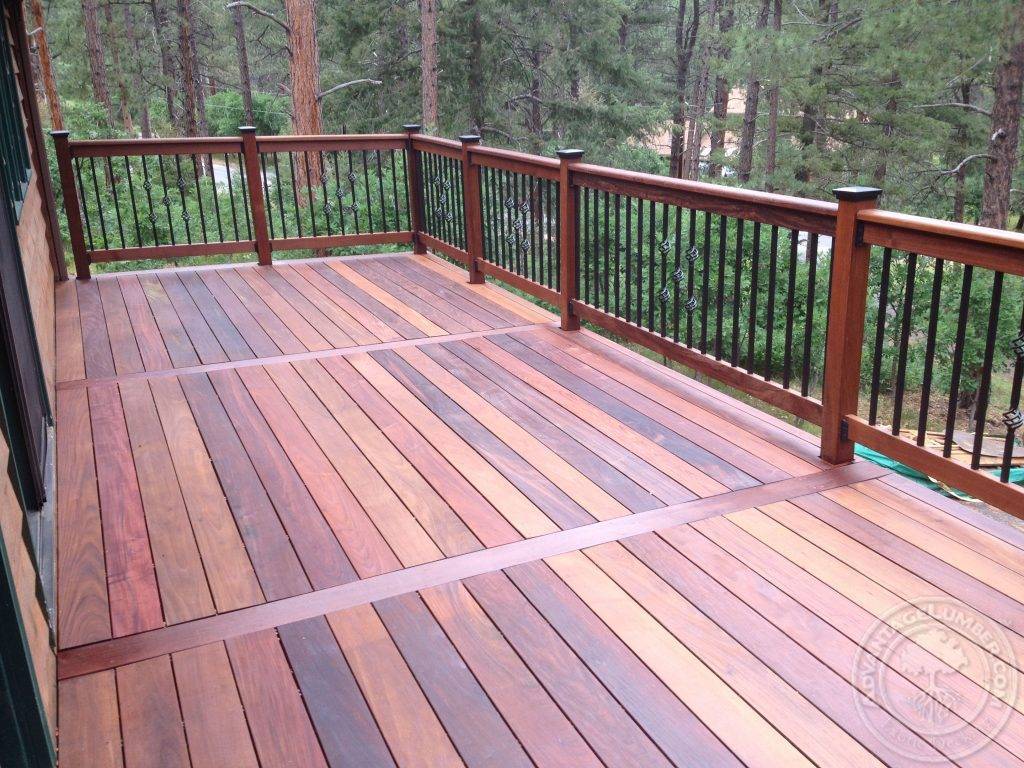
For one thing, a breaker board gives the deck a deliberate stopping point. At the same time, it can make movement easier to manage while creating a cleaner layout.
Although you can certainly build a good deck with butt joints, breaker boards often make large decks easier to plan.
Instead of trying to make a 30 or 40 foot visual run act like one continuous piece, you divide the deck into smaller sections. In many cases, it looks better too.
Don’t Guess at Expansion Gaps
Ultimately, here’s probably the most useful advice in this article.
Don’t memorize one expansion gap and use it for everything.
There simply isn’t one universal number.
For instance, Trex has its requirements.
TimberTech has its requirements.
Likewise, Deckorators has different requirements depending on the collection.
At the same time, PVC behaves differently from wood plastic composite.
Mineral based composite behaves differently again.
And, of course, Ipe behaves nothing like PVC.
Even the installation temperature can change the gap a manufacturer calls for.
So, before you start installing, pull up the current instructions for the exact product you’re using.
Fortunately, it only takes a few minutes.
Although stopping to check may feel like it slows you down, fixing boards that buckle or bind takes a whole lot longer.
Let the Decking Acclimate
Along those same lines, it’s smart to let decking adjust to job site conditions when the manufacturer recommends it.
Deckorators, for example, recommends acclimation periods for some products before installation.
Storage matters too.
For instance, don’t leave half your boards in full sun while the other half sit under a tarp in deep shade and then expect both stacks to measure the same when you start cutting.
With temperature sensitive synthetic decking, that difference can matter.
Similarly, TimberTech recommends keeping decking as cool as practical during installation and fastening boards soon after cutting.
Although that sounds like a small detail, it can help keep long runs more consistent.
So, How Much Does a 20 Foot Deck Board Actually Move?
Ultimately, the answer is:
It depends on what the board is made from.
With solid wood decking, pure thermal movement along the length stays relatively small. Instead, moisture related movement, especially across the board’s width, matters much more.
With composite and PVC decking, however, temperature can cause meaningful changes in length, especially across a 20 foot board and across a large seasonal temperature range.
Even then, different synthetic products can behave very differently.
So, I’d be skeptical of anyone who says, “Composite decking expands by exactly X amount.”
Which composite?
Trex?
TimberTech Composite?
TimberTech Advanced PVC?
Deckorators Voyage?
Deckorators Venture?
Although all of those products compete in the decking market, they don’t share the same material makeup or the same movement characteristics.
The Longer the Board, the More the Details Matter
Personally, I like long deck boards.
When the layout works, fewer butt joints usually give a deck a cleaner look. For example, on a large Ipe deck, uninterrupted 16 and 20 foot boards can look fantastic.
Long boards aren’t very forgiving, though.
After all, twenty feet gives every small framing error, spacing mistake, and dimensional change more room to show itself. Long length boards can easily develop a bow before you install them. Those you will ideally want the hardwood wrench or the hardwood wrench jr. which are both deck board straighteners.
So, don’t fight the material.
Instead, give synthetic decking the expansion space its manufacturer requires. Likewise, give hardwood decking the spacing, airflow, and moisture conditions it needs. At the same time, support the ends properly and plan your picture frames and breaker boards before you start fastening.
Most importantly, don’t assume every deck board moves the same way.
Wood moves mainly with moisture. Synthetic decking moves much more with temperature.
Once you understand that difference, the spacing requirements stop looking picky and start making practical sense.
