
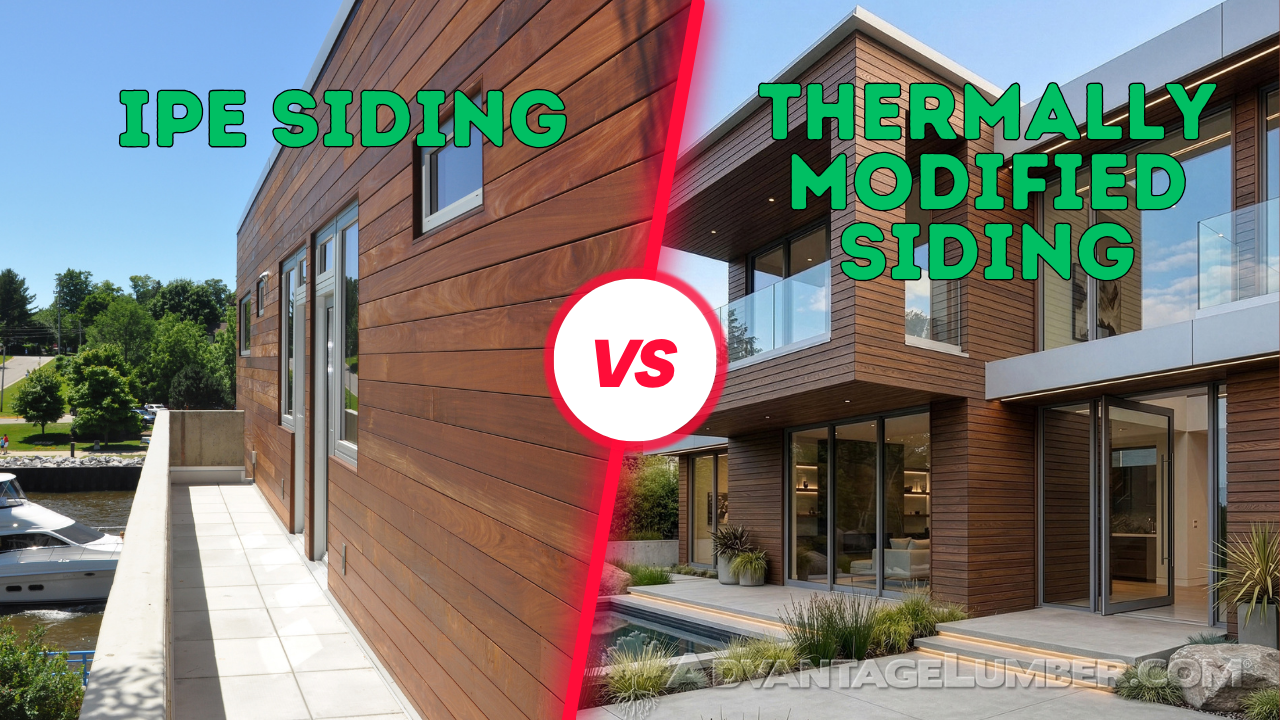
If you’re looking for real wood siding for a high end home, you’ve probably come across both Ipe and thermally modified wood.
For starters, Ipe has served outdoor projects for decades and has earned a reputation as one of the toughest exterior woods you can buy. Thermally modified wood, on the other hand, takes a different approach. Instead, manufacturers use carefully controlled heat and steam to change how species such as ash and pine react to moisture.
So, which makes better siding?
Well, I’ve worked with enough exterior wood to tell you there isn’t one answer for every house. Although Ipe wins when maximum durability matters most, thermally modified wood brings some real advantages when you put it on a wall instead of a deck.
So, let’s compare them.
What Is Ipe Siding?
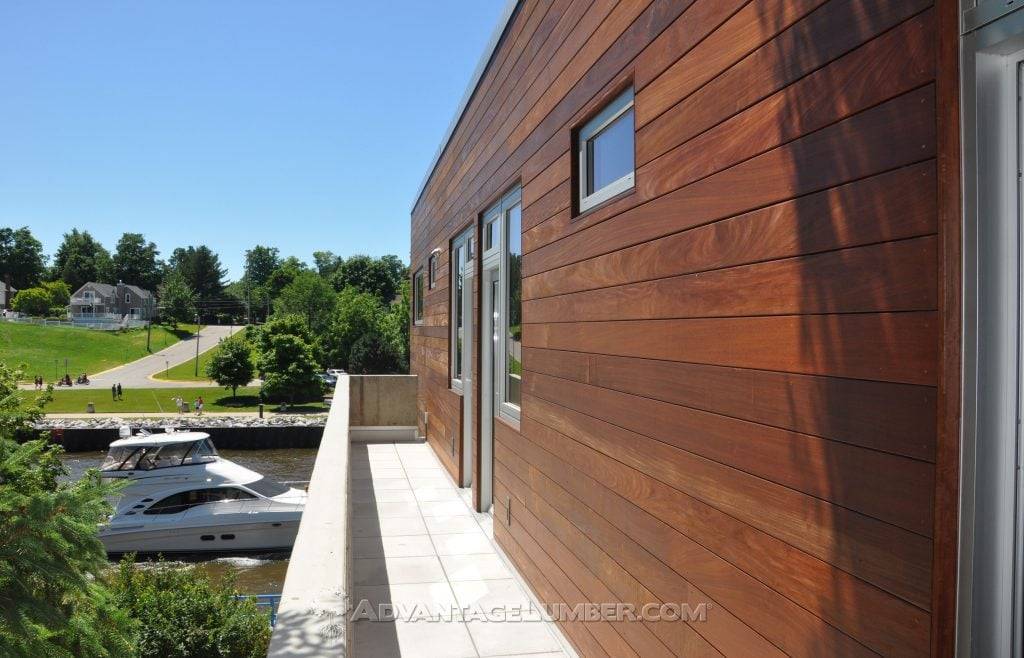
First, Ipe is a naturally dense tropical hardwood from Central and South America. You may also hear people call it Brazilian Walnut, though Ipe isn’t actually a walnut.
More importantly, the wood naturally resists rot, insects, moisture, and everyday outdoor abuse. As a result, these traits have made Ipe popular for demanding exterior projects such as decks, boardwalks, docks, siding, and outdoor structures.
With siding, however, you get those same traits without putting the wood through nearly as much abuse as you would on a deck.
After all, nobody walks on your siding. Likewise, patio furniture doesn’t scrape across it. Snow doesn’t sit on it for weeks, either. Instead, rain can drain away rather than sitting on a horizontal surface.
As a result, Ipe can perform exceptionally well as exterior cladding.
What Is Thermally Modified Wood Siding?
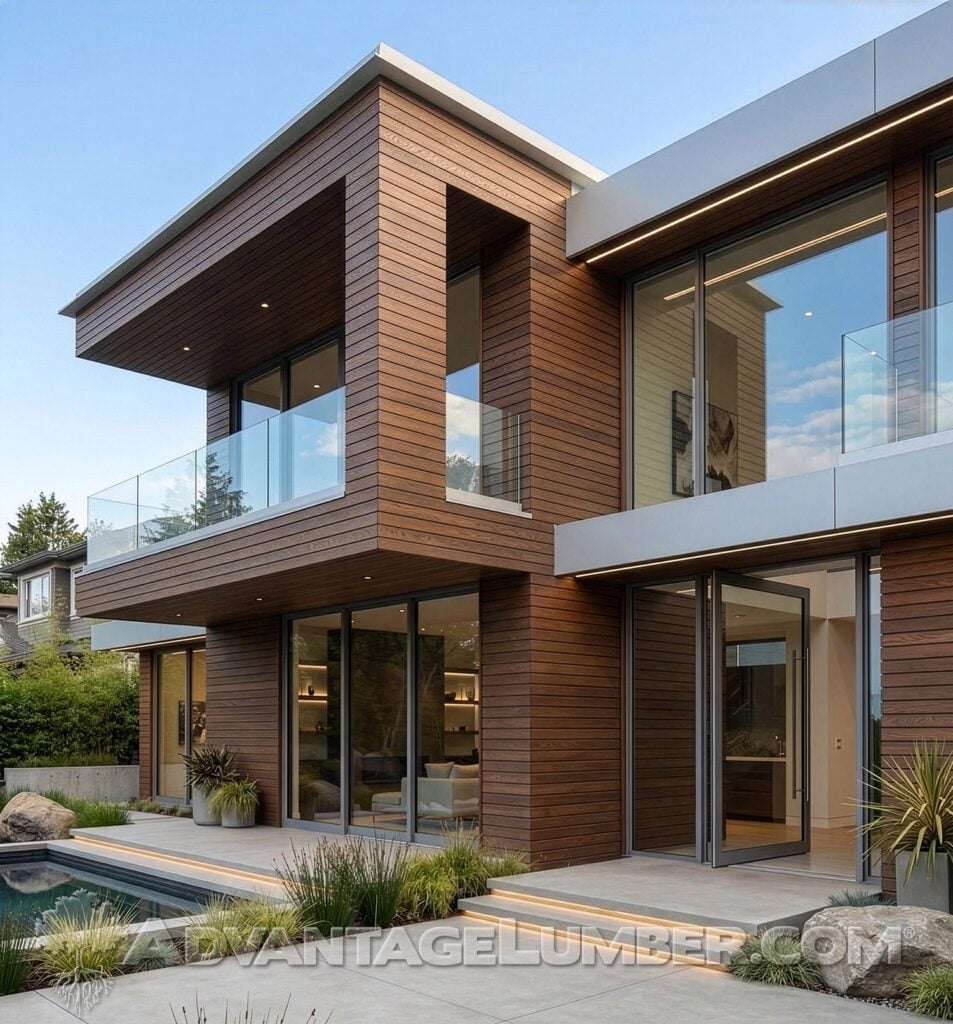
Thermally modified wood, meanwhile, starts with another species of lumber, commonly ash or pine. Manufacturers then heat the lumber to very high temperatures under controlled conditions, often using heat and steam instead of chemical preservatives.
During that process, the heat changes how the wood reacts to moisture. At the same time, it helps the wood resist decay and improves its dimensional stability.
As an added benefit, the process darkens the wood, too.
Thermally modified ash, for example, can develop a rich brown appearance that sometimes surprises people who have only seen ordinary ash used indoors. In fact, it doesn’t look much like the unfinished ash you might have used for cabinets, furniture, or trim.
More importantly for siding, though, the wood tends to move less as moisture levels change.
And that’s where this comparison gets interesting.
Ipe vs. Thermally Modified Wood Siding
Here’s the basic way I look at these two materials.
| Category | Ipe Siding | Thermally Modified Wood Siding |
|---|---|---|
| Durability | Excellent | Very Good |
| Rot Resistance | Excellent | Very Good |
| Insect Resistance | Excellent | Very Good |
| Dimensional Stability | Excellent | Excellent |
| Hardness | Extremely High | Moderate to High, depending on species |
| Weight | Heavy | Lighter |
| Cutting/Milling | More Difficult | Easier |
| Fastening | More Demanding | Easier |
| Natural Color | Rich brown with natural variation | More uniform brown |
| Weathered Color | Silver/gray | Silver/gray |
| Maintenance | Low if allowed to weather | Low if allowed to weather |
| Material Cost | Higher | Usually Lower |
| Best Fit | Maximum durability and luxury projects | Modern architecture and value conscious premium projects |
Although the chart gives you the quick version, a few important details deserve a closer look.
Ipe Wins for Maximum Durability
If somebody asks me which material I’d choose strictly for durability, I’d choose Ipe. Quite simply, that’s really what you’re paying for.
Unlike many exterior wood products, Ipe doesn’t rely on a factory treatment to make it durable. Instead, its density and natural characteristics help it resist decay and insects. In fact, that natural durability explains why builders have used Ipe for exterior projects where ordinary lumber often struggles.
For siding, though, that level of durability may almost seem excessive.
Even though you may not need such a tough wood on a vertical wall, sometimes overkill is exactly what you want.
For example, if I’m working on a luxury waterfront home, an exposed commercial building, or a house where the owner wants premium natural wood without compromising much on durability, Ipe would sit near the top of my list.
Of course, you pay for that performance.
Thermally Modified Wood May Offer Better Value for Siding
On the other hand, here’s where I think thermally modified wood deserves more attention.
Quite simply, siding doesn’t need the same hardness as decking.
On a deck, hardness matters. After all, you’ve got foot traffic, grills, chairs, dogs, tools, and whatever else the homeowner drags across it.
Your siding, however, doesn’t face those problems.
Instead, you need siding that resists decay, stays stable, handles moisture well, looks good, and installs without creating unnecessary headaches.
Fortunately, thermally modified wood checks a lot of those boxes.
Although Ipe easily wins the hardness contest, siding, cladding, ceilings, and soffits don’t necessarily benefit enough from extreme hardness to justify the added cost on every project.
So, if I were trying to build a premium real wood exterior without paying for Ipe across an entire house, I’d give thermally modified wood a serious look.
Ipe Is Much Harder
When it comes to hardness, there’s really no contest here.
Ipe is incredibly hard.
On one hand, that helps after you install it. During installation, though, you’ll definitely notice it.
For example, Ipe wears on saw blades and drill bits faster than softer woods, and you need to use the right fasteners. Depending on the siding profile and fastening system, you may also need to pre-drill.
Still, I’ve always looked at Ipe this way: the same traits that make it somewhat difficult to work with also help it survive outdoors.
In other words, dense wood isn’t particularly interested in cooperating with you.
Once it’s on the wall, though, that density becomes a major advantage.
Thermally Modified Wood Is Easier to Work With
Thermally modified wood, by comparison, generally feels much more familiar to a carpenter.
For one thing, it weighs less than Ipe, and you can usually cut, mill, and handle it more easily.
Although those differences may sound minor when you compare a couple of sample boards, they can matter quite a bit on a large siding project.
Think about it this way. Imagine carrying thousands of linear feet of siding around scaffolding, making hundreds of cuts, trimming around windows, working around doors, and fastening everything to the wall.
Suddenly, weight matters.
And so does labor.
As a result, when a material machines more easily, a crew can often move through the job faster and put less wear on tools.
There is one caution, though. Thermal modification can make wood more brittle. Because of that, you need to use appropriate fastening methods and take care around board ends and thinner profiles.
So, although it’s easier to work with than Ipe, that doesn’t mean you should treat it like ordinary construction lumber.
Both Materials Stay Very Stable
Next, let’s talk about something that matters quite a bit with wood siding: movement.
Wood moves.
More specifically, it absorbs moisture, dries out, expands, and contracts. Anyone who has worked with exterior lumber long enough has seen what happens when builders ignore those changes.
Eventually, boards cup. Gaps change. Fasteners take extra stress. Likewise, joints that looked perfect on installation day can look completely different after several seasons.
Fortunately, Ipe performs very well because it’s exceptionally dense and naturally stable.
Thermally modified wood, however, reaches a similar goal through a different route. Although the original species may move more in its untreated form, the thermal process reduces how readily the wood takes on moisture.
As a result, thermally modified wood can remain impressively stable outdoors.
In fact, that’s one of the biggest reasons I’m comfortable recommending it for siding.
The Appearance Is Different
Of course, performance isn’t everything. Appearance matters, too.
And this part really comes down to taste.
Ipe has a rich brown color with natural variation from board to board. For example, you’ll see darker browns, medium browns, and occasional lighter or olive tones.
Personally, that’s part of what I like about it.
After all, it looks like real wood because every board brings its own grain and color.
Thermally modified wood, meanwhile, usually has a more uniform brown appearance because heat darkens the material throughout the modification process.
Although some homeowners prefer Ipe’s natural variation, that consistency can work beautifully with contemporary architecture.
For example, put thermally modified ash on a modern house with black windows, steel accents, large glass panels, and clean horizontal or vertical siding lines, and it can look fantastic.
Ipe can certainly work on the same house, though it usually gives you a richer and more varied tropical hardwood appearance.
Both Will Eventually Turn Gray
Regardless of which material you choose, every homeowner who considers exterior wood needs to understand this point.
Sunlight changes wood.
Over time, if you leave Ipe exposed to UV without maintaining a UV-inhibiting finish, the brown color will gradually fade toward a silver gray patina.
Likewise, thermally modified wood will also weather toward gray.
Some homeowners, however, love that look.
In fact, I’ve seen modern homes where the architect intentionally chose wood with the expectation that it would weather naturally. Although the siding loses its original brown color, the gray patina can fit contemporary architecture extremely well.
If you want to keep the brown color, however, you’ll need to apply a suitable UV-protective finish and maintain it periodically.
And here’s something I tell people all the time: gray wood doesn’t automatically mean rotten wood.
In other words, color and structural condition aren’t the same thing.
After all, UV exposure can change the surface color long before durable exterior wood reaches the end of its useful life.
Don’t Forget the Rainscreen
Now, regardless of which wood you choose, you can buy the best siding in the world and still create problems if you install it poorly.
For that reason, I strongly prefer a properly designed rainscreen system for most exterior wood cladding projects.
Fortunately, the basic idea is simple.
Instead of trapping your siding directly against the wall assembly, you leave a drainage and ventilation space behind it.
Why?
Because water gets behind siding. That’s reality.
Although good flashing and siding details keep a lot of water out, you shouldn’t build the wall around the assumption that moisture will never get behind the cladding.
Instead, give that moisture somewhere to drain.
At the same time, give the wall a chance to dry.
Fortunately, both Ipe and thermally modified wood work very well with rainscreen designs, whether you want horizontal or vertical siding.
However, don’t improvise the wall assembly on the jobsite. Instead, follow the siding manufacturer’s installation requirements, fastening schedule, local building codes, and the specifications for the wall assembly you’re building.
What About Maintenance?
As for maintenance, neither material is maintenance free.
Then again, I’ve never been a big fan of the phrase “maintenance free.”
After all, exterior building products get dirty. Leaves and debris collect against them. Surface mold can grow on dirt and organic debris. Meanwhile, finishes weather, and joints and fasteners deserve an occasional look.
For that reason, “low maintenance” gives homeowners a much more realistic expectation.
If you’re happy letting either wood turn gray, maintenance can stay pretty simple.
If you want to preserve that fresh brown color, however, expect to clean the siding and reapply an appropriate UV-protective finish periodically.
So, how often?
Well, that depends heavily on exposure.
For example, a shaded north facing wall beneath a large roof overhang doesn’t live the same life as a south facing wall that gets blasted by afternoon sun.
Although both walls may use the exact same siding, they probably won’t weather at the same rate.
So, treat them accordingly.
What About Cost?
Now we get to a factor that can quickly change the decision: cost. Generally speaking, Ipe will cost more.
After all, you’re buying one of the densest and most durable exterior hardwoods available, so the higher price shouldn’t come as a surprise.
Thermally modified wood, meanwhile, can offer an attractive middle ground. Some lumber yards will offer thermally modified wood that has passed through 2 or 3 other parties. This can make some thermally modified wood products seem more expensive than Ipe.
At AdvantageLumber.com we sell direct and cut out the middleman whenever possible and pass the savings directly to our customers. As a result you’ll generally find Advantage Lumber has very competitive pricing on thermally modified wood siding that is shipped directly to your home or job site.
In other words, you still get real wood. You get excellent dimensional stability, improved decay resistance, attractive brown coloring, and strong exterior performance. However, you can generally get those benefits at a lower material cost than Ipe thanks to Advantage Lumber’s direct to consumer pricing.
On a small accent wall, the price difference may not drive the decision.
On a 5,000 square foot house covered with wood cladding?
Now we’re talking real money.
So, although Ipe may offer superior durability, thermally modified wood becomes especially interesting when you start multiplying the price difference across thousands of square feet.
Where I Would Use Ipe Siding
With all of that in mind, I’d lean toward Ipe when the project calls for:
- Maximum natural durability
- Premium luxury construction
- Harsh exterior exposure
- Coastal or humid environments
- High end rainscreen systems
- A naturally varied tropical hardwood appearance
- A long term exterior where material performance matters more than initial price
Ipe also makes sense when the rest of the project already uses tropical hardwood.
For example, an Ipe deck that flows into Ipe siding or soffits can create a beautiful, coordinated exterior.
Where I Would Use Thermally Modified Wood Siding
On the other hand, I’d lean toward thermally modified wood when the project calls for:
- Premium real wood siding at a lower cost than Ipe
- Modern or contemporary architecture
- Lightweight cladding
- Excellent dimensional stability
- Easier cutting and installation
- Large siding areas where labor and material costs matter
- A more uniform wood color
- Thermally modified ash or pine across siding, soffit, or ceiling applications
In particular, I like thermally modified wood when an architect wants to use a lot of exterior wood.
After all, wrapping an entire home in Ipe can get expensive quickly. Although Ipe may still win on outright durability, thermally modified wood lets you capture much of the warmth and depth of natural wood without pushing the material budget quite as far.
So, Which One Would I Choose?
Ultimately, if money weren’t part of the equation and I wanted the most durable natural wood siding possible, I’d choose Ipe.
That’s the easy answer.
But, of course, money is almost always part of the equation.
And when you look specifically at siding rather than decking, thermally modified wood becomes a much stronger competitor.
Quite simply, you don’t need Ipe’s extreme hardness on the side of a house.
Although thermally modified wood can’t match every natural characteristic of Ipe, it gives you excellent stability, improved decay resistance, lighter weight, easier installation, and beautiful natural wood grain. As a result, on a large modern home, those advantages may outweigh Ipe’s superior hardness and durability.
So, I’d break it down this way:
Choose Ipe when maximum durability and premium natural hardwood performance matter most.
Choose thermally modified wood when you want strong exterior performance, easier installation, and better value across a large siding project.
Either material can produce a beautiful exterior.
In the end, although choosing the right wood matters, don’t spend all your time comparing species while ignoring the wall behind the siding. Proper flashing, ventilation, drainage, fasteners, clearances, and installation details may have more influence on the success of the project than the difference between these two excellent materials.
So, build the wall correctly first. Then let the wood do its job.
