
What Is WUI?
WUI (Wildland-Urban Interface) fire ratings refer to building material and construction standards designed to improve a structure’s resistance to wildfire in areas where development meets wildland. These ratings include classifications like Class A, B, or C for flame spread and ignition resistance, with Class A being the most fire-resistant. Other requirements can involve a minimum 20-minute fire-resistance rating for doors and glazing, or a 1-hour fire-resistance rating for exterior walls.
Key Concepts in WUI Fire Ratings
- Wildland-Urban Interface (WUI): The zone where human development and wildland vegetation intermingle, creating a higher risk of wildfire igniting structures.
- Ignition Resistance: Materials are classified based on their ability to resist ignition and slow the spread of flames.
- Class A, B, & C Flame Spread Ratings: These ratings measure how quickly fire will spread across a material’s surface.
- Class A: The highest rating, indicating superior resistance to flame spread (flame spread index 0–25).
- Class B: A lower level of resistance (flame spread index 26–75).
- Class C: The lowest rating (flame spread index 76–200).
- Fire-Resistance Ratings: These measure how long a building assembly can withstand fire under specific test conditions.
- 1-Hour Rating: Required for exterior wall assemblies in many WUI zones.
- 20-Minute Rating: A common minimum requirement for exterior doors and glazing.
- Compliance Standards: WUI regulations can be complex and vary by location. Compliance often involves using a combination of ignition-resistant materials and specific construction methods for the entire building envelope (including roofs, walls, decks, windows, and vents).
Examples of WUI Requirements
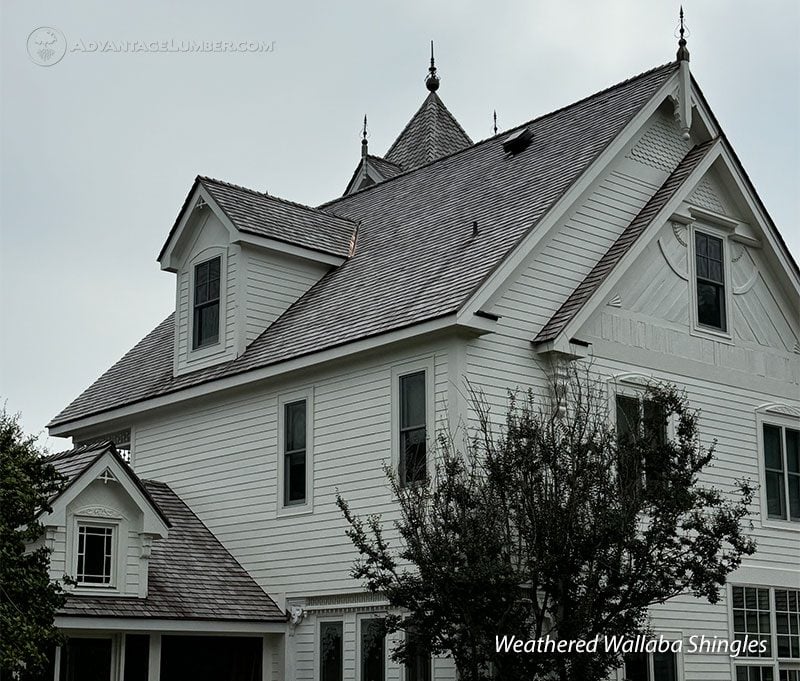
- Roofs: Must be ignition-resistant and often require a Class A rating.
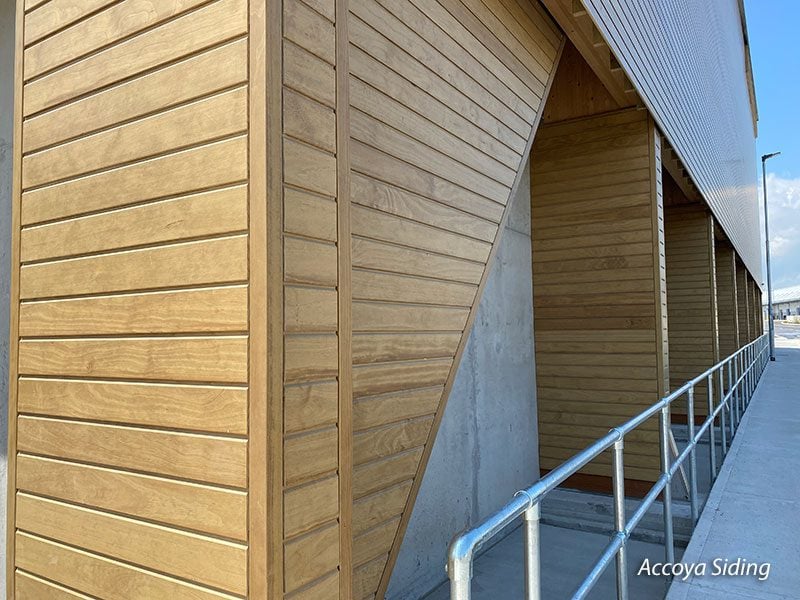
- Exterior Walls: Can be constructed with noncombustible, ignition-resistant, or 1-hour fire-rated materials.
- Windows and Doors: Typically must have tempered glass and meet a minimum 20-minute fire-resistance rating.
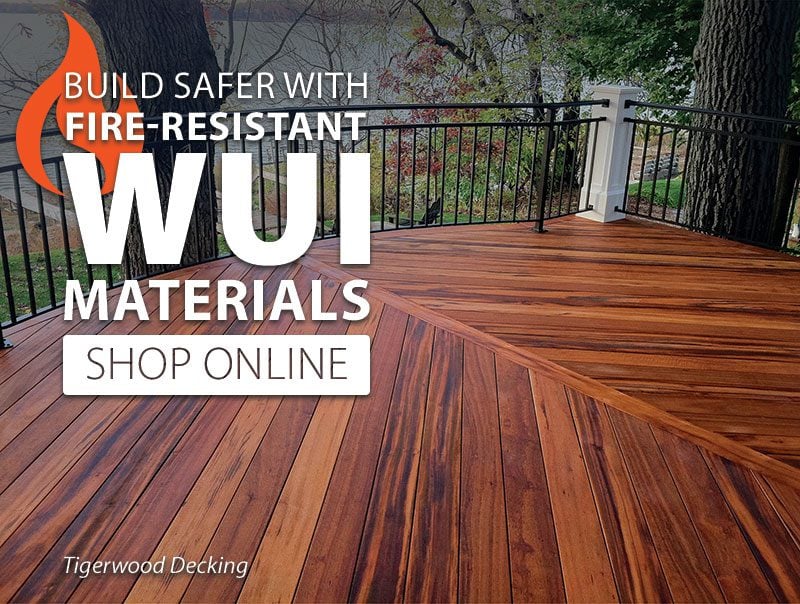
- Decking: May need to be noncombustible or have a Class A flame spread rating.
While individual materials are rated for WUI, these requirements generally apply to complete assemblies—the roof as a whole rather than an individual shingle. As a result, a building product may not meet the WUI requirements on its own, but will pass when installed correctly.
It should also be noted that while some materials may be rated well according to WUI requirements, this is not the only consideration when building in fire-prone regions. Some materials, like PVC, perform well in flame testing, but also give off toxic gases when burned, making them a poor choice for indoor use.
Which Materials Meet WUI Requirements?
Perhaps unintuitively, solid wood actually provides a good baseline for meeting WUI’s minimum 20-minute fire-resistance rating for exterior doors. But tropical hardwoods take this to the next level. Many of our wood products meet the WUI flame spread requirements:
- Ipe decking and siding
- Cumaru decking and siding
- Tigerwood decking and siding
- Accoya siding
- Wallaba shingles (with proper installation and underlayment)
Several synthetic decking lines have been specially engineered to resist fire and meet WUI requirements:
- Trex Select® decking
- Trex Transcend® decking
- TimberTech Vintage® decking
- TimberTech Landmark® decking
Additionally, Trex is releasing a new Class A flame spread line, and Deckorators is coming out with a new WUI-compliant decking line in the near future. Stay tuned for more info on those!