
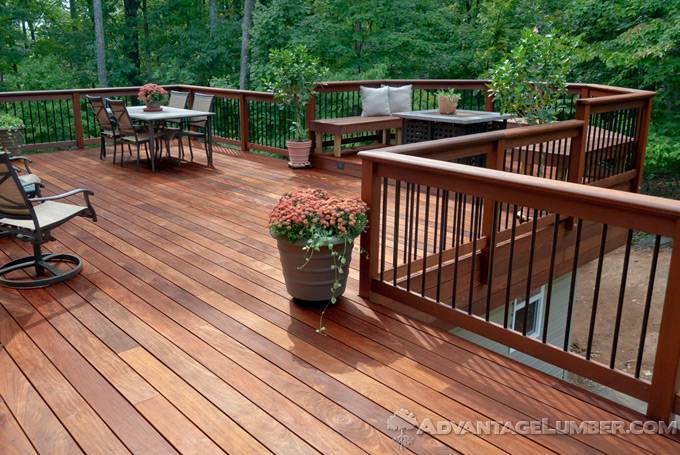
Here’s a situation we’ve seen more than a few times over the years.
A homeowner builds a beautiful Ipe or Cumaru deck over a traditional pressure treated wood frame. Then, ten or fifteen years later, they look at the deck boards and think, “These still look pretty good.” And I mean really good in some cases. You might have some graying on the surface, but the wood itself can still feel rock solid under your feet.
However, then they crawl underneath the deck.
That’s where things can get interesting. If you’ve worked around older decks long enough, you probably know where I’m heading with this.
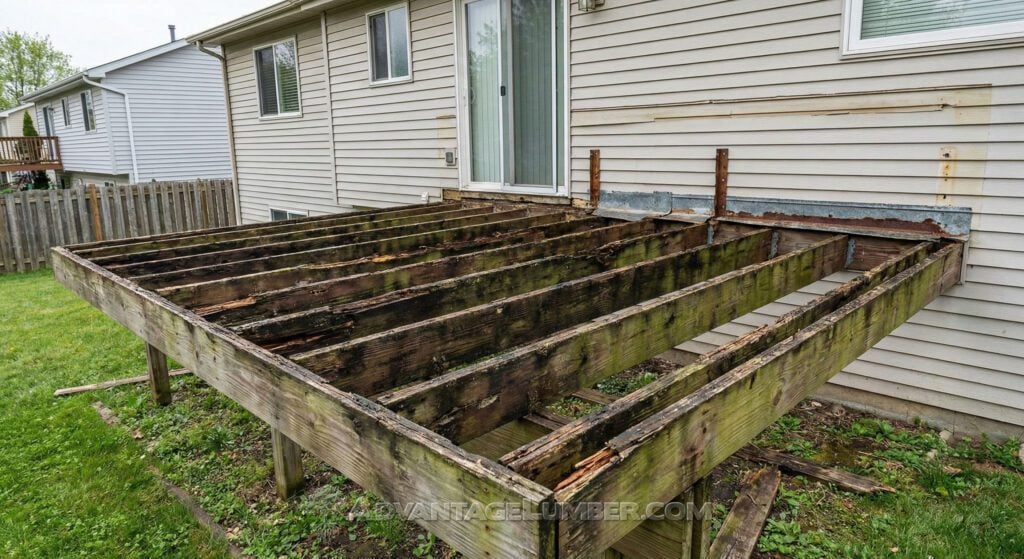
Although the hardwood decking may still have decades of useful life ahead of it, parts of the frame may already show rot. Sometimes the tops of the joists soften first. In other cases, though, trouble may start around the ledger, beams, fastener holes, or any place where water tends to sit. I’ve seen decks where the boards on top looked good enough that you’d never suspect what was happening underneath. That’s why appearances can sometimes fool you with decks.
At first, it sounds backward. After all, the framing holds the deck up. So, shouldn’t it last at least as long as the boards?
Ideally, yes. Wouldn’t that make more sense?
In the real world, though, decking and framing can age at very different rates.
Tropical Hardwood Is Naturally Built for the Outdoors
To begin with, woods such as Ipe and Cumaru work so well for decking for a simple reason: they’re extremely dense and naturally resistant to decay.
Ipe is probably the best known example. With proper care and installation, Ipe decking can potentially last for many decades. In fact, builders have also used it in demanding commercial settings where long term durability matters. After working with Ipe for years, its durability still impresses me. Pick up a piece sometime and compare it with a typical piece of softwood. You’ll probably understand pretty quickly that you’re dealing with a different animal.
Cumaru performs extremely well outdoors, too. Likewise, Tigerwood, Garapa, Brazilian Redwood, also called Massaranduba, Teak, and Mahogany can potentially deliver impressive service life when you match the species to the application and install it correctly.
More importantly, these woods don’t rely entirely on chemical treatment to survive outdoors. Instead, their natural density and durability may help them stand up to moisture, insects, decay, foot traffic, and weather.
Although hardwood can take a beating, it isn’t magic. I wish it were. It would make our jobs a whole lot easier.
Over the years, I’ve seen plenty of problems come from poor airflow, bad drainage, incorrect gap spacing, improper fasteners, and shortcuts during the build. Ultimately, premium material probably can’t overcome bad construction forever.
Still, when you install tropical hardwood correctly, the decking itself can remain sound for an awfully long time.
And, of course, that’s where the framing question comes in.
Your Deck Is Really Two Different Systems
Most homeowners see a deck as one structure.
A builder, however, tends to see two systems. After you’ve built enough of them, it can become hard not to look at a deck this way.
On one hand, you have the visible decking on top. On the other hand, you have the structure underneath it.
That structure includes:
- Joists
- Beams
- Posts
- Ledgers
- Blocking
- Connectors
- Footings
- Fasteners
Traditionally, most residential decks still use pressure treated lumber for much of this structure.
There’s a good reason for that. For one thing, pressure treated lumber usually costs less than many alternatives. Also, most lumberyards stock it, contractors know how to work with it, and crews can typically cut and fasten it with familiar tools.
I’ve built with plenty of it. Most contractors probably have. There’s nothing inherently wrong with that, either.
However, the problem isn’t pressure treated lumber itself. Instead, the problem comes when someone assumes it will automatically last as long as premium hardwood decking. That’s the assumption I’d probably question before spending serious money on a long lived deck surface.
Those are two different questions.
As a result, you can potentially end up with hardwood decking that still has decades of life left while the frame underneath has reached the end of its useful life.
Think about that for a minute. You paid for a decking material because you wanted longevity, yet you may have put it over something that could need major work much sooner. Does that really make sense?
In other words, perfectly good deck boards may still sit on joists that need replacement.
That’s not exactly the retirement plan you had in mind when you bought a premium deck. Nobody gets excited about potentially paying to dismantle a beautiful deck just to reach rotten framing.
Water Usually Finds the Weak Spots
When I inspect an older deck, I’m not necessarily worried about rain hitting the middle of a joist.
Instead, I’m looking for places where water might get trapped. Water has a funny way of finding the places you’d rather it didn’t.
For example, the top of a joist gives you a perfect example.
The deck board sits over the joist, and the fastener penetrates the framing. Meanwhile, dirt, pollen, leaves, and other debris can work into those small spaces. Naturally, water can follow. It doesn’t take much debris, either. A surprisingly small amount of crud may hold moisture longer than you’d expect.
Then, unfortunately, the area may dry slowly.
Repeat that cycle through years of rain, snow, humidity, washing, and freeze thaw weather, and eventually you can create a rough environment for lumber. One rainy weekend probably isn’t the issue. It’s those wet and dry cycles happening year after year that I pay attention to.
Likewise, the same thing can happen around beams, ledgers, posts, and connections.
Although these areas may look harmless at first, tight spaces can potentially hold moisture against the framing for long periods.
That’s why I’ve learned to follow a basic rule when I build outdoors:
Wood getting wet isn’t always the biggest problem. Wood staying wet can be the problem.
I’ve repeated some version of that line more times than I can count, but it’s probably worth repeating because it explains an awful lot about outdoor wood construction.
So, give water somewhere to go, and give the structure a chance to dry.
Ventilation Matters More Than People Think
People spend a lot of time talking about deck board color, railing style, hidden fasteners, and picture frame borders.
Meanwhile, nobody gets particularly excited about airflow. You’re probably not going to show your neighbor your new deck and brag about the ventilation underneath it.
They should. Well, maybe not brag about it, but they should certainly think about it.
After all, good airflow can help both the decking and the framing dry after rain. At the same time, natural wood gains and loses moisture as weather conditions change, so the whole assembly may benefit when air can move freely.
For comparison, a deck that sits eight feet above grade may live a pretty comfortable life compared with one that sits only a few inches above damp soil.
Same decking. Same framing. Yet, it can be a completely different environment. I can’t stress that enough. Two decks built with identical materials may age very differently simply because one can breathe and the other can’t.
That’s why ground level decks need more planning. Although a low deck may look simple, limited airflow can keep the underside damp for much longer. Then, add shade, wet soil, heavy vegetation, or poor drainage, and the framing may stay wet enough to create problems.
For standard hardwood decking, we generally like to see roughly 18 inches of open air beneath the joists when the site allows it.
However, when a project can’t provide that much clearance, you may need to rethink the system instead of forcing a standard deck build into a space where it doesn’t belong. Sometimes the best construction decision may be admitting that the system you originally wanted isn’t the right system for the site. I know homeowners don’t always love hearing that, but it can potentially save a lot of trouble later.
Protect Pressure Treated Framing with Joist Tape
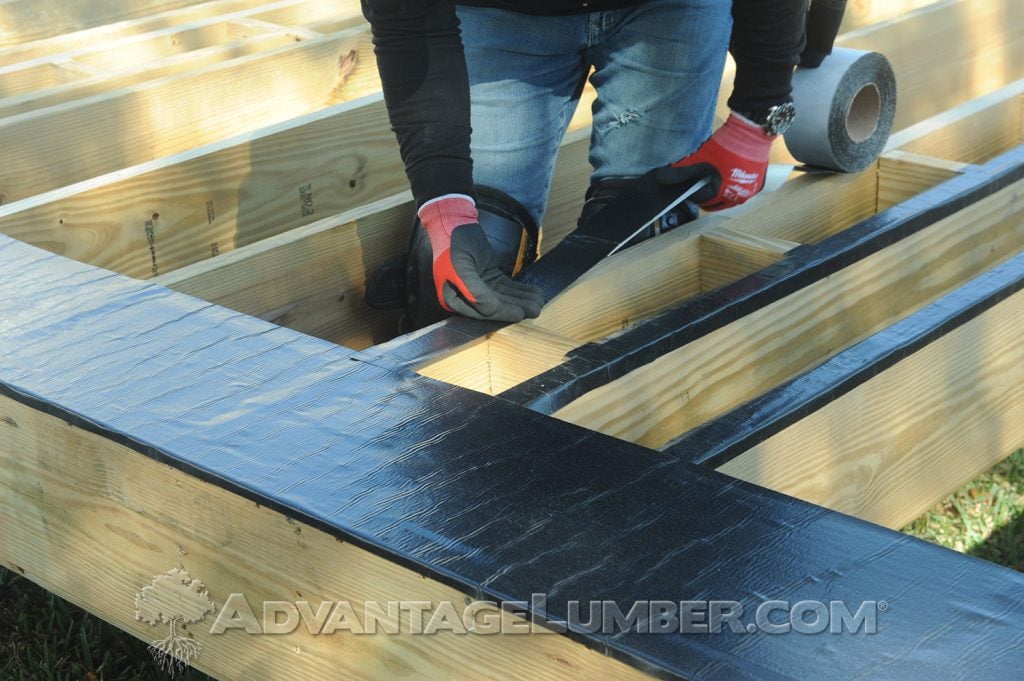
If you use pressure treated framing under a hardwood deck, joist tape gives you one of the simplest upgrades you can make.
Simply put, it’s cheap insurance. And compared with what the entire deck costs, we’re probably not talking about a huge expense here.
Joist tape covers the tops of the joists and can help keep water out of the framing, especially around screw penetrations and the narrow space between the decking and the joist.
Similarly, ledger tape can do the same kind of work across larger surfaces such as ledgers and beams.
Although tape won’t fix bad drainage or poor construction, it can help protect some of the frame’s most vulnerable horizontal surfaces. Don’t treat it like a magic Band Aid, though. You still need to build the deck correctly.
Personally, if I were spending money on a premium hardwood deck today but wanted to keep the project on a reasonable budget, I probably wouldn’t skip this step.
After all, you’re already paying for decking that may serve you for decades.
So, spending a little more to protect the frame underneath can make sense. To me, this is one of those upgrades where the math is usually pretty easy.
Or Build a Frame for a Longer Service Life
On the other hand, you can also take another approach.
Instead of trying to stretch the life of conventional wood framing, you can choose a framing material that may have a better chance of keeping pace with the decking.
For that reason, steel and aluminum deck framing have become much more appealing.
Yes, they cost more upfront. There’s no point dancing around that part.
Naturally, that’s the first thing everyone notices. I get it. When you’re staring at the total cost of a new deck, every additional dollar can suddenly look very large.
However, I don’t like comparing framing materials by initial price alone. If I’m designing a deck around Ipe, Cumaru, or another long lasting material, I also want to know how long I can reasonably expect the entire deck to stay in service.
So, if you hope to build a deck that lasts 40, 50, or even more years, a more durable frame may make a lot of sense. Why spend premium money on the top half and automatically choose the cheapest reasonable option underneath it?
At the same time, metal framing can give you better dimensional consistency. Anyone who has sorted through a pile of pressure treated lumber and searched for straight joists knows exactly what I’m talking about. You pull one board off the pile, look down it, put it back. Grab another one, same thing. If you’ve done it, you’re probably smiling right now.
Still, steel deck framing isn’t necessarily the right answer for every job.
For one thing, it costs more. Also, crews may need to use different methods, and the installer needs to handle fasteners, connections, and material compatibility correctly.
That’s why I don’t tell every homeowner, “You need metal framing.”
Instead, I tell them to think about how long they want the whole deck to last. That’s really the conversation worth having.
Match the Frame to the Decking
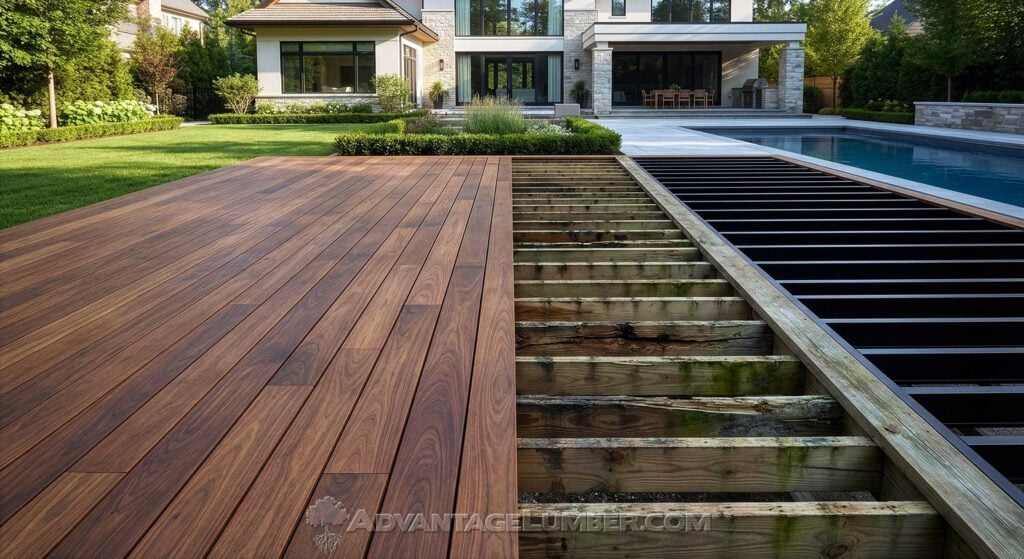
Ultimately, this is really the heart of the issue.
If you install an inexpensive decking material that you expect to replace fairly soon, an extremely expensive 50 year framing system may not make financial sense. I’m not going to tell someone to spend money just for the sake of spending it.
On the other hand, if you choose Ipe because you want a deck that may last for decades, why ignore the frame underneath it?
I’ve never understood that. Maybe it’s because we can see the deck boards and can’t see the joists, but structurally speaking, those hidden parts probably deserve just as much thought.
People will spend hours comparing deck boards because one may last 25 years while another may last 50. Then, somehow, they put either one on the same framing without giving the frame another thought.
Of course, the frame isn’t the glamorous part.
Nobody comes to your barbecue and says, “Wow, look at those joists.” And if somebody does, you probably invited a deck builder.
But, at the end of the day, those joists do all the work.
Don’t Forget the Hardware
There’s another part of the deck that deserves attention: fasteners and connectors.
When you work with tropical hardwoods, for example, use hardware that suits the job. This probably isn’t the place where I’d try to save a few bucks.
We generally recommend stainless steel screws with hardwood decking because, frankly, you don’t want cheap fasteners to become the weak point in an otherwise premium deck. I’ve never liked the idea of putting bargain bin hardware into expensive hardwood. You saved a little money today. Great. What might happen ten years from now?
For grooved hardwood decking, Ipe Clip hidden deck fasteners remain one of our preferred systems. Instead of driving screws through the face of every board, they let you secure the boards from the sides.
Likewise, the same principle applies underneath the deck.
Joist hangers, structural screws, bolts, post bases, and other connectors all need to suit the application and meet local building requirements.
Although one bad fastener may seem like a small detail, a deck can only perform as well as its weakest critical parts.
After all, a 50 year board doesn’t help much if another key component fails first. That’s a little like putting a 50 year roof on a house with rotten rafters.
Good Hardwood Still Needs Good Installation
Sometimes, people assume Ipe automatically gives them a 50 plus year deck.
Not quite. I wish buying good material made every other construction detail disappear, but it doesn’t work that way.
Although the material matters, the build may matter just as much.
For starters, hardwood decking still needs proper airflow, drainage, fastening, and gap spacing. At the same time, the correct gap can change with the wood’s moisture level, drying method, climate, and job site conditions.
Likewise, the framing needs proper flashing and water control.
For example, you need to flash the ledger correctly.
You also need to size and place the footings correctly.
Likewise, you need solid post and beam connections.
Most importantly, water needs somewhere to go.
And, at the same time, air needs somewhere to move.
Admittedly, none of this stuff sounds particularly exciting. However, it can often determine whether a deck still performs decades later. Honestly, the boring details are usually the ones I worry about most. Fancy railing gets the photographs. Flashing may keep you from rebuilding things.
What If Your Existing Frame Is Already Rotting?
Interestingly, hardwood decking can sometimes give homeowners an unusual second chance.
Over the years, we’ve seen older hardwood decks where the boards still had plenty of useful life even though the frame needed serious work. It can be a strange sight. You look at the surface and think the deck has years left, then you get underneath and realize you’ve got a completely different project on your hands.
In that situation, if the decking remains in good shape, you may be able to remove the boards carefully, rebuild the structure, and reinstall many of those same boards.
Of course, every deck is different. And I wouldn’t promise somebody beforehand that every board will come off perfectly. That’s just not realistic.
So, you need to inspect the boards, grooves, screw holes, ends, and overall condition. During removal, some boards may get damaged. Others, meanwhile, may need trimming or replacement.
Still, compare that with a deck where both the surface and the frame have failed at the same time.
With quality hardwood, you may still be able to save the most visible and expensive part of the deck. When you can do that, it may certainly take some of the sting out of rebuilding the frame.
Look Under Your Deck Once in a While
Finally, here’s one last piece of advice.
Don’t judge your deck only from the top.
Instead, get underneath it. Yes, you might get dirty. That’s okay.
Every spring, grab a flashlight and spend ten minutes looking around. You’ll probably spend longer deciding what to grill for dinner that night. Ten minutes isn’t much to ask for a structure attached to your house.
First, check the joists.
Then, look around the ledger.
Next, inspect the beams.
After that, check the post bases.
Also, look for rusty hardware.
At the same time, pay attention to spots that stay damp.
If you find suspicious wood, probe it with a screwdriver. If your screwdriver sinks into something that should feel solid, you may have learned something important.
And, while you’re under there, watch for water stains and places where leaves or dirt collect.
Although you don’t need to be a structural engineer to notice every problem, you can often spot signs that deserve a closer look. If something seems wrong, then call an experienced deck contractor or another qualified professional. There’s no prize for guessing when structural safety is involved.
After all, catching a small moisture problem today can cost a lot less than replacing a rotten beam several years from now.
Build the Whole Deck for the Lifespan You Want
After years of working with decks and outdoor lumber, I’ve become a big believer in looking at the whole assembly instead of obsessing over one product. Maybe that comes from seeing enough expensive materials installed over structures that didn’t receive the same level of thought.
Without question, premium hardwood decking can last an incredibly long time.
That’s one of the reasons people buy it.
However, if you invest in Ipe, Cumaru, Tigerwood, Garapa, Brazilian Redwood, Teak, Mahogany, or another long lasting hardwood, spend some time thinking about what goes underneath it. You don’t need to overbuild everything, but you should at least ask whether the pieces of the system make sense together.
If you use pressure treated framing, protect vulnerable areas with quality joist and ledger tape, and build the structure so water can drain and the wood can dry.
On the other hand, if your budget allows, look at steel or aluminum framing and decide whether the extra cost makes sense for your project. For some decks, I think it absolutely can. For others, a well built and well protected pressure treated frame may fit the budget and project better.
Most importantly, don’t assume the frame and decking will age at the same rate just because you installed them on the same day.
In reality, they may not.
As a result, a beautiful hardwood deck can still have decades of life left while the structure underneath may tell a very different story. We’ve seen it happen, and once you’ve seen it a few times, you tend to pay a lot more attention to what’s underneath the boards.
So, build accordingly.
