
When homeowners invest in premium hardwood decking, they’re often thinking long term and for good reason.
High density hardwood species such as Ipe, Cumaru, Tigerwood, Garapa, and Brazilian Redwood can provide decades of service when properly installed and maintained. Depending on the species and conditions, many hardwood decks can last 40–75+ years.
But there’s an important question that often gets overlooked:
Will the deck frame underneath last as long as the decking on top?
For most traditionally constructed decks, the answer may be no.
That’s why pairing aluminum deck framing with hardwood decking can make so much sense. Instead of installing exceptionally durable deck boards over a frame that may need replacement decades earlier, you can build the entire deck with longevity in mind.
The Weak Link in a Long Lasting Hardwood Deck
Most residential decks in the United States have traditionally been framed with pressure treated lumber. Pressure treated wood is readily available, relatively inexpensive, easy for contractors to work with, and can provide years of service when properly designed and installed.
However, pressure treated lumber is still a softwood.
Exposure to moisture, poor ventilation, trapped debris, fastener penetrations, and water collecting around joists and beams can eventually lead to deterioration and rot.
Modern pressure treated lumber is also different from much of the material used decades ago. Older pressure treated lumber commonly contained chromated copper arsenate (CCA). CCA was phased out for most residential consumer applications because of concerns surrounding arsenic exposure.
Today’s residential pressure treated lumber typically uses alternative preservative systems. While these treatments help protect lumber from decay and insects, they do not make wood indestructible.
Under unfavorable conditions, we have seen newer pressure treated deck framing begin showing serious deterioration in as little as 10–15 years.
That creates a major mismatch when you’re installing hardwood decking designed to last several times longer.
What We’ve Seen After 30+ Years in the Decking Business
At AdvantageLumber.com, we’ve been supplying decking materials for more than 30 years. One of the trends we’ve increasingly encountered involves customers who purchased hardwood decking years ago and are now dealing with a problem they didn’t expect.
The hardwood isn’t the problem.
In many cases, customers with Ipe or Cumaru decking tell us that after 10 years their deck boards still look excellent and have many years of useful life remaining.
Unfortunately, the pressure treated framing underneath may have started to rot.
This can put homeowners in the frustrating position of having premium deck boards that could potentially last for decades sitting on top of a structure that needs major repairs or replacement.
And replacing a deck frame isn’t a small project. Even if some of the hardwood decking can be carefully removed and reused, dismantling a deck to replace deteriorated framing means additional labor, disruption, and expense.
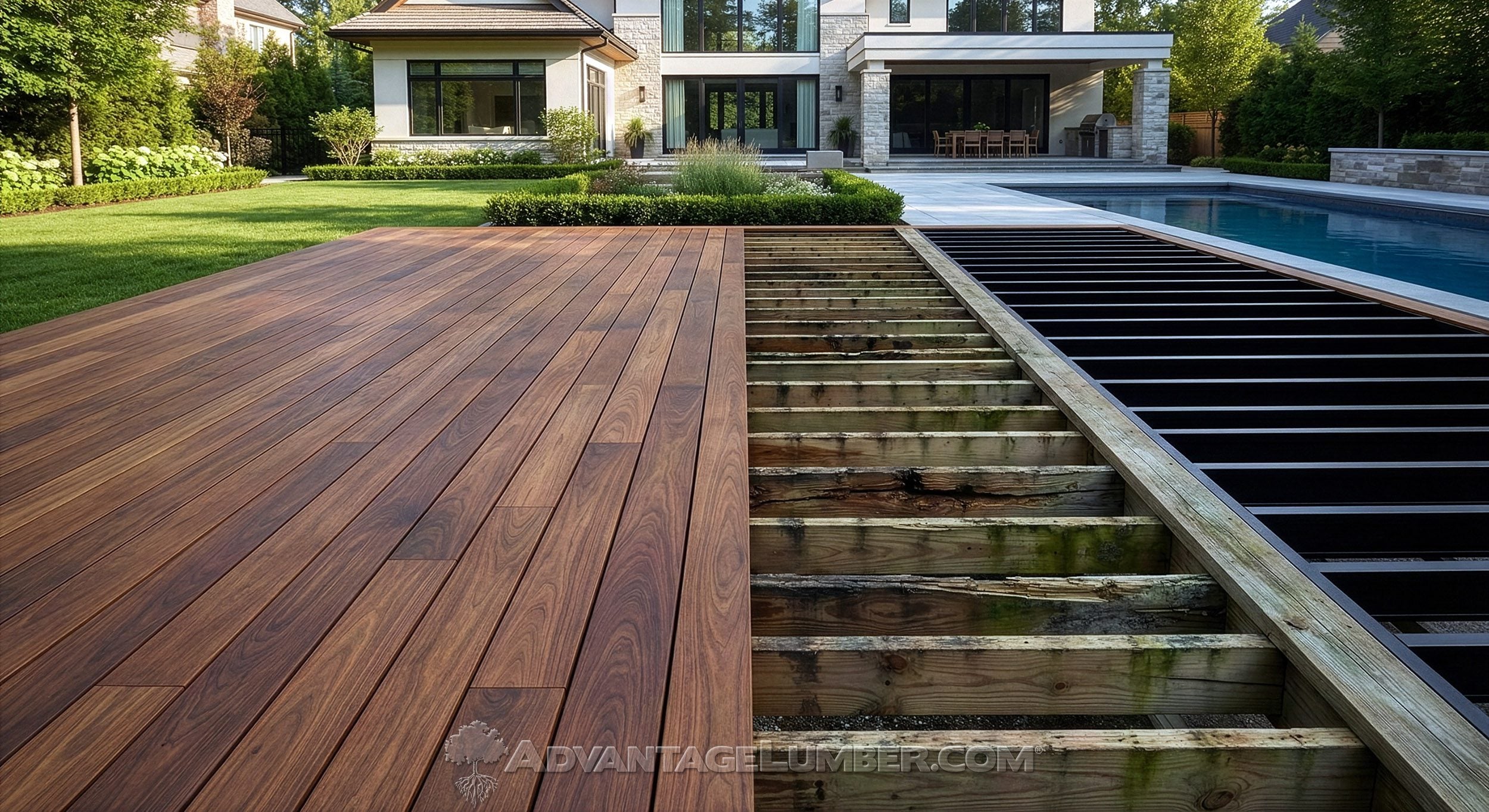
The picture at the top of this post shows this exact scenario. A customer installed Ipe decking around a pool deck and the pressure treated framing had started to rot after 10 years due to the excess moisture from the pool.
The homeowner had to start replacing the pressure treated frame with an aluminum deck frame even though their Ipe decking still looked brand new.
Match Your Deck Frame Lifespan to Your Decking Lifespan
This is the principle we recommend homeowners consider when planning a premium deck:
Match the expected lifespan of your deck framing as closely as possible to the expected lifespan of your decking.
Think about it this way.
What sense does it make to purchase a deck board with a potential 50-year lifespan if the structure supporting it might only last 10–15 years under adverse conditions?
Your deck is a complete system. The surface is only one component.
If longevity is one of the main reasons you’re choosing hardwood decking in the first place, it makes sense to consider the longevity of everything underneath it, too.
Why Aluminum Deck Framing Is an Excellent Match for Hardwood
Aluminum deck framing eliminates one of the fundamental vulnerabilities of wood framing: wood rot.
Because aluminum isn’t an organic material, it cannot rot the way pressure treated lumber can. It also isn’t a food source for termites and other wood destroying insects.
That makes aluminum particularly attractive for homeowners investing in long lasting hardwood decking.
Some of the key advantages include:
1. Aluminum Doesn’t Rot
Water is one of the biggest enemies of a traditional wood deck structure. Over time, repeated wetting can create conditions that promote decay.
Aluminum does not rot, helping eliminate one of the most common causes of deck frame deterioration.
2. Excellent Lifespan Potential
Premium hardwood decking is purchased because homeowners don’t want to replace their deck boards every decade or two.
Using aluminum framing applies the same long term thinking to the structure underneath the deck.
3. Resistant to Insects
Termites and other wood destroying insects can attack traditional lumber framing. Aluminum provides no food source for these pests.
4. Consistent Material
Wood naturally expands, contracts, twists, checks, and can warp as moisture conditions change.
Aluminum framing provides a highly consistent structural platform, which can be particularly beneficial when installing dense, premium hardwood decking.
5. A Better Long Term Investment
Pressure treated lumber will have a lower initial material cost than aluminum framing.
But initial price isn’t the only cost worth considering.
If a wood frame requires major repairs or replacement while your hardwood decking still has decades of life remaining, the cost and labor associated with rebuilding the structure can substantially change the long term economics of the project.
For homeowners planning to stay in their homes for many years, spending more on the framing system initially may help reduce the possibility of having to rebuild the deck structure later.
Hardwood Decking Is Already a Long Term Investment
One reason aluminum framing pairs so naturally with hardwood is that many of the species we sell are exceptionally durable.
Ipe Decking
Ipe is one of the most recognized premium hardwood decking species in the world. Its exceptional density and natural resistance to rot, decay, insects, and weather have made it a popular choice for demanding residential and commercial applications.
Properly installed Ipe decking can provide 50–75+ years of service, making it a natural candidate for a long lasting framing system.
Cumaru Decking
Cumaru is another extremely dense and durable South American hardwood. It offers excellent resistance to decay and insects while providing beautiful grain patterns and warm natural coloring.
Cumaru can offer a lifespan measured in decades and represents an excellent alternative for homeowners seeking premium hardwood performance.
Tigerwood Decking
Known for its dramatic appearance, Tigerwood features rich reddish brown coloration with distinctive dark streaking. In addition to its appearance, Tigerwood offers impressive natural durability.
Garapa Decking
Garapa provides a lighter golden appearance while still offering many of the durability advantages homeowners seek from tropical hardwood decking.
Brazilian Redwood
Brazilian Redwood, also known as Massaranduba, is another dense tropical hardwood with excellent natural durability and a rich reddish appearance.
With hardwood options capable of lasting for decades, it makes sense to think beyond the visible decking surface when designing the structure.
Pressure Treated Framing vs. Aluminum Framing
Pressure treated lumber still has a place in deck construction, particularly when upfront budget is the primary consideration. Proper design, flashing, drainage, ventilation, and maintenance can also help extend the life of a wood deck frame.
However, homeowners choosing premium hardwood should understand the potential lifespan mismatch.
| Feature | Pressure Treated Wood Framing | Aluminum Deck Framing |
|---|---|---|
| Can Rot | Yes | No |
| Susceptible to Wood Destroying Insects | Yes | No |
| Can Warp or Twist | Yes | No |
| Upfront Cost | Lower | Higher |
| Pairing With 40–75+ Year Hardwood | Potential lifespan mismatch | Excellent long term pairing |
| Maintenance Concerns | Moisture management is critical | Reduced concern about rot and decay |
| Class A Flame Spread Rating | No | Yes |
| Limited Lifetime Warranty | No | Yes |
The goal isn’t simply to choose the cheapest framing material today. It’s to determine which framing system makes the most sense over the entire expected life of your deck.
Don’t Put a Long Life Deck Board on a Short Life Structure
Imagine installing beautiful Ipe decking today.
Ten years later, the Ipe still looks fantastic. It may have weathered to an attractive silver gray patina, or you may have maintained its original color with periodic applications of hardwood oil.
Either way, the boards themselves remain structurally sound.
But then you discover that moisture has caused deterioration around the joists, beams, or other areas of the pressure treated structure underneath.
Now your durable hardwood decking has to be removed so the frame can be repaired or replaced.
That’s exactly the situation a longer lasting framing system is designed to help avoid.
Think About the Entire Deck as a System
When planning a deck intended to last for decades, every major component deserves consideration.
That includes:
- Decking
- Joists and beams
- Posts and structural connections
- Fasteners
- Flashing and water management
- Railing
- Footings and foundation
- Proper ventilation and drainage
A deck is only as reliable as the system supporting it.
Premium hardwood decking paired with aluminum framing creates an opportunity to approach the entire project with longevity as a central design goal rather than treating the decking surface and supporting structure as separate decisions.
Aluminum Framing Can Make Even More Sense for Elevated Decks
Long term structural performance becomes particularly important with second story and elevated decks.
Replacing deteriorated framing on a low deck is inconvenient. Rebuilding a large elevated structure can be considerably more complicated and expensive.
Elevated decks also create opportunities to use the space underneath as patios, outdoor kitchens, seating areas, or dry storage areas. Investing in durable framing can therefore benefit more than just the deck surface.
For homeowners building a premium elevated hardwood deck, aluminum framing is worth serious consideration from the beginning of the project.
Build Once and Build for the Long Term
Choosing hardwood decking is often about moving away from the cycle of frequently replacing lower durability decking materials.
Your framing deserves the same consideration.
If you’re investing in Ipe, Cumaru, Tigerwood, Garapa, Brazilian Redwood, or another long lasting hardwood, consider what will be supporting those boards 10, 20, 30, or even 50 years from now.
A premium hardwood deck deserves a framing system designed with similar longevity in mind.
At AdvantageLumber.com, our team has more than 30 years of experience helping homeowners, contractors, architects, and builders select materials for long lasting decks. We can help you plan your hardwood decking project and determine the materials needed to build a deck designed for decades of enjoyment.
Don’t just build for how your deck will look next summer. Build for how it will perform decades from now.
Explore hardwood decking and long lasting deck framing options at AdvantageLumber.com.
