
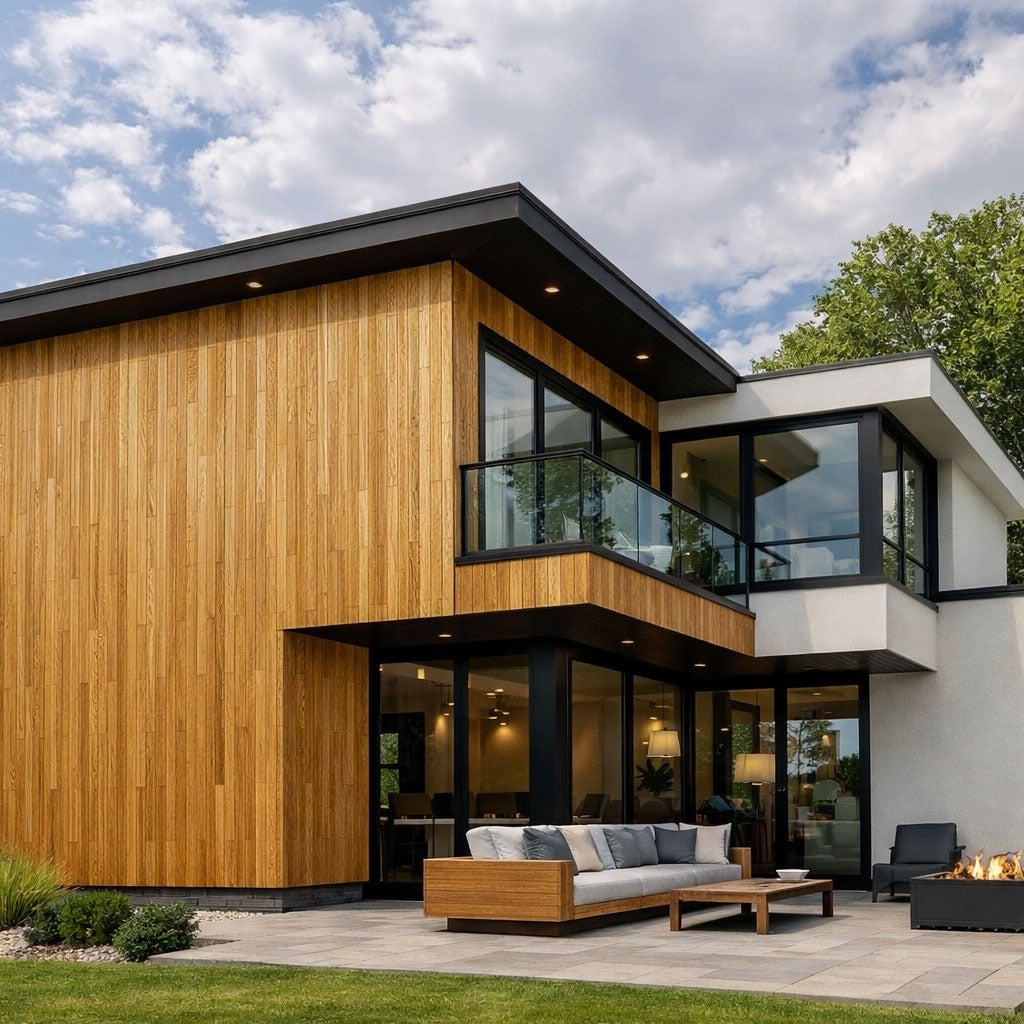
If you’ve been looking at premium siding, decking, saunas, or outdoor ceilings lately, you’ve probably run across the term Thermowood®.
And if you haven’t yet, you probably will. I’ve noticed it coming up more and more whenever someone wants real wood but also wants to know what newer options may be out there.
At first glance, it sounds like a special species of lumber. However, although the name can make it sound that way, Thermowood® is not a wood species.
I’ll admit, the name doesn’t exactly help clear things up. I’ve had plenty of conversations over the years where a product name can make something sound much more complicated than it really is.
Instead, manufacturers make Thermowood® by heating wood under carefully controlled conditions. Rather than relying on chemical preservatives, they use high heat and steam to change how the wood may react to moisture and weather.
Pretty interesting idea when you think about it, isn’t it? You’re essentially taking familiar wood and changing how it behaves without turning it into some completely different material.
As a result, the process can make the wood more stable, more resistant to decay, and darker in color.
For that reason, builders often use thermally modified wood for cladding and siding, decking, saunas, outdoor ceilings, soffits, and other architectural wood projects.
Still, although Thermowood® can offer several advantages, it also comes with limitations. Like any building material, it will generally work best when you choose the right species and use it in the right place.
And that last part is important. I’ve been around building materials long enough to get suspicious whenever somebody tells me one product is perfect for everything. It probably isn’t.
First, What Does “Thermowood” Actually Mean?
To start, there’s a small distinction here that’s worth knowing.
ThermoWood® is a registered trademark of the International ThermoWood® Association. Meanwhile, the broader category goes by the names thermally modified lumber or thermally modified wood.
Even though those terms aren’t identical, contractors, architects, homeowners, and lumber suppliers may often use “Thermowood®” as a general term for thermally modified lumber.
Honestly, you’ll probably hear the terms used interchangeably on job sites anyway. That’s just how construction terminology tends to go.
Fortunately, the basic idea is pretty simple.
First, manufacturers place lumber in a controlled chamber and heat it to very high temperatures. At the same time, they use steam to help manage the process and potentially protect the wood while the heat changes its structure.
With the official ThermoWood® process, manufacturers do not add chemicals during treatment.
That tends to catch people’s attention. When I explain thermally modified wood to someone for the first time, “So they’re not pressure treating it?” is probably one of the first questions I hear.
However, although some people may confuse this with kiln drying, the two processes do very different things.
For example, kiln drying mainly removes moisture from lumber. Thermal treatment, on the other hand, goes further and can change how the wood behaves after it leaves the kiln.
In other words, we’re not just talking about getting a wet board dry. There’s potentially a lot more going on here.
Why Heat Wood in the First Place?
Simply put, wood moves.
Anyone who has worked with lumber long enough has probably dealt with boards that cup, twist, shrink, swell, or otherwise decide they don’t care what your plans were for them.
If you’ve ever installed a perfectly straight board and come back later to find it doing something completely different, you probably know exactly what I’m talking about. Wood has a way of keeping you humble.
In many cases, moisture can cause much of that movement.
Naturally, wood takes on and releases moisture as humidity changes. However, thermal treatment can reduce how readily the wood absorbs moisture, so the boards may stay more stable as conditions change.
As a result, that can help quite a bit outdoors.
Take siding, for example. It deals with changing temperatures, rain, humidity, and direct sunlight. Although no wood stays perfectly still, boards that move less may help you maintain tighter joints and cleaner lines.
And who doesn’t want that? Nobody finishes a beautiful siding job hoping the joints will start looking rough after a few seasons.
Likewise, the same benefit can matter with decking, soffits, ceilings, and other exterior woodwork.
What Species Are Used for Thermowood®?
One of the biggest misconceptions about thermally modified wood is the idea that it refers to one species.
It doesn’t.
Instead, manufacturers can thermally modify many different woods.
Some species you’ll commonly see include:
- Pine
- Ash
- Ayous
- Spruce
- Radiata Pine
- Hard Maple
- Yellow Poplar
- Red Oak
- Iroko
- Hemlock
Although each species goes through a similar type of heat treatment, each one can give you a different finished product.
And this is where things get interesting because, as any woodworker knows, species matters. You wouldn’t expect Pine, Ash, and Red Oak to behave exactly the same way before treatment, so why would you expect every Thermowood® product to perform exactly the same afterward?
For instance, Thermally Modified Pine can work well when you want better outdoor performance without moving into the price range of some premium hardwoods.
Meanwhile, Thermally Modified Ash can give you a more distinct hardwood look. Ash already has an attractive grain, and heat treatment may deepen its color considerably.
Personally, I like the grain you get with Ash. Give it that darker color from thermal modification and it can look like a much more exotic piece of lumber than people might expect.
Likewise, Thermally Modified Ayous gives you another option. Ayous is an African hardwood, and thermal treatment can give it a warm brown tone that may work well for cladding and sauna projects.
So, when someone tells me they’re considering Thermowood®, I usually ask, “Which species?”
After all, that matters.
It’s a little like someone telling me they want a “wood deck.” Okay, sure, but what kind of wood are we talking about? The details can completely change the conversation.
Where Is Thermowood® Commonly Used?
Thermally modified wood can work in quite a few applications, although several uses stand out.
Cladding and Siding
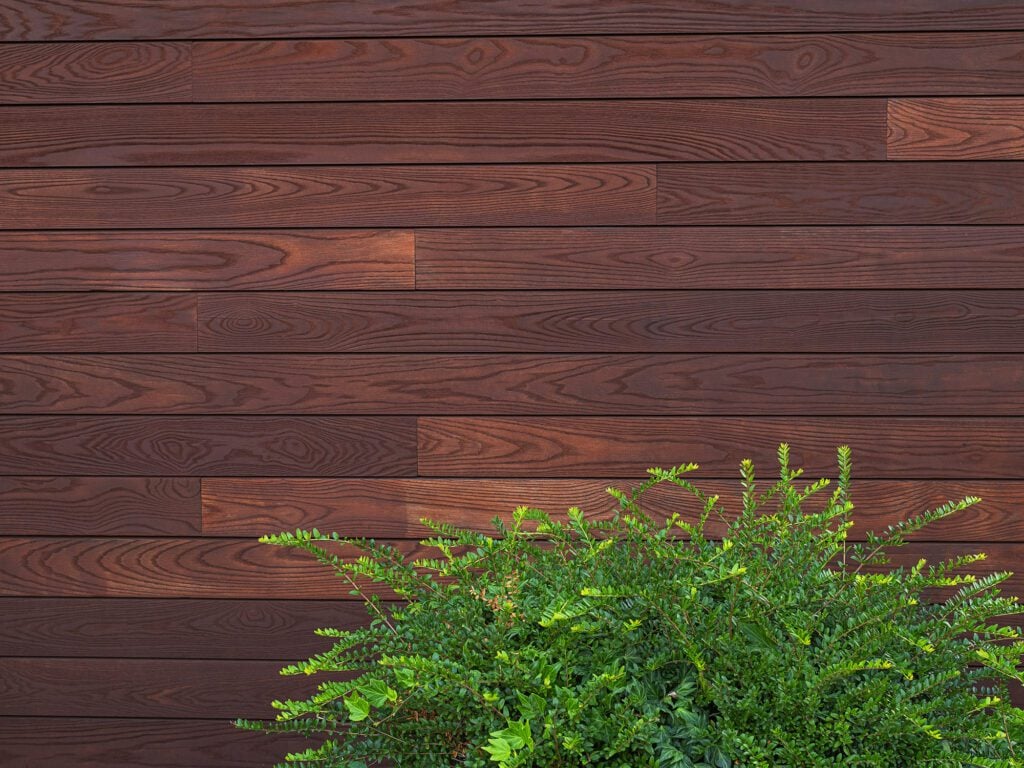
For starters, exterior cladding may be one of the best uses for Thermowood®.
Homeowners and architects often want the look of real wood siding, though ordinary lumber can move quite a bit as weather changes.
Fortunately, thermal treatment can help improve stability and decay resistance while keeping the natural look and feel of wood.
In addition, you can mill thermally modified lumber into many siding profiles, including tongue-and-groove boards and rainscreen profiles.
That flexibility can matter more than people sometimes realize. A good piece of lumber is one thing, but being able to mill it into the profile an architect or builder actually needs can make it much more useful.
Although style always comes down to personal taste, Thermowood® can look especially good on modern homes where wood siding meets stone, metal, stucco, or glass.
I’m a wood guy, so maybe I’m biased here, but I think natural wood can soften up some of those modern designs that otherwise might start feeling a little cold.
Decking
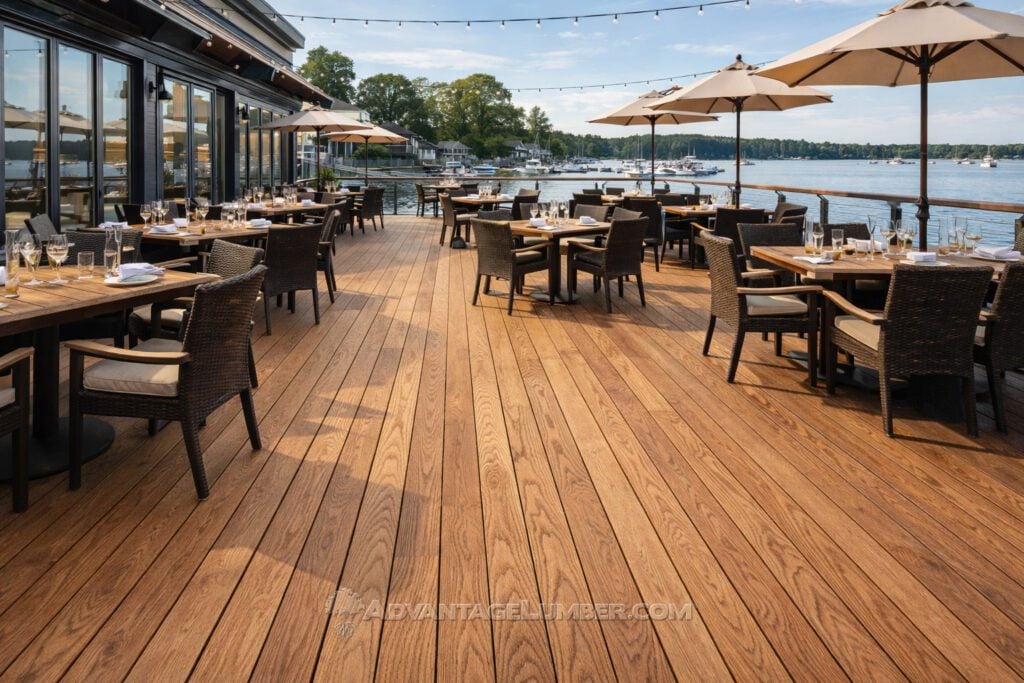
Likewise, builders also use thermally modified wood for decking.
We’ve worked with tropical hardwood decking for decades, so I wouldn’t put Thermowood® and Ipe in the same category. Although both can work outdoors, they get there in very different ways.
On one hand, Ipe has incredible natural density and durability. On the other hand, Thermally Modified Pine or Ash can gain much of its improved outdoor performance through heat treatment.
There’s nothing wrong with admitting those differences. In my experience, customers usually make better decisions when you explain what each material actually does instead of pretending every option is somehow the “best.”
Still, Thermowood® can make an attractive deck, especially for homeowners who want real wood but also want to compare it with tropical hardwood, cedar, pressure-treated lumber, composite, or PVC.
And these days, why wouldn’t you compare them? There are probably more legitimate decking choices available now than there were years ago, and that’s good for homeowners.
Saunas
Saunas are another natural fit.
After all, think about what wood inside a sauna deals with: heat, moisture, and repeated temperature swings.
That’s not exactly an easy environment for lumber, is it?
Although the environment can be tough on ordinary lumber, thermally modified wood may handle changing moisture levels more predictably.
For that reason, builders commonly use species such as Ash and Pine in sauna projects because they can combine stability with a warm, natural appearance.
And although synthetic materials can handle moisture well, many people may still want real wood in a high-end sauna because the material contributes so much to the look and feel of the space.
Personally, I get it. If you’re spending the money to build a beautiful sauna, real wood just feels right.
Outdoor Ceilings and Soffits
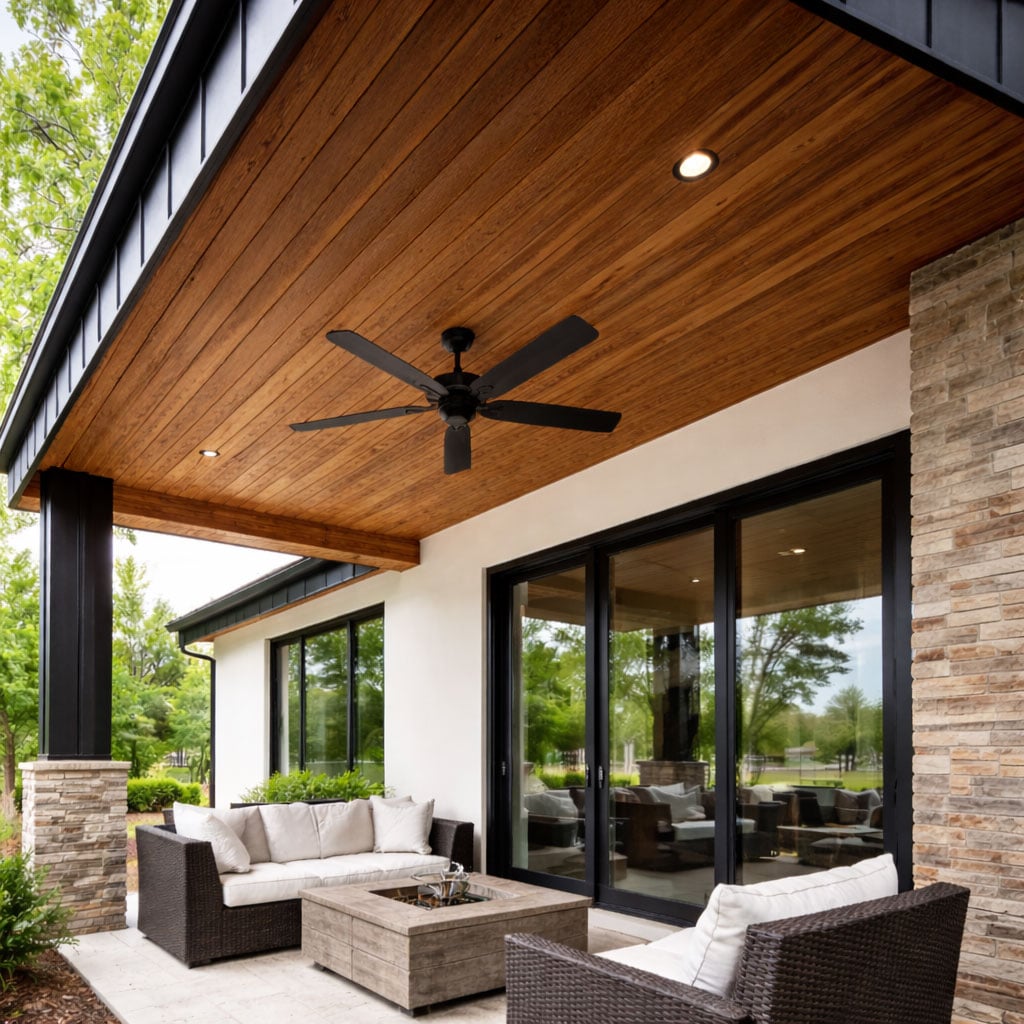
Personally, this is one of my favorite uses.
Simply put, wood ceilings can completely change the look of a porch, lanai, covered patio, or entryway.
I’ve seen otherwise fairly ordinary covered outdoor spaces completely change once a good tongue-and-groove wood ceiling goes up. Sometimes you stand back afterward and think, “Yep, that was worth doing.”
Thermally Modified Ash or Pine can give you the warmth of natural wood, though the boards usually face less abuse overhead than they would on a deck.
For example, a tongue-and-groove Thermowood® ceiling can look great next to stone columns, modern siding, or large windows.
Likewise, soffits can work well for the same reason.
Although the material still sits outdoors, an overhead location can protect it from much of the standing water, debris, and foot traffic that decking has to handle.
And obviously, nobody’s walking across your soffit. At least I hope they’re not.
Does Thermowood® Need Maintenance?
Yes.
Quite frankly, I’ve never been a fan of calling any exterior material “maintenance free.”
After all, put something outside long enough and Mother Nature will eventually have something to say about it.
I’ve seen enough decks, siding, railings, and outdoor woodwork over the years to know better. Sun, rain, snow, humidity, dirt, pollen—you name it. The outdoors will probably win a few rounds.
And remember, Thermowood® is still wood.
So, if you leave it unfinished in direct sunlight, it may gradually lose its original brown color and move toward a weathered gray.
Of course, some homeowners actually want that look.
And there’s nothing wrong with that. I actually like naturally weathered wood on the right house.
However, if you want to keep the darker brown color, you’ll usually need an exterior finish and periodic upkeep.
For that reason, although either approach can work, I’d probably decide what look you want before installation.
Do you want the wood to keep its original color, or do you want it to weather naturally?
Either way, it’s much easier to make that decision before you cover an entire house in wood siding.
Trust me, you don’t want to have that conversation halfway through the project.
Is Thermowood® Stronger Than Regular Wood?
Not necessarily.
In fact, this is an important point.
Thermal treatment can improve stability and decay resistance, though it does not automatically make wood stronger.
Instead, high heat changes the wood, and some mechanical properties may drop depending on the species and treatment level.
That’s why you need to match the product to the job.
For example, exterior cladding and a structural deck beam have very different responsibilities.
Sounds obvious, right? You’d be surprised how often people assume that “more durable” automatically means “stronger.”
So, although a thermally modified board may perform well outside, you should never assume it can replace structural lumber.
Instead, follow the manufacturer’s requirements and your local building code.
I know nobody gets excited about reading installation instructions and code requirements, but they’re probably a lot more enjoyable than rebuilding something later.
Thermowood® vs. Tropical Hardwood
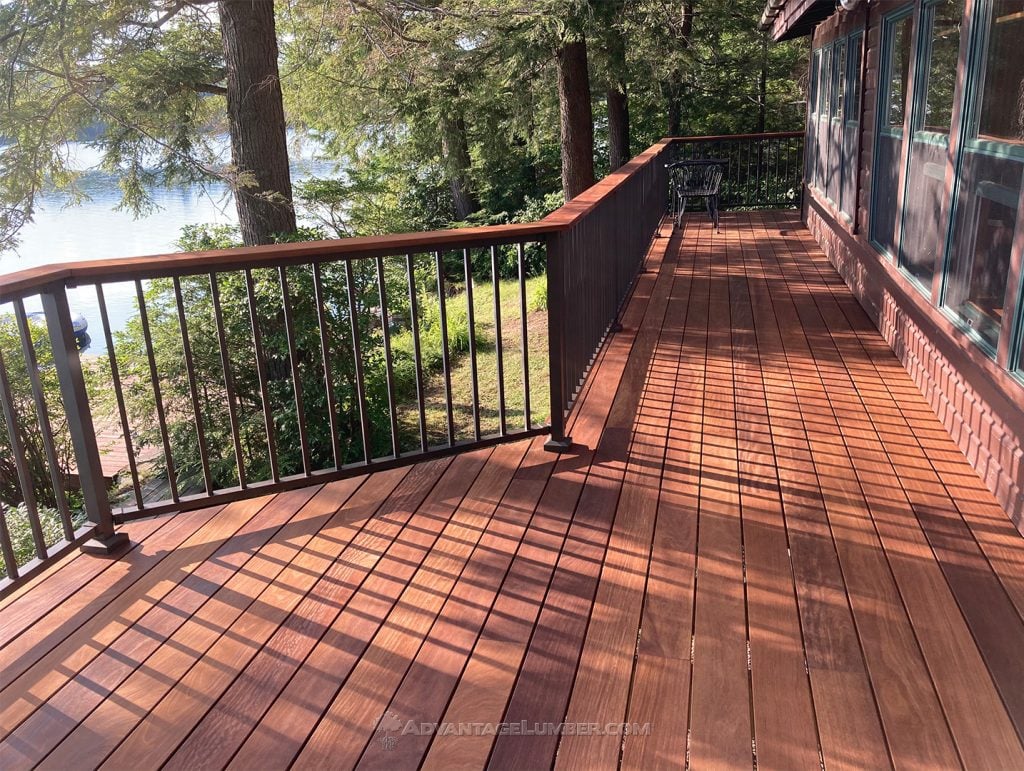
We often talk with customers who compare thermally modified wood with Ipe, Cumaru, Garapa, Tigerwood, and other tropical hardwoods.
However, there isn’t one answer that works for every project.
Wouldn’t it be nice if there were? Unfortunately, construction rarely works that way.
On one hand, tropical hardwoods such as Ipe and Cumaru are naturally dense, hard, and durable. Although they need no thermal treatment to gain those traits, they can cost more and can be harder to machine and fasten.
If you’ve ever drilled, cut, or screwed into Ipe all day, you know exactly what I mean. Bring sharp tools, good blades, and probably a little patience.
On the other hand, thermally modified woods take species that may not naturally offer the same exterior performance and can improve some of those properties through heat.
So, if I were building a deck where hardness, wear resistance, and maximum durability mattered most, I’d give tropical hardwood serious consideration.
However, although Thermowood® may not match Ipe in hardness, it can make a lot of sense for architectural siding, soffits, ceilings, and saunas where stability, appearance, weight, and workability may matter more.
Of course, price also matters.
Let’s face it, eventually almost every building material conversation gets around to the budget.
In the end, sometimes the right choice may simply come down to the species, profile, budget, appearance, and application.
Thermowood® vs. Composite and PVC
People also compare Thermowood® with Trex, TimberTech, and Deckorators when they shop for decking.
However, the biggest difference usually becomes obvious when you put the materials side by side.
Thermowood® is real wood.
As a result, you can see and feel the natural grain because every board comes from a tree.
For some people, that alone may make the decision. They want knots, grain, color differences, and all the little variations that remind you you’re looking at an actual piece of wood.
Although composite and PVC manufacturers have become very good at copying wood grain and color variation, they still make manufactured decking products.
And to give them credit, some of the newer products can look a whole lot better than the composites we saw years ago.
At the same time, composite and PVC decking can offer predictable colors, long warranties, and straightforward upkeep.
So, there’s no universal winner.
Someone who loves real wood may prefer Thermowood®. Meanwhile, someone who wants lower upkeep and fewer concerns about preserving natural wood color may lean toward composite or PVC.
Honestly, I’d rather see someone choose the material that fits how they actually plan to use and maintain the deck than buy something because somebody told them it was automatically “better.”
Is Thermowood® Worth Considering?
Absolutely.
I’ve watched building materials change quite a bit over the years, and thermally modified wood seems to fill an interesting spot in the market.
And I like seeing more choices in real wood. For a while there, it seemed like every new exterior product had to be synthetic.
In particular, it can let contractors, architects, and homeowners use real wood outdoors without relying only on naturally durable tropical hardwoods or pressure-treated lumber.
Still, although the word “Thermowood®” tells you something about how manufacturers treated the material, it doesn’t tell you everything you need to know.
So, ask what species it is.
Then, ask how the manufacturer treated it.
Also, ask whether they designed it for decking, siding, sauna use, ceilings, or another application.
Finally, ask what finish and fasteners they recommend.
Those might sound like simple questions, but simple questions can potentially save you a lot of headaches on a job.
After all, those details may matter more than the name on the brochure.
For the right project, Thermally Modified Pine, Ash, and other species can make beautiful decking, siding, cladding, saunas, ceilings, and soffits while still giving you something many homeowners may want:
real wood.
