
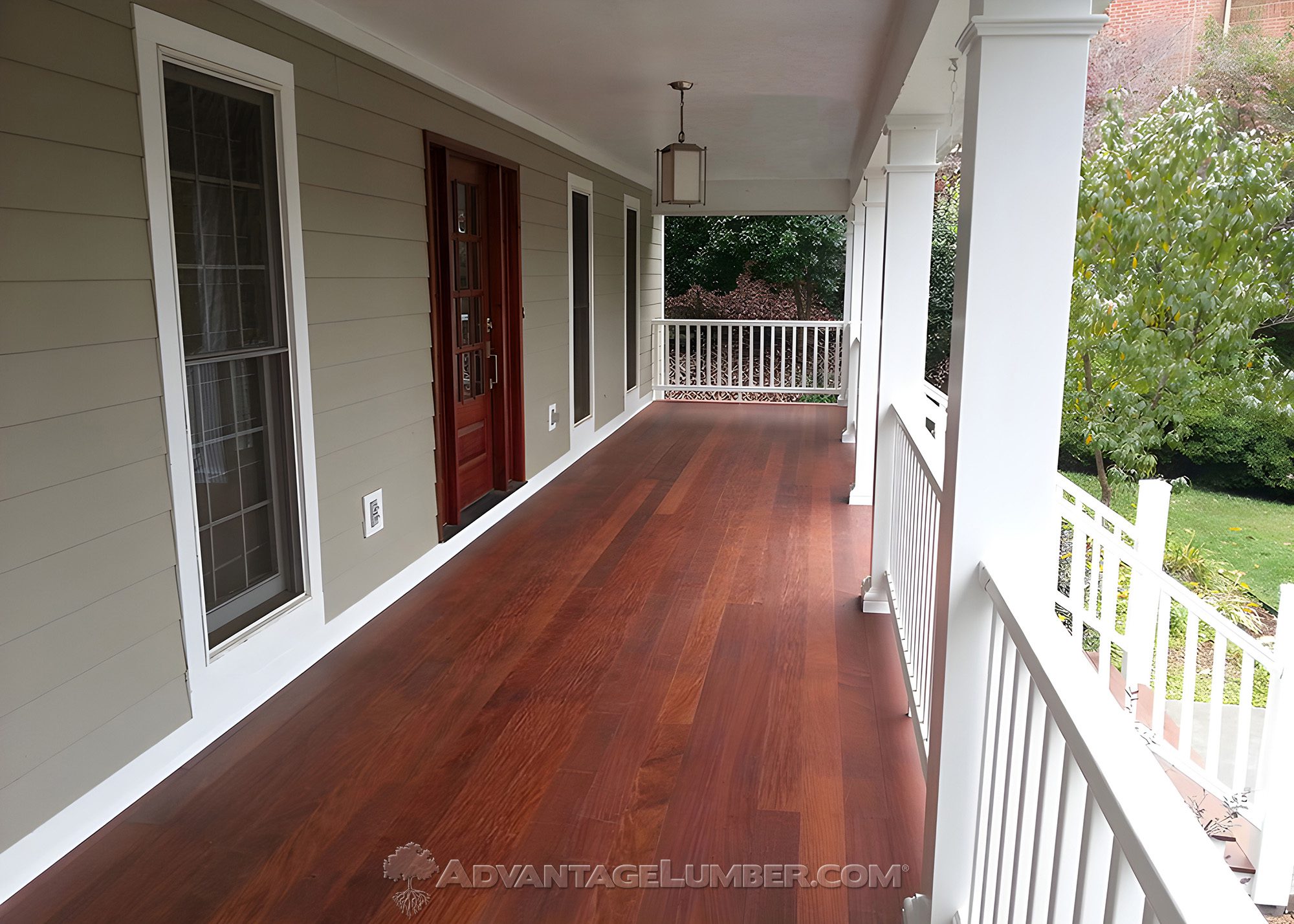
📦 1. Acclimation: Critical First Step
Proper acclimation ensures that the T&G hardwood decking boards remain tight-fitting after installation. For a successful Tongue & Groove Porch Decking Installation, it’s essential to follow preparation steps carefully.
Why acclimate?
Hardwood decking is a natural material that will expand and contract based on moisture content and temperature. Failing to properly acclimate may result in gapping, buckling, or cupping.
How to acclimate properly:
- Duration: Acclimate the boards at least 7–14 days prior to installation.
- Location: Stack decking in the same environment where it will be installed (i.e., the covered porch), elevated off the ground with spacers (stickers) between layers to allow for airflow on all sides.
- Covering: Keep the boards covered on top only (e.g., with a breathable tarp), allowing sides and bottom to breathe.
- Check moisture: Use a moisture meter to ensure the wood moisture content is within 2%–4% of the substructure’s moisture level before installation.
🛠️ 2. Substructure Requirements
- No subfloor allowed: Install directly over joists for proper ventilation.
- Joist spacing: Maximum spacing of 16″ on center (OC). For thicker boards (≥1”), 24” OC may be acceptable depending on site conditions and wood thickness/species.
- Slope: The porch must be pitched away from the structure, ideally 1/4″ per foot, to allow for water runoff.
- Ventilation: The underside of the porch must remain well-ventilated to avoid moisture buildup and wood degradation.
🔩 3. Fastening Method
Tools & Materials:
- Stainless steel trim-head screws (e.g., #8 x 2″ length)
- Cordless drill/driver
- Countersink bit (if needed)
Procedure:
- Begin at a wall: Start with the groove side toward the structure, and the tongue side facing outward.
- Face-screw the starter board: Pre-drill and screw the starter board through the face into the joists. Use stainless steel screws and wood plugs if aesthetics matter.
- Screw angle technique: For every subsequent board:
- Insert a stainless steel trim-head screw at a 45° angle through the bottom of the tongue.
- The screw head must be sunk fully into the groove to allow the next board to fit over it.
- No surface screws visible: This blind-screw method hides fasteners and ensures a smooth finish.
- Continue laying boards: Tap boards gently into place using a rubber mallet and a tapping block, never a hammer directly.
- End joints: Stagger them across multiple joists to avoid weak points and improve aesthetics.
🧼 4. Finishing & Sealing
- Pre-finish recommended: Apply oil-based UV-resistant penetrating sealer (e.g., Ipe Oil™) before installation if so desired, oil may be applied after installation as well.
- Cut ends: Seal all end cuts with a wax-based end sealer (e.g., Ipe Seal) to prevent end checking.
- Maintenance: Clean and reapply finish every 6–12 months depending on exposure.
❗ 5. Site Conditions & Precautions
- Covered only: T&G decking is for covered porches only. It is not suitable for open-air decks due to water pooling risk.
- Avoid moisture traps: Ensure there’s no trapped moisture between decking and joists.
- No glue or adhesive: Mechanical fastening only — do not use adhesives which may interfere with expansion.
🔁 6. Post-Installation Tips
- Monitor gaps: T&G should be installed tight with no visible gap. If boards are dry and climate is humid, allow a small expansion gap (~1/32”) to avoid buckling.
- Inspection: Regularly inspect for movement or uplift, especially during the first year as the wood completes adjustment.
📝 Summary
| Step | Key Action |
|---|---|
| ✅ Acclimation | 7–14 days in site conditions, proper air circulation |
| ✅ Structure | No subfloor, 16″ OC joists, sloped & ventilated |
| ✅ Installation | 45° screw through tongue, blind fastened |
| ✅ Finish | Seal before install, oil finish, end seal all cuts |
| ✅ Environment | Covered porches only, dry and well-ventilated area |
