
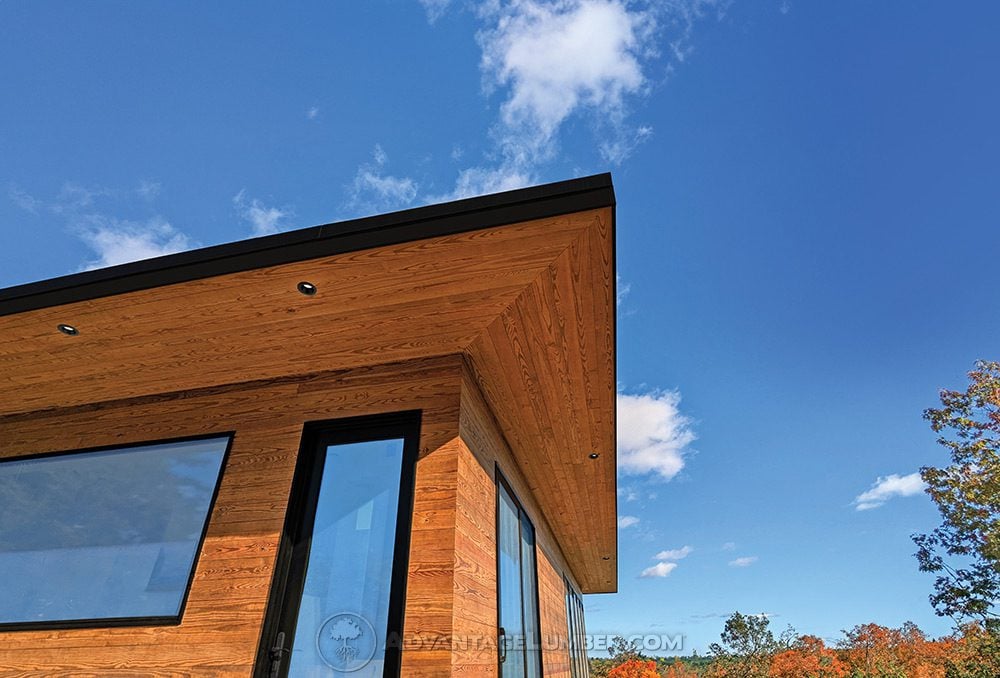
People barely notice a soffit until it looks wrong. Indeed, they notice it every time they walk up to the house.
At the same time, that strip of wood under the eaves or on a porch ceiling does more than hide rafters. In fact, it finishes the building. As a result, it ties the siding to the roof. On a covered porch, it is the ceiling you stare at while you sit outside. Cheap vinyl or painted pine can work. Even so, it rarely looks like a high end house.
Wood soffits work differently. On one hand, the right species can make a porch feel finished, warm, and intentional. On the other hand, the wrong one will cup, stain, or need paint every few years.
Meanwhile, soffits hold one big advantage over decks and siding: they sit in a relatively protected spot. Still, they take humidity, heat, insects, and the occasional wind driven rain. However, they don’t take the same beating a floor takes in full sun. As a result, that opens more species than you might think. At the same time, a dense hardwood can last a very long time with almost no fuss.
Here, then, are nine woods worth considering.
1. Ipe
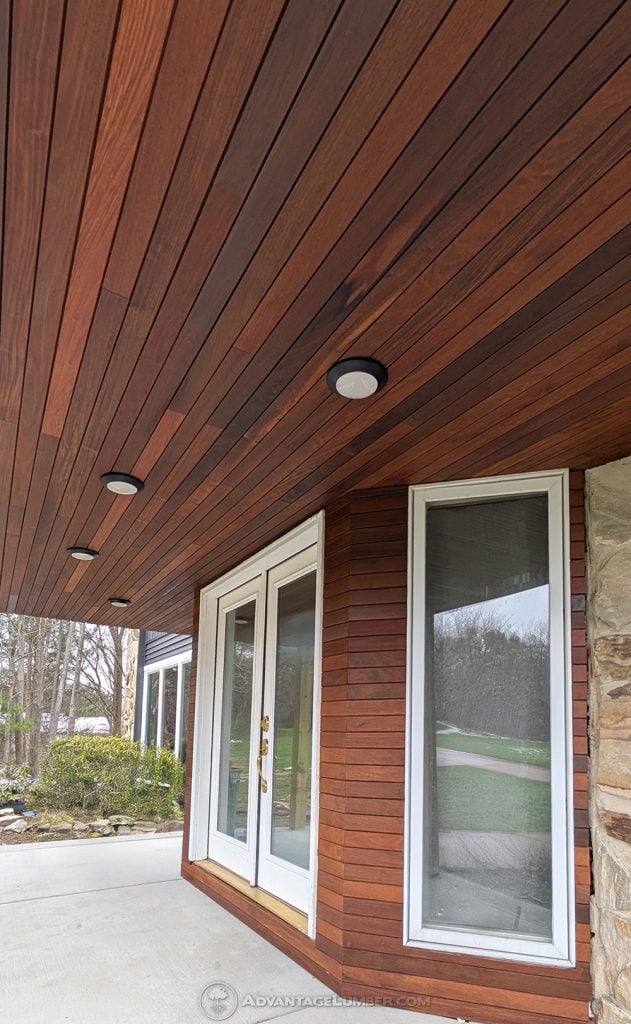
If you already have an Ipe deck, Ipe wood soffits give you the cleanest match you can make.
Indeed, Ipe stays extremely dense. As a result, it resists rot and insects on its own. At the same time, it stays stable enough for tongue and groove porch ceilings. Leave it unfinished, and it weathers to a silver gray. Oil it, however, and it keeps that rich chocolate brown people pay for in the first place.
Still, the trade offs stay the same ones you already know from decking. For one thing, it is heavy. In addition, you need sharp carbide blades. Likewise, you should pre-drill. Paint, meanwhile, is a bad idea. So if you want white porch ceilings, pick another wood.
Even so, for a luxury build where the soffit needs to last as long as the rest of the exterior, Ipe is hard to beat.
2. Cumaru
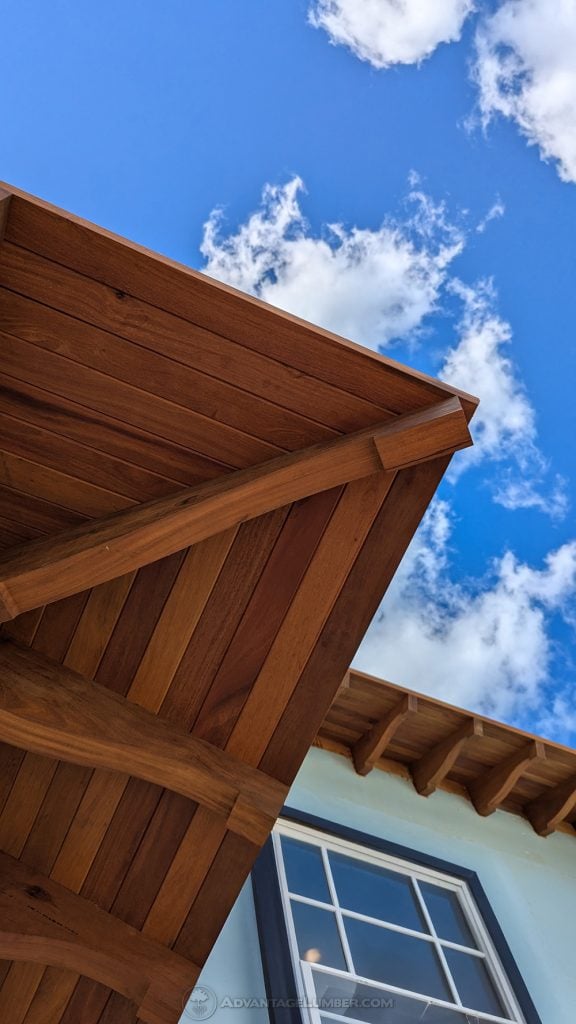
We recommend Cumaru when someone loves the look Ipe gives, although they want a little more color variation and a board that works a little easier.
In fact, it carries the same family of strengths: density, natural oils, and strong outdoor performance. Even so, the grain runs a bit wilder. Some boards, for example, run golden. Others, by contrast, lean reddish brown. On a soffit, as a result, that variation can look great, especially in a v-groove or T&G profile where the pattern repeats across a ceiling.
Like Ipe, however, Cumaru does not love film forming finishes. Therefore, use an UV blocking oil such as Ipe Oil for exotic hardwoods if you want to keep the original color. If you let it go, though, it will gray out just like the deck.
3. Tigerwood
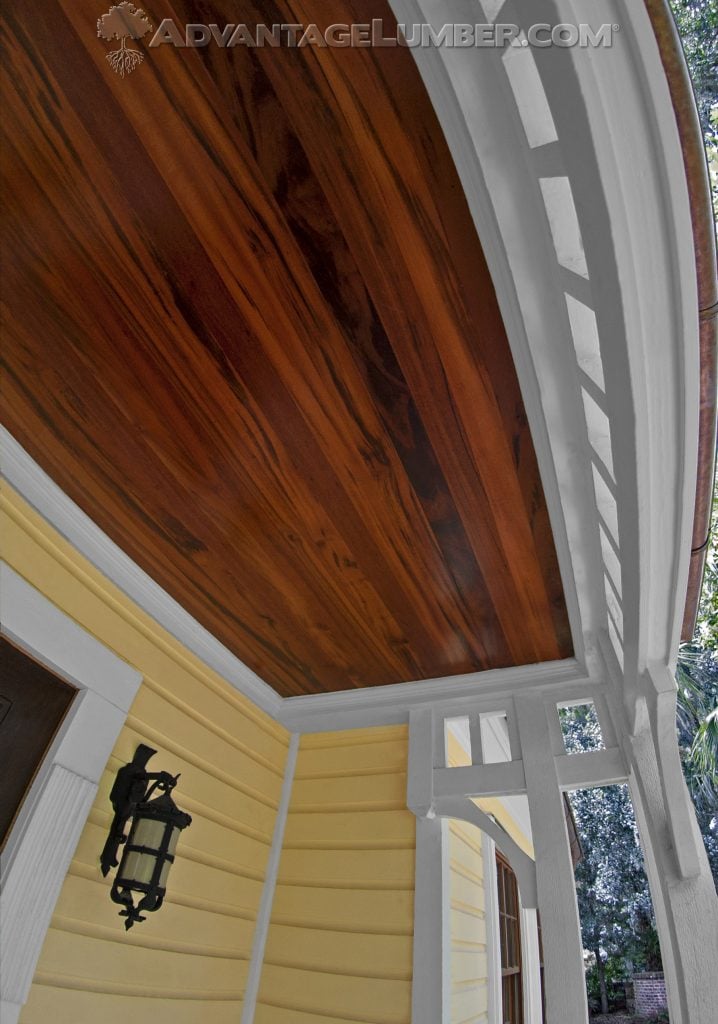
Choose Tigerwood when you want people to see the soffit.
Indeed, the dark streaks sit against a reddish gold background and look dramatic. On a porch ceiling, as a result, that figure reads as custom millwork, not builder grade trim. At the same time, it is still a dense tropical hardwood. Consequently, it holds up outdoors far better than a pretty domestic board with similar figure.
The downside, however, is consistency. After all, Tigerwood is not a quiet, uniform wood. So if the rest of the house stays very restrained, the soffit can steal the show. In the end, that is either the point or a problem, depending on the design.
4. Garapa
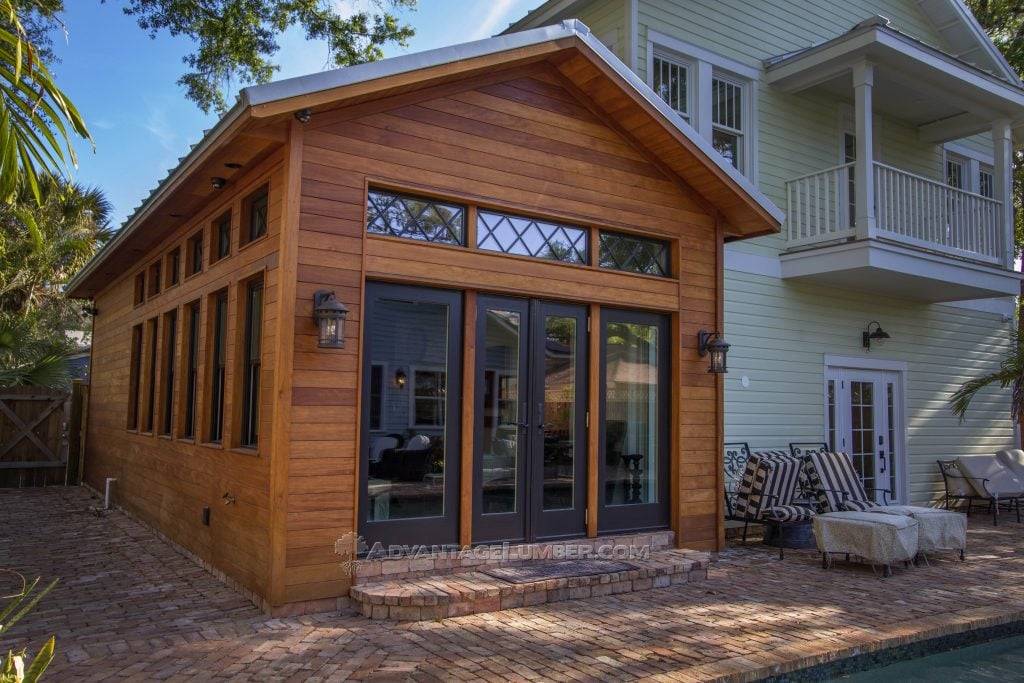
Garapa is the lightest of the common Brazilian decking species. As a result, that is exactly why it works so well as a soffit.
For one thing, a pale gold ceiling under dark siding or a dark roof line can brighten a porch without paint. At the same time, Garapa is still a hardwood. Indeed, it still lasts outdoors. Moreover, it still beats cedar if you want low upkeep. Even so, it is just not as brutally hard as Ipe. As a result, cutting and fastening stay a little less punishing.
If the house already has Garapa decking or railing, then match the soffit. In that case, the whole outdoor room will feel like one material.
5. Brazilian Redwood (Massaranduba)
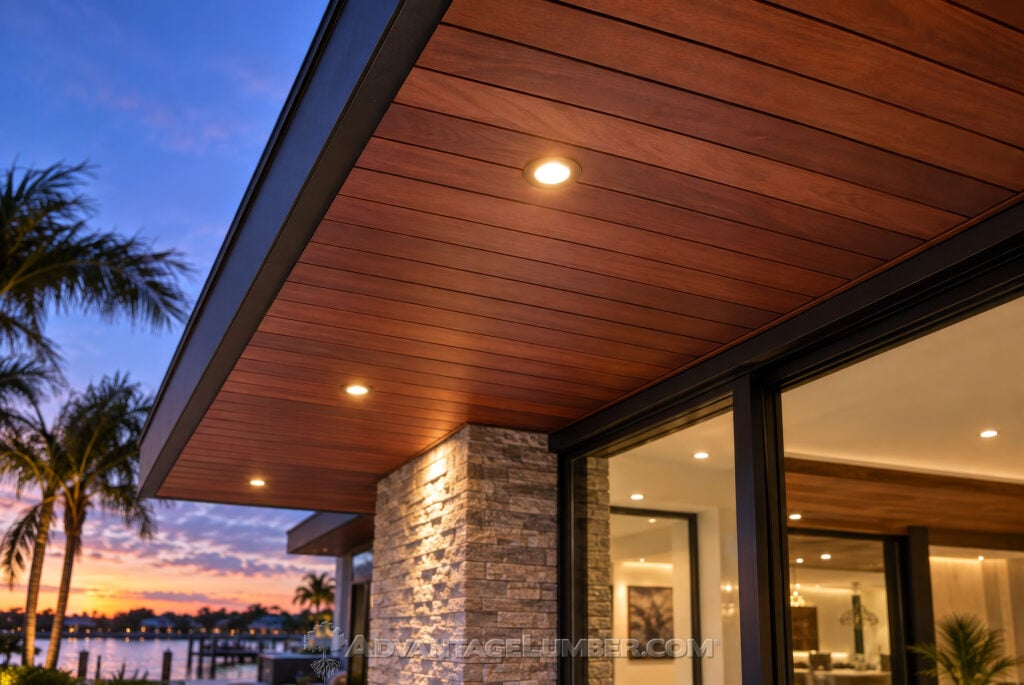
Sellers often call Massaranduba Brazilian redwood. Even so, the name is fair. Fresh boards, after all, show a deep reddish brown that looks expensive the minute they go up.
Meanwhile, it stays dense and durable. As a result, it fits exterior ceilings, fascia, and trim on high end homes. At the same time, the color runs richer than most Ipe and less striped than Tigerwood. Consequently, it sits somewhere in the middle visually.
The same rules, however, apply as the other exotics. Oil it, then, if you want to keep the red. Leave it alone, on the other hand, if you are fine with gray. In any case, do not expect latex paint to stick.
6. Mahogany (Red Balau)
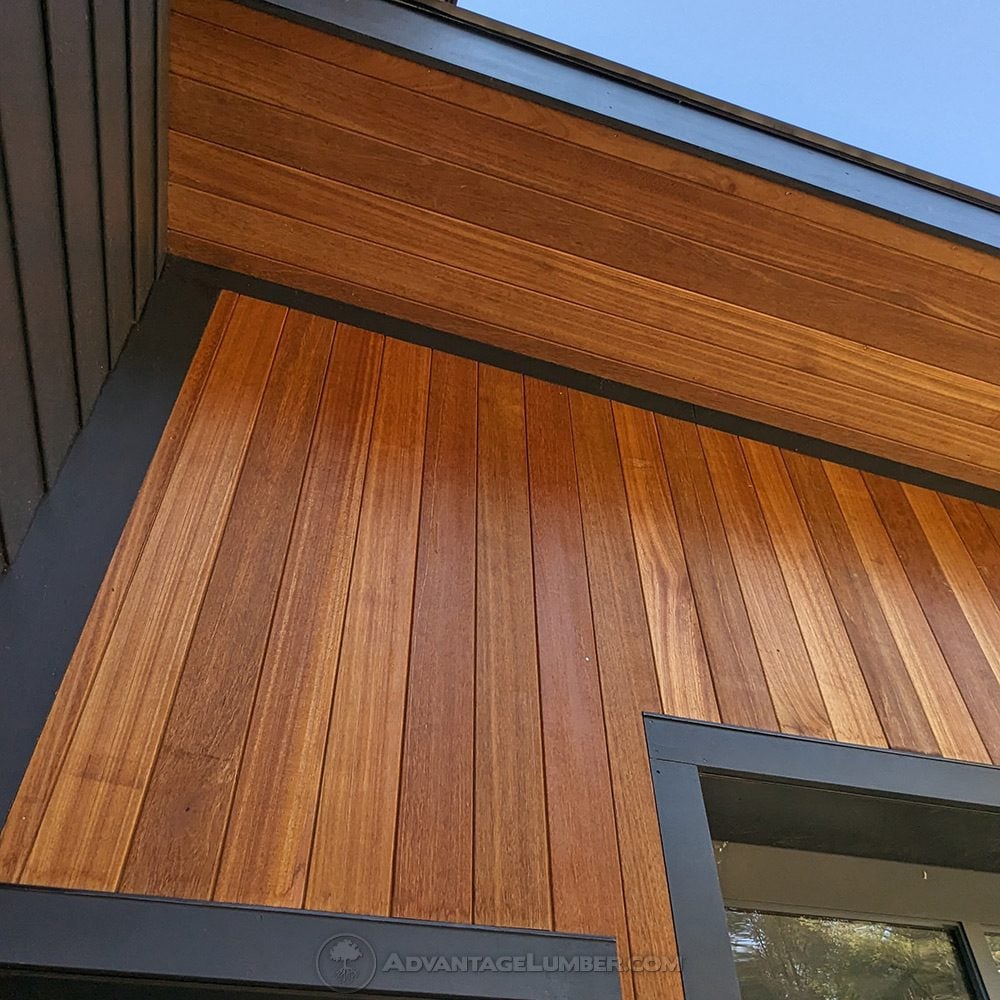
When people say mahogany for exterior work, they often mean Red Balau, not the furniture grade genuine mahogany that belongs indoors.
Red Balau, for its part, shows a fine, even grain and a warm reddish brown color that looks traditional on porches and Craftsman style homes. In addition, it lasts well enough for soffits. At the same time, it looks much more refined than a knotty softwood. So if you want a classic wood ceiling that still performs outside, this is one of the better hardwood options.
It is not, however, quite as hard or as rot proof as Ipe. In a protected soffit, even so, that usually does not matter. In a wet eave you cannot ventilate well, though, choose Ipe, teak, or thermally modified ash instead.
7. Western Red Cedar
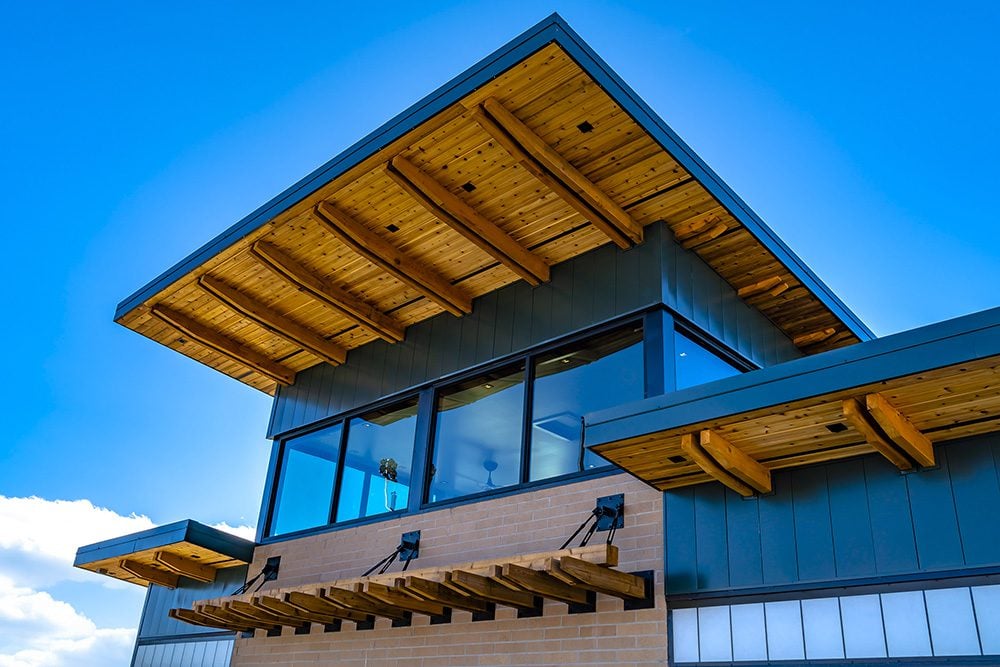
Cedar is still the standard for a reason.
For one thing, it stays light. In addition, you can cut it easily, stain it, or paint it. At the same time, its oils help it resist decay. On a soffit, therefore, those qualities matter. After all, you often work overhead. As a result, a 1x T&G cedar board is a lot friendlier to install than a 5/4 Ipe board.
Cedar will not, however, last like Ipe if you ignore it. Moreover, it dents more easily. Likewise, it needs a finish if you want to keep the color. Even so, you gain workability and that familiar, warm look people associate with porches.
If you will paint the soffit, then, cedar usually beats any of the tropical hardwoods. Indeed, paint sticks. At the same time, the wood stays stable enough in a protected location. As a result, you are not fighting density and natural oils the way you would with Ipe.
8. Thermally Modified Ash
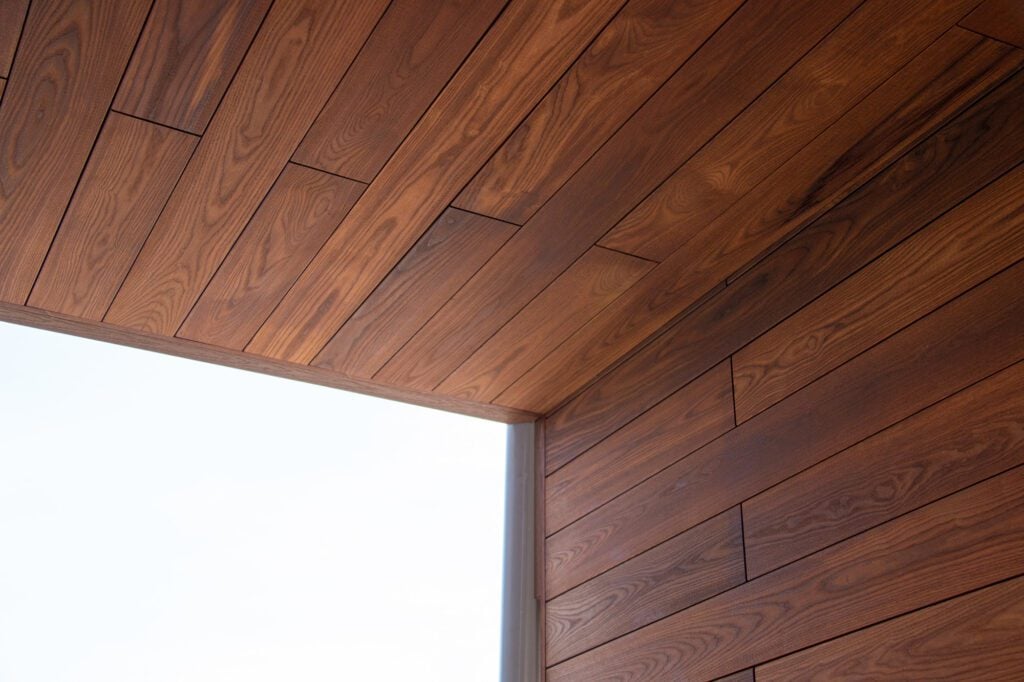
We reach for thermally modified ash when someone wants a hardwood look without tropical density, and without the movement untreated domestic boards give.
The process, in fact, is straightforward in concept: mills heat the wood in a controlled, low oxygen environment until they cook out the sugars rot and insects feed on. As a result, you get back real ash, just darker, more stable, and much more durable outdoors than the original board.
For soffits, meanwhile, that stability matters. Ash, after all, already machines cleanly. After thermal modification, therefore, it is less likely to cup or twist in a boxed eave. At the same time, the color usually lands in a rich brown that looks closer to walnut than pale ash. Consequently, it works so well on modern porch ceilings and rainscreen details.
It cuts and fastens, moreover, more easily than Ipe. In addition, it resists rot better than raw cedar. It is not, however, maintenance free if you want to keep the dark color. Even so, it can still gray if you leave it unfinished. In a protected soffit, though, it is one of the better middle ground materials you can buy.
9. Plantation Teak
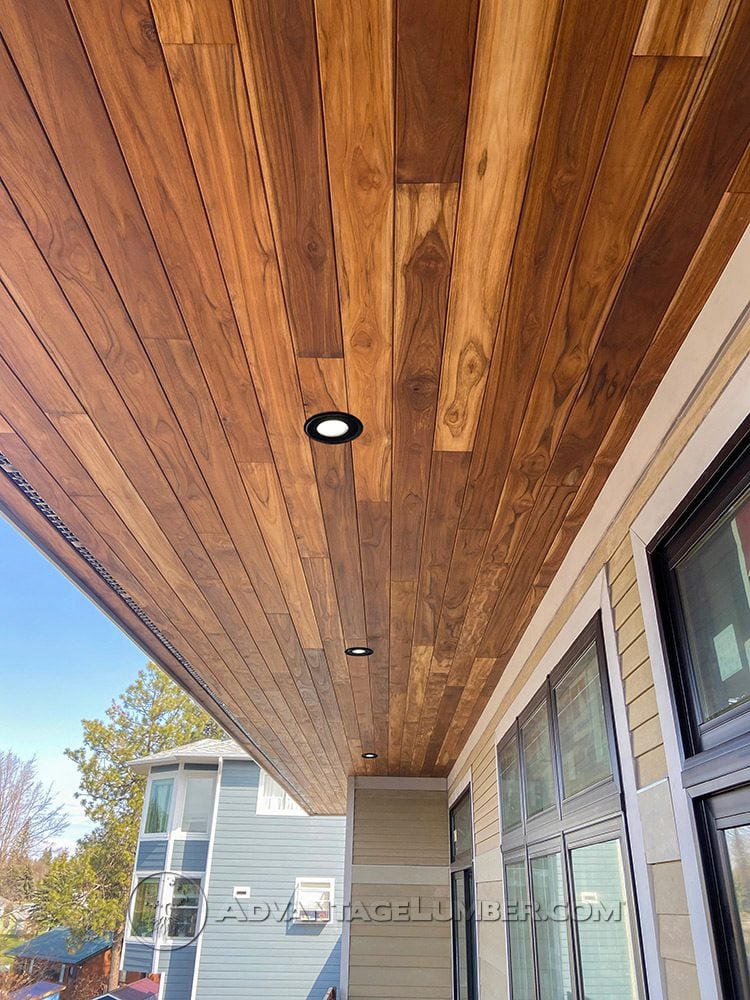
Teak has a reputation a lot of woods try to borrow. Plantation teak, however, is the version that actually shows up in real building packages without the old growth price and supply problems.
Good plantation teak, indeed, still has the oily, tight grain that made teak famous on boats and outdoor furniture. As a result, that oil is why it resists moisture and decay so well, even in a soffit that sees humid air and the odd splash of rain. Meanwhile, the color starts golden to medium brown. After that, it weathers toward silver if you do not oil it.
On a porch ceiling, then, teak looks refined rather than rustic. In fact, the grain usually stays quieter than Tigerwood and warmer than Garapa. At the same time, it also works well when you want the soffit to match teak decking, benches, or an outdoor kitchen.
Still, the honest caveats remain. For one thing, quality varies by plantation and mill. Therefore, buy consistent, kiln dried stock with a real outdoor grade, not a furniture leftover. Teak, on one hand, works more easily than Ipe. On the other hand, it can still stay oily enough to make some finishes fussy. And like the other premium hardwoods, in any case, it is a poor candidate for paint.
If the project is high end and the soffit is part of the architecture, then plantation teak is one of the few woods that looks expensive and performs like it.
What Actually Matters on a Soffit
Species, however, is only part of the decision.
Ventilation still counts. A soffit can, after all, trap moisture against framing if the eave is boxed in tight and never dries. Therefore, keep air moving behind or through the soffit. In a wet climate, as a result, that is not optional.
Profile changes the look more than people expect. Tongue and groove, for example, gives you a tight ceiling. V-groove, by contrast, adds shadow lines. Meanwhile, wider boards look more contemporary. Narrower boards, on the other hand, look more traditional and stay a little more stable.
Match the rest of the exterior if you can. An Ipe deck with a vinyl soffit, after all, always looks unfinished. An Ipe deck with an Ipe or Cumaru porch ceiling, however, looks designed. The same, likewise, is true for teak and thermally modified ash.
Finish is a choice, not a requirement. Hardwood soffits can, in fact, gray out and still perform. Cedar, by contrast, usually looks better after you stain or paint it. Thermally modified ash, meanwhile, will hold color longer after you oil it. Even so, it does not have to be coated to last in a protected location. Therefore, decide that before the boards go up. After all, the first coat is easier on sawhorses than on a ladder.
A soffit will not make a bad house good. Even so, the right wood can make a good house look complete. In the end, that is the whole point.
