
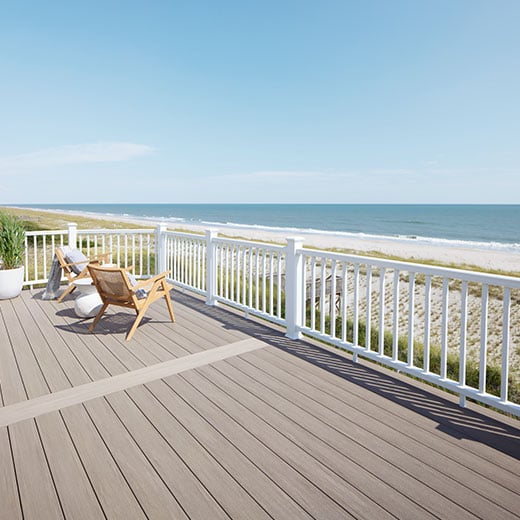
When homeowners research low maintenance decking options, PVC decking often gets positioned as the premium choice. It’s 100% synthetic, completely waterproof, and backed by long warranties. But is it always the better option compared to composite decking?
The short answer: No. While PVC excels in specific high moisture or high maintenance scenarios, composite decking frequently offers better value, more natural aesthetics, and easier installation for many homeowners. The right choice depends on your climate, budget, design goals, and how you’ll use the space.
At AdvantageLumber.com, we carry both high performance PVC options (like TimberTech® PVC) and premium composite lines (like Trex®), along with our signature exotic hardwood decking. Here’s a clear breakdown to help you decide.
What’s the Difference in Composition?
- PVC Decking: Made entirely from polyvinyl chloride (a type of plastic) with no wood fibers. It’s a solid or cellular PVC material designed for maximum moisture resistance.
- Composite Decking: A blend of wood fibers (often recycled) and plastic resins, usually with a protective polymer cap on one or more sides. The wood content gives it more rigidity and weight.
This fundamental difference drives most of the performance variations.
Pros and Cons of PVC Decking
Pros:
- Superior waterproofing — 100% moisture proof with zero absorption, making it highly resistant to mold, mildew, rot, and swelling.
- Excellent fade and stain resistance — Holds color better in intense sunlight; many lines offer 50-year fade/stain warranties.
- Low maintenance — Typically just occasional soap and water cleaning. No sealing or staining required.
- Cooler underfoot — Many modern PVC products (with “cool touch” technology) stay noticeably cooler than composite in direct sun.
- Scratch and stain resistant — Great for high-traffic areas, pets, or furniture.
- Lightweight — Easier to handle and transport during installation.
Cons:
- Higher upfront cost — Usually $8–$15+ per square foot (installed), significantly more than most composites.
- Less natural appearance — More uniform, “plastic” look and feel compared to wood grain composites.
- Harder to work with — Difficult to rip, route, or make custom cuts on site. Requires closer joist spacing in some cases due to potential deflection.
- Temperature movement — Can expand and contract more with extreme temperature swings.
- Potential slipperiness — Some users report it feels slicker when wet (though textured versions help).
Pros and Cons of Composite Decking
Pros:
- More affordable — Typically $5–$10 per square foot, offering strong performance at a lower entry price.
- Realistic wood look and feel — Embossed wood grain textures and warmer underfoot feel make it closer to natural hardwood.
- Easier to install — More flexible; can be ripped, routed, and bent more easily for custom designs or curves.
- Solid, stable feel — Heavier construction often results in less bounce and a more substantial deck.
- Good slip resistance — Textured surfaces generally provide better grip, especially when wet.
- Eco-friendly appeal — Many use high percentages of recycled wood and plastic content.
Cons:
- Some moisture absorption — Even capped composites can take on a small amount of water over time, increasing risk of mold or swelling in very wet conditions.
- More fading and staining potential — Generally shorter warranties (25–50 years depending on tier) and can show wear faster in harsh sun.
- Gets hotter — Darker colors can become uncomfortably hot in direct sunlight.
- Heavier to handle — More challenging for DIYers or tight access job sites.
- Variable quality — Lower-tier composites can perform noticeably worse than premium capped versions.
Where PVC Decking Is Usually the Better Choice
PVC shines when moisture is a constant factor:
- Pool decks, hot tubs, and waterfront properties
- Coastal or high humidity climates (e.g., Pacific Northwest, Florida, coastal areas)
- Areas with intense, year round sun exposure
- High traffic commercial or rental properties where maximum durability and minimal upkeep are priorities
- Situations where the longest possible warranty and fade resistance matter most
Where Composite Decking Is Often the Smarter Pick
Composite wins on value and versatility for many residential projects:
- Budget conscious homeowners who still want low maintenance
- Decks in moderate or shaded climates where extreme moisture isn’t a daily issue
- Designs requiring custom cuts, angles, or curves
- Homeowners who prioritize a warm, natural wood like appearance and feel
- Projects where balancing upfront cost with solid long term performance is key
Making the Right Choice for Your Project
| Factor | PVC Decking | Composite Decking | Winner Depends On… |
|---|---|---|---|
| Moisture Resistance | Excellent | Very Good | Wet climates → PVC |
| Aesthetics | Modern, uniform | Natural wood grain | Natural look → Composite |
| Upfront Cost | Higher | Lower | Budget → Composite |
| Maintenance | Very Low | Low | Tie |
| Heat Retention | Cooler | Warmer (can get hot) | Hot sun → PVC |
| Ease of Installation | More difficult | Easier | Custom work → Composite |
| Warranty | Often 50 years | 25–50 years | Longevity → PVC |
Bottom line: PVC isn’t universally “better” than composite — it’s simply optimized for different conditions. Many homeowners are perfectly happy (and save money) with high quality composite decking, especially when paired with proper installation and a good cap layer.
At AdvantageLumber.com, we help customers choose the best material for their specific needs. Whether you’re leaning toward premium TimberTech PVC, a top-tier Trex, Deckorators or TimberTech composite, or the unmatched beauty and longevity of our exotic hardwood decking (Ipe, Cumaru, Teak, and more), we ship direct to your home or job site with expert guidance.
Ready to compare options for your project? Contact our decking specialists or browse our full selection of hardwood and synthetic decking at AdvantageLumber.com. Your perfect outdoor space starts with the right material.
