
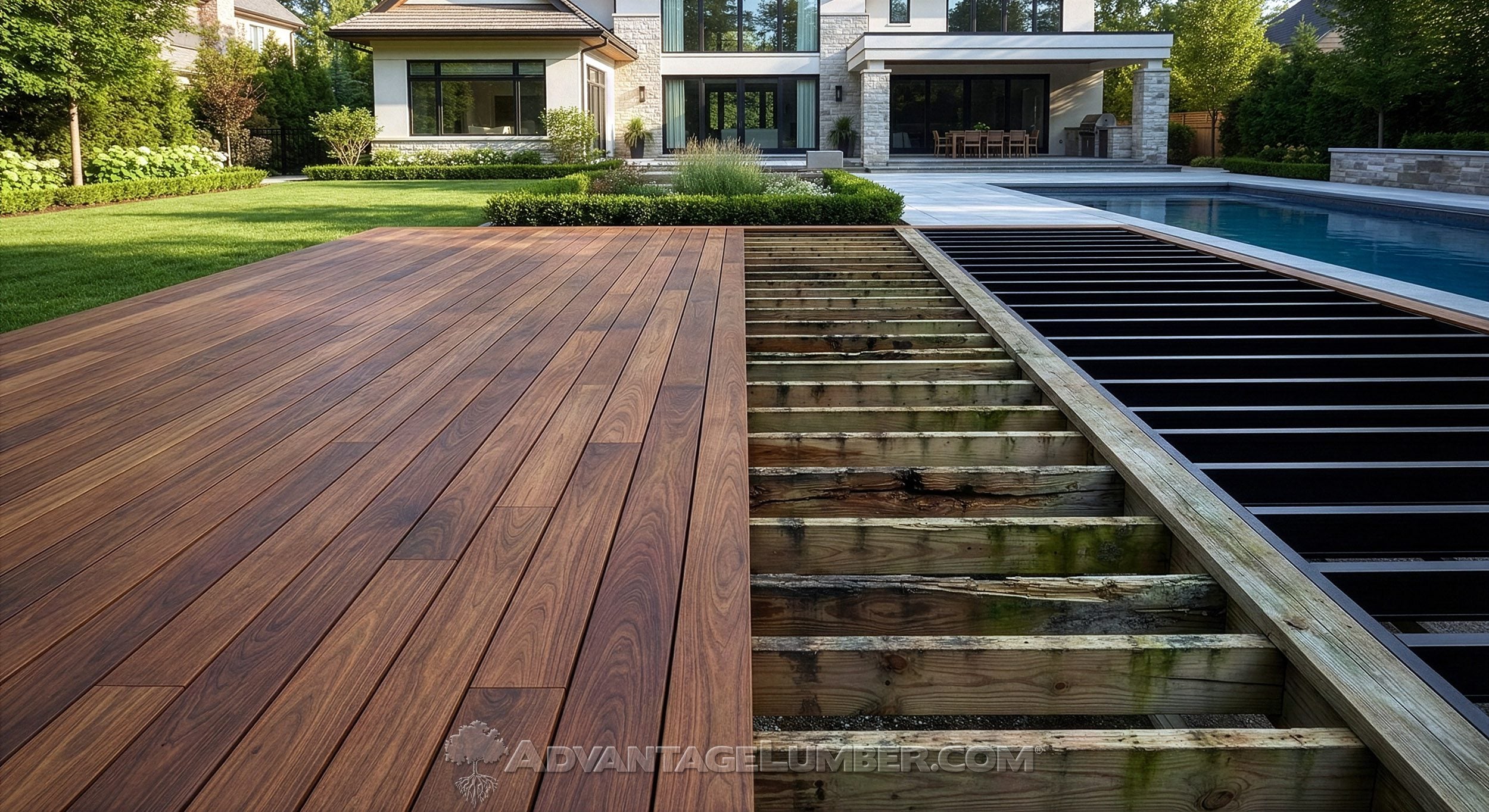
You spent good money on beautiful, long lasting deck boards. But what happens when the wood holding them up starts rotting years before the decking wears out?
It’s a problem I’ve seen more often than you’d think, especially with decks that use premium hardwoods like Ipe, Cumaru, and Teak. Homeowners spend thousands of dollars upgrading to decking materials that can last 40, 50, or even 75 years. Then, underneath all that beautiful wood, there’s a frame built from ordinary pressure treated pine that may start showing signs of serious decay in just 10 to 15 years.
Doesn’t make much sense, does it?
Unfortunately, it’s a pretty common mistake in deck construction. And although pressure treated lumber has been the go to framing material for decades, today’s decking materials have changed quite a bit. The way we build the structures underneath them needs to catch up.
Let’s look at why deck frames sometimes fail prematurely, what causes the damage, and how you can build a deck that won’t need major structural repairs long before the decking itself wears out.
Your Deck Boards Might Outlive the Structure Holding Them Up
Think about how much attention people give their decking material.
They’ll spend weeks comparing Ipe versus composite, looking at different Trex colors, researching TimberTech warranties, and deciding whether they want hidden fasteners or traditional deck screws.
But when it’s time to discuss the framing?
“Just use pressure treated lumber.”
That’s usually where the conversation ends.
Now, don’t get me wrong. Pressure treated pine has its place. It’s affordable, readily available, and can provide years of service when you build with it correctly.
However, there’s a pretty big difference between building a deck with inexpensive pressure treated boards and building one with premium materials that could last half a century or longer.
For example, consider the potential lifespan of some popular decking materials:
| Decking Material | Potential Service Life |
|---|---|
| Ipe Hardwood | 50–75+ years |
| Cumaru Hardwood | 40–50+ years |
| Plantation Teak | 40–50+ years |
| Tigerwood Hardwood | 30+ years |
| Garapa Hardwood | 25–40+ years |
| Premium Composite Decking | Often backed by 25–50-year limited warranties |
| Premium PVC Decking | Often backed by 30–50-year limited warranties |
These are general estimates under suitable conditions, not guaranteed lifespans. Actual performance depends on climate, installation, maintenance, and product specifications. Manufacturer warranty periods aren’t necessarily predictions of service life.
Here’s where things get interesting.
While your premium deck boards may still look fantastic after 20 years, the pressure treated joists underneath could already be experiencing significant moisture damage.
I’ve always felt that if you’re investing in a premium deck, you should put just as much thought into the framing as you do the boards on top.
After all, nobody wants to tear apart a perfectly good Ipe deck because the structure underneath has become unsafe.
Why Doesn’t Pressure Treated Lumber Last as Long as It Used To?
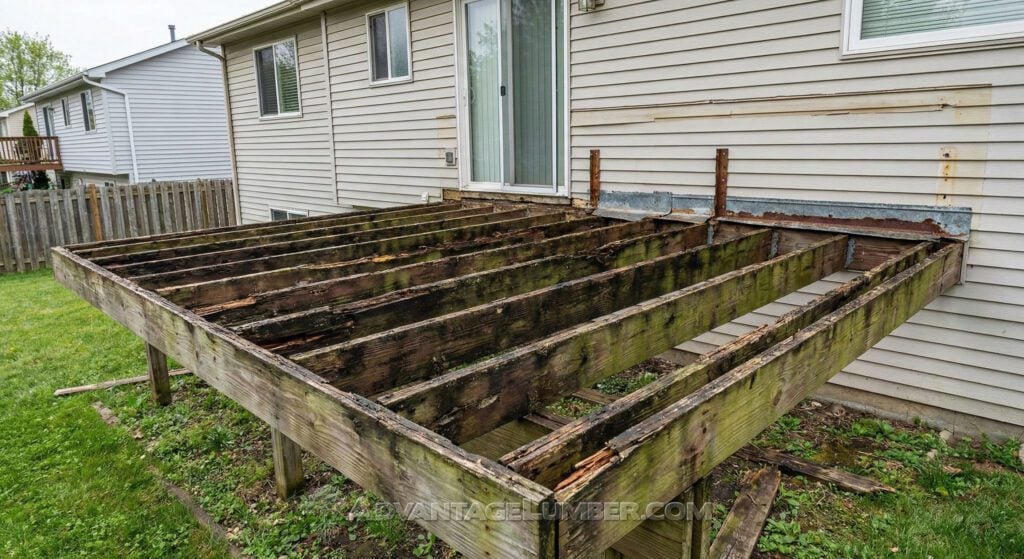
If you talk to an experienced carpenter who’s been building decks for 30 or 40 years, you might hear something interesting.
They’ll tell you that some older pressure treated lumber seemed to hold up better than the material they’re buying today.
There’s some history behind that observation.
Pressure Treated Lumber Formulas Have Changed
Years ago, much of the pressure treated lumber used for residential decks contained chromated copper arsenate, commonly called CCA.
CCA treated lumber was widely used because it offered strong resistance against fungal decay and wood destroying insects.
However, concerns about arsenic exposure led the lumber industry to voluntarily discontinue CCA for most residential uses beginning in 2004.
Today, residential pressure treated lumber typically uses alternative preservatives, including alkaline copper quaternary (ACQ), copper azole (CA), and micronized copper formulations.
These modern preservatives can provide excellent protection when manufacturers treat the lumber to the appropriate standard and builders use it correctly.
Still, not all pressure treated lumber is created equal.
The amount of preservative, the treatment process, the wood species, and the intended exposure conditions all play a role in how long the material lasts.
For example, lumber rated for above ground use isn’t necessarily the best choice for framing that’s constantly exposed to moisture or has limited airflow.
And that’s where some deck builders get into trouble.
Today’s Fast Growing Pine Can Create Additional Challenges
Another factor worth discussing is the lumber itself.
A lot of construction lumber comes from managed pine plantations where trees grow relatively quickly.
Fast growing trees can produce different proportions of juvenile wood and mature wood, which may affect dimensional stability and other physical properties.
However, fast growth alone doesn’t mean the wood will rot faster. Preservative penetration, treatment retention, moisture exposure, and construction details matter far more when it comes to decay resistance.
Nevertheless, anyone who’s worked with enough construction lumber knows that quality can vary considerably from one board to another.
Some pieces are straight, dense, and easy to work with. Others twist, cup, or develop substantial checking as they dry.
Those cracks can also create places where water collects, especially when they face upward on horizontal framing members.
Over time, that becomes another potential problem.
The Biggest Enemy of Your Deck Frame Is Trapped Moisture
Here’s something every homeowner should understand.
Pressure treated lumber is decay resistant, not waterproof.
That’s an important distinction.
The preservatives help protect the wood against organisms that cause decay, but they don’t stop the lumber from absorbing moisture.
And if the wood stays wet long enough, especially where treatment protection is inadequate, decay can eventually develop.
Think about what happens every time it rains.
Water runs through the gaps between your deck boards and lands directly on the framing underneath.
Some of that water drains away. Some evaporates.
But a portion can sit on top of the joists, particularly where the decking boards make contact with the framing.
The Top of Your Joists Takes a Beating
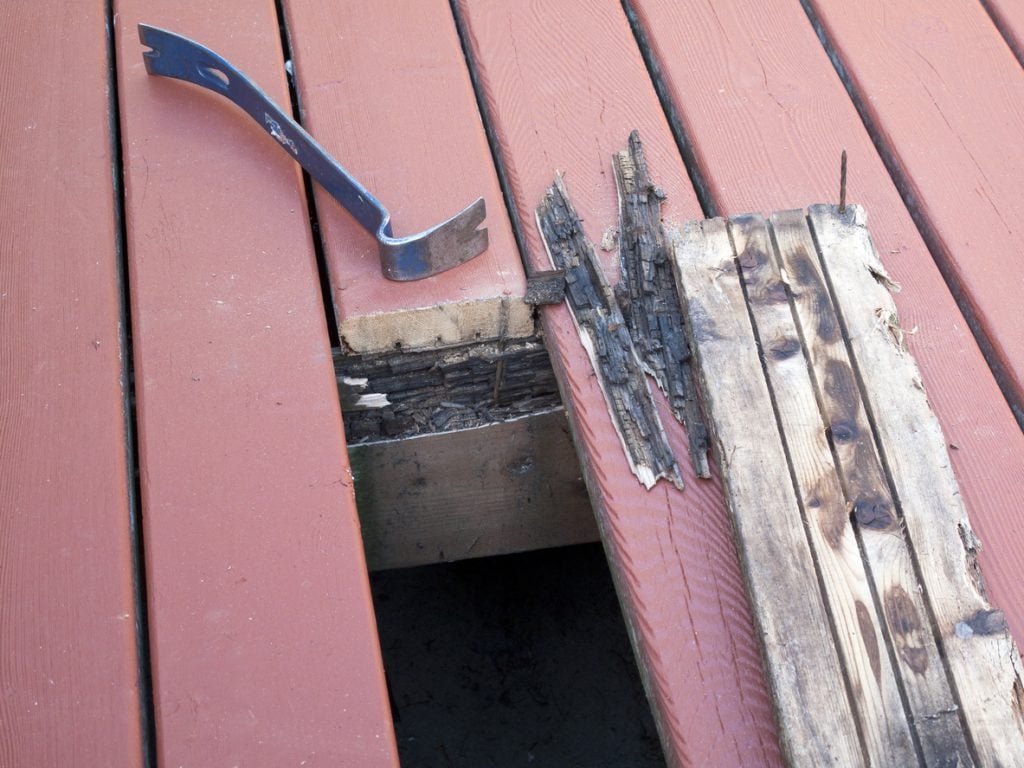
One of the most vulnerable places on a traditional wood deck frame is the top surface of the joists.
Why?
Because the decking boards sit directly against them.
That contact can create narrow spaces where moisture lingers after a rainstorm.
Now add a few other factors:
- Leaves and debris collecting between deck boards
- Shaded areas that receive very little sunlight
- Poor ventilation underneath the deck
- Snow sitting on the decking throughout winter
- Repeated wetting and drying cycles
- Fastener holes that allow moisture into the wood
Suddenly, you’ve got a pretty harsh environment for any wood product.
Even pressure treated lumber can struggle when those conditions continue year after year.
And here’s something that surprises a lot of homeowners: the top of a joist may experience serious decay while the sides still look relatively healthy.
You might not notice the problem until deck boards start feeling loose or fasteners no longer hold properly.
Ledger Boards Can Be an Even Bigger Problem
If there’s one part of a deck frame that deserves extra attention, it’s the ledger board.
The ledger connects many attached decks to the house, and improper installation can create both moisture problems and serious structural hazards.
Without proper flashing, water can work its way behind the ledger and damage the wood or even the house framing.
I’ve seen homeowners focus on replacing a few rotten deck boards when the much bigger concern was the connection between the deck and the house.
That’s not something you want to overlook.
Proper flashing, compatible fasteners, correct structural connections, and appropriate water management are essential.
And if you suspect ledger deterioration, have a qualified professional inspect the connection before using the deck.
Composite Decking Doesn’t Prevent Your Wood Frame From Rotting
This is another misconception I hear occasionally.
Some homeowners assume that because composite decking doesn’t rot like ordinary wood, the entire deck will be protected against decay.
Unfortunately, that’s not how it works.
Let’s say you install a beautiful new Trex or TimberTech deck over a traditional pressure treated wood frame.
The composite or PVC boards may resist moisture related deterioration extremely well. Many premium collections also carry lengthy manufacturer warranties.
But underneath those boards, your wood joists still experience rain, humidity, condensation, and seasonal moisture changes.
In fact, the low maintenance nature of composite decking can sometimes make it easier to overlook what’s happening below.
The surface looks great, so homeowners assume everything underneath must be fine.
Meanwhile, the frame could be developing problems that aren’t visible from above.
This is one reason I always recommend inspecting the framing whenever someone plans to replace an older wood deck with composite decking.
If you’re going to spend thousands of dollars on premium new boards, make sure the structure underneath has enough remaining service life to justify the investment.
Otherwise, you might be putting a brand new deck surface on a frame that’s already halfway through its useful life.
How Long Does a Pressure Treated Deck Frame Actually Last?
This is where things get a little tricky.
There’s no single answer because climate, construction quality, wood treatment, and maintenance can make an enormous difference.
Some pressure treated deck frames can last 25 years or longer, especially when they’re properly designed, well ventilated, and kept reasonably dry.
Others may develop serious decay in just 10 to 15 years. In particularly harsh conditions, problems can show up even sooner.
For example, consider two decks.
One sits several feet above the ground in a relatively dry climate. It gets plenty of airflow underneath, and the builder carefully flashed the ledger and protected the framing.
The other sits close to the ground in a humid coastal environment. There’s little ventilation, wet leaves collect between the boards, and the joists stay damp for days after a storm.
Even if both decks use pressure treated pine, I wouldn’t expect them to age the same way.
That’s why I don’t like making blanket claims about how long a pressure treated deck frame will last.
What matters most is how well the entire system handles moisture over time.
Five Ways to Build a Deck Frame That Lasts Longer
The good news is that you have several options if you want your deck structure to last longer.
And no, you don’t necessarily need to spend a fortune.
Some improvements are relatively inexpensive, especially when you incorporate them into the original construction.
1. Use Joist Tape on Pressure Treated Framing
If you’re building a traditional wood deck frame, joist tape is one of the simplest upgrades worth considering.
Products such as DeckWise JoistTape™ create a protective barrier along the tops of joists and other framing members.
The idea is pretty straightforward.
Instead of allowing water to sit directly against the top of the wood, the tape helps shed moisture away from that vulnerable surface.
It can also help protect the areas around fastener penetrations, depending on the product and installation.
Think of it as an additional layer of defense for the parts of your framing that take the most abuse.
Is joist tape a guarantee against rot? Of course not.
But when you install it correctly over suitable, dry framing, it’s a relatively affordable way to reduce moisture exposure.
For homeowners building with pressure treated lumber, I think it’s an upgrade that’s well worth considering.
2. Upgrade to Steel Deck Framing
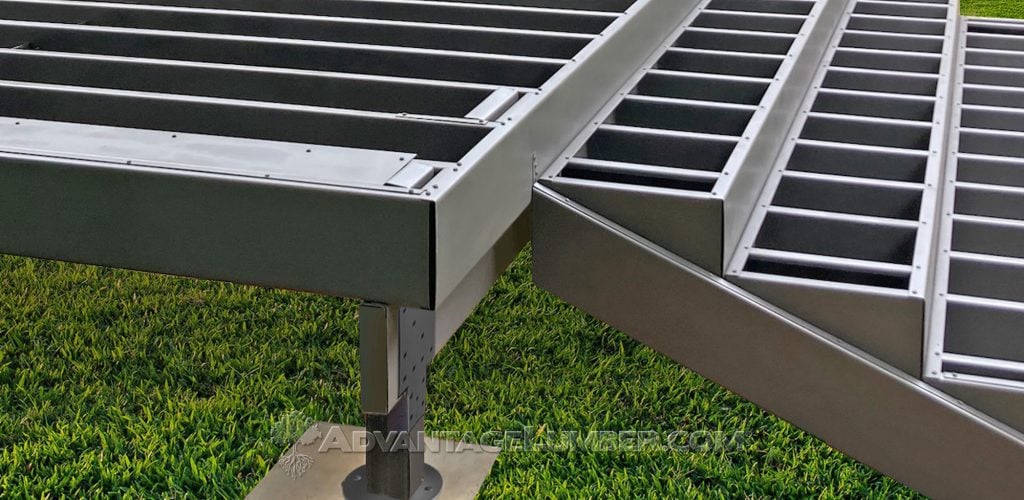
Now we’re talking about one of my favorite options for premium deck construction.
If you’re planning to install Ipe, Cumaru, Teak, or another long lasting decking material, why not consider a frame that can offer a similarly long service life?
Steel deck framing eliminates the concern of fungal wood rot in the framing members themselves.
At AdvantageLumber.com, we offer New Castle Steel deck framing, which uses galvanized steel with protective coatings designed to resist corrosion.
Unlike traditional wood framing, steel won’t warp, twist, or develop fungal decay.
It also provides consistent dimensions, something contractors tend to appreciate when they’re trying to create a perfectly flat deck surface.
And if you’ve ever tried to straighten a badly twisted pressure treated joist, you know exactly what I’m talking about.
Steel framing can be particularly attractive for:
- Premium hardwood decks
- Long lasting composite and PVC decks
- Elevated deck structures
- Projects where straight, consistent framing matters
- Homeowners who want to minimize future structural maintenance
Of course, steel still requires proper engineering, compatible corrosion resistant connections, and appropriate protection for the exposure conditions.
Coastal environments, in particular, deserve careful consideration.
Still, for a high end deck where longevity matters, steel framing deserves a serious look.
3. Consider Aluminum Deck Framing
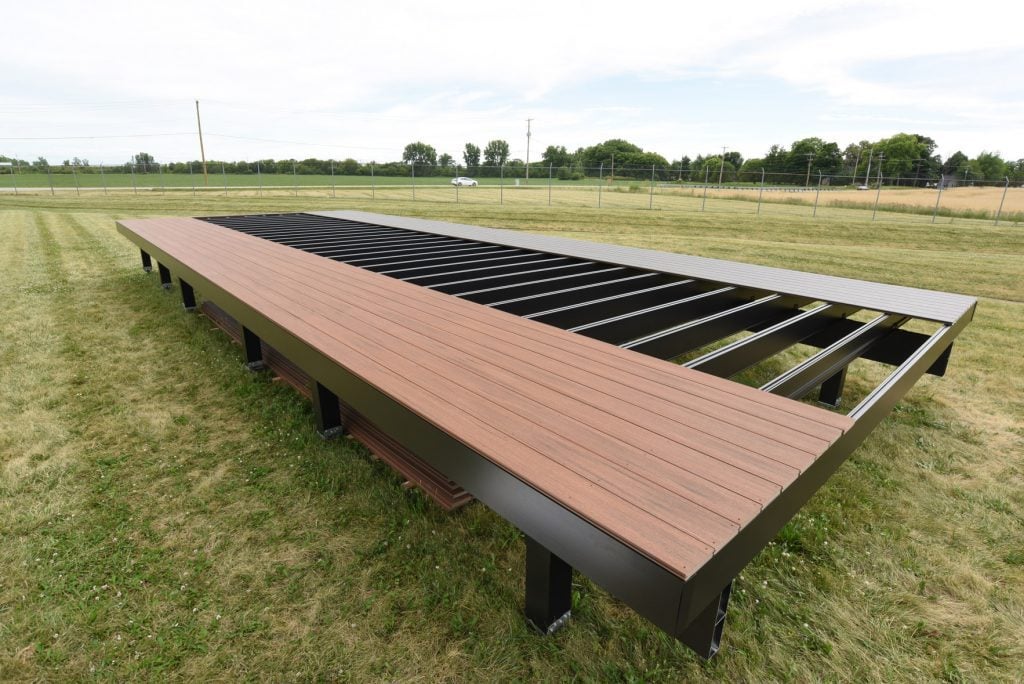
Another excellent alternative is aluminum framing.
Systems such as TimberTech aluminum framing and Outdure aluminum framing offer a completely different approach from traditional wood construction.
Aluminum doesn’t experience fungal decay, and its corrosion resistance makes it attractive for many outdoor environments.
It’s also lightweight, dimensionally stable, and well suited for certain premium decking applications.
For homeowners near the coast or around swimming pools, aluminum can be especially appealing.
Now, that doesn’t mean every aluminum framing system is appropriate for every deck.
You still need to account for structural spans, loads, fastener compatibility, local building codes, and the manufacturer’s installation requirements.
However, when properly designed and installed, aluminum framing can provide a durable foundation for a long lasting deck.
4. Look Into Treated LVL Deck Framing

Not every framing upgrade needs to involve metal.
Another option worth considering is treated laminated veneer lumber, or LVL, designed and approved for exterior deck applications.
Products such as PWT Treated LVL combine engineered wood construction with preservative treatment.
One advantage is dimensional consistency.
Traditional sawn lumber can twist, crown, and warp as moisture conditions change. Engineered LVL products generally offer more predictable dimensions and structural properties.
However, don’t confuse exterior rated treated LVL with ordinary interior LVL.
The treatment, approved exposure conditions, installation details, and manufacturer’s specifications matter.
When you use the correct product for the application, treated LVL can be a useful alternative for deck framing and beams.
5. Give Your Deck Room to Breathe
Sometimes the best improvement isn’t a new material.
It’s better deck design.
Wood framing performs much better when moisture can drain away and the structure can dry after rain.
That’s why I pay close attention to ventilation, drainage, and ground clearance.
A deck that sits inches above wet soil faces a very different environment from one that’s elevated several feet above the ground.
If you’re building a low clearance deck, don’t assume traditional wood framing is automatically the best choice.
You may want to consider a different structural system or, when installing over a suitable concrete surface, a properly designed sleeper system or deck tile installation.
Also, avoid trapping moisture underneath your deck with landscaping, debris, or poorly placed skirting.
A little airflow can make a meaningful difference over time.
Wood vs. Steel vs. Aluminum Deck Framing: Which Lasts Longer?
Here’s a quick comparison of common framing options.
| Framing Material | Main Advantages | Main Considerations |
|---|---|---|
| Pressure Treated Pine | Affordable, widely available, familiar to contractors | Can decay, warp, and twist; lifespan varies considerably |
| Pressure Treated Pine With Joist Tape | Lower cost framing with added moisture protection | Still requires proper drainage, ventilation, and maintenance |
| Treated LVL | Consistent dimensions, engineered strength, preservative protection | Must be specifically approved for exterior deck use |
| Galvanized Steel | Won’t suffer fungal rot, strong, dimensionally consistent | Requires corrosion protection and compatible connections |
| Aluminum | Won’t suffer fungal rot, lightweight, corrosion resistant | Higher initial material cost; system specific engineering |
Although steel and aluminum typically cost more upfront than pressure treated pine, their longer term value can be attractive.
Especially when you consider what it costs to replace a failed deck frame.
And that’s something homeowners don’t always calculate when comparing decking estimates.
The Hidden Cost of Replacing a Rotten Deck Frame
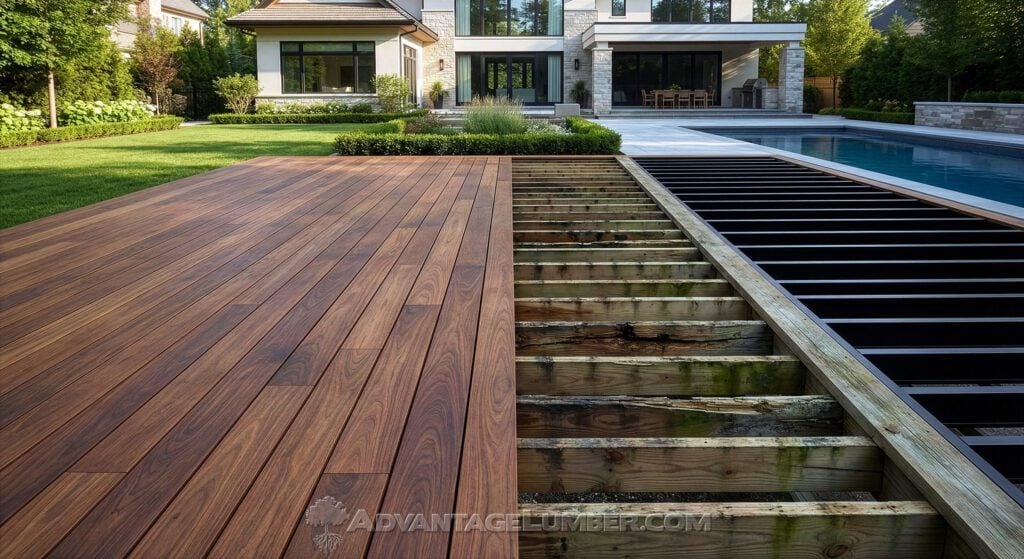
Let’s say you install a beautiful Ipe deck. Twenty years later, the boards still have decades of potential service life remaining.
But the pressure treated framing underneath has deteriorated to the point where it needs replacement.
What happens next?
Well, replacing the frame isn’t quite as simple as sliding a few new joists underneath the decking.
Depending on the design and condition of the structure, a contractor may need to remove much of the deck surface, railings, stairs, and other components to access the framing safely.
That means additional labor, possible damage to decking during removal, replacement fasteners, and potentially new railings or trim.
Even when the original boards are reusable, taking apart an older deck can be a major project.
And if the deck uses hidden fasteners, complex picture framing, or custom railing details, the work can become even more involved.
This is why I encourage homeowners to think beyond the initial price of the framing materials.
The cheapest deck frame today isn’t necessarily the least expensive deck frame over the life of the deck.
Spending more on a longer lasting framing system might save you from an expensive reconstruction project down the road.
Warning Signs Your Deck Frame May Be Rotting
One challenge with deck frame deterioration is that homeowners often don’t notice it right away.
After all, most people spend their time looking at the decking surface, not crawling underneath the structure.
Still, there are a few warning signs worth watching for.
Soft or spongy wood: If accessible framing members feel unusually soft or show visible deterioration, that could indicate decay. Don’t probe structural members aggressively or assume a surface inspection establishes their strength.
Loose deck boards: Fasteners that no longer hold securely may indicate damaged framing underneath.
Sagging or uneven areas: A deck surface that starts dipping or shifting could point to structural movement, deteriorated framing, or failing connections.
Dark, persistently damp wood: Discoloration alone doesn’t prove rot, but areas that remain wet long after the rest of the deck dries deserve closer attention.
Rusting or corroded connectors: Damaged joist hangers, bolts, and other structural hardware can create serious safety concerns even when the wood looks acceptable.
Movement near the house: Any separation, unusual movement, or deterioration around the ledger connection should be taken seriously.
If you notice these problems, don’t wait for them to get worse.
Have a qualified deck contractor or structural professional inspect the deck. If there’s significant movement, sagging, or suspected connection failure, avoid using it until someone determines it’s safe.
Should You Replace Your Deck Frame When Installing New Deck Boards?
This is a question that comes up all the time.
A homeowner has an older pressure treated deck and wants to upgrade the surface to Trex, TimberTech, Deckorators, or Ipe.
Naturally, they want to save money by keeping the existing frame.
And sometimes that’s perfectly reasonable.
But here’s my advice: don’t judge the condition of your framing based on how it looks from a distance.
Before reusing an existing frame, have someone evaluate the joists, beams, posts, footings, ledger connections, and structural hardware.
You also need to confirm that the framing meets the requirements for your new decking material.
For example, some composite and PVC decking products require closer joist spacing than traditional wood decking, particularly for diagonal installations or stairs.
An older frame with joists spaced 16 inches on center may need additional framing for certain products or layouts.
Likewise, changing decking materials can affect the structure’s dead load and fastening requirements.
If your frame is already 15 or 20 years old and you’re installing premium decking intended for decades of use, I’d seriously consider whether rebuilding the frame makes better financial sense.
Nobody enjoys paying for structural components they can’t see.
But that’s a whole lot better than discovering five years later that your new decking needs to come back off.
Building a 50 Year Deck? Think About the Entire Structure
Here’s the way I look at it.
If you’re building a budget deck that you expect to replace or remodel in the future, traditional pressure treated framing may be a perfectly sensible choice.
But if you’re investing in a high end outdoor living space with Ipe decking, premium composite boards, expensive railing, custom stairs, and built in features, I’d approach the framing differently.
Why spend so much money on long lasting materials and then overlook the structure supporting everything?
It’s a little like buying a luxury car and putting the cheapest tires you can find on it.
Sure, it’ll work.
But is that really where you want to cut corners?
For a premium deck, I’d strongly consider steel or aluminum framing, particularly when the project is elevated, exposed to substantial moisture, or designed for decades of service.
And if you’re sticking with pressure treated lumber, make sure the builder uses the appropriate treatment category, protects vulnerable areas with joist tape where suitable, flashes the ledger correctly, and provides adequate drainage and ventilation.
Those details matter.
A lot.
AdvantageLumber.com Offers More Than Just Deck Boards
At AdvantageLumber.com, we’ve spent decades helping homeowners, contractors, and builders select premium decking materials for projects across the country.
We’re well known for our extensive inventory of tropical hardwoods, including Ipe, Cumaru, Tigerwood, Garapa, Teak, Brazilian Redwood, and Mahogany.
We also stock leading composite and PVC decking brands, including Trex, TimberTech, and Deckorators.
But building a great deck involves more than choosing the surface material.
That’s why we also offer framing solutions and accessories to help customers build a complete deck system.
Whether you’re considering traditional pressure treated framing with DeckWise joist tape, New Castle Steel framing, treated LVL, or aluminum framing, our team can help you explore the available options.
We can also assist with decking estimates, material takeoffs, railing selections, and planning your project.
With four U.S. warehouse and manufacturing locations, AdvantageLumber.com supplies decking materials to homeowners and contractors nationwide.
Visit AdvantageLumber.com to explore our decking and framing products or speak with our team about your next project.
Final Thoughts: Don’t Let Your Deck Frame Become the Weakest Link
A beautiful deck should be something you enjoy for decades, not something you have to tear apart because the framing deteriorated prematurely.
And although pressure treated lumber remains a practical choice for many projects, it isn’t automatically the best match for every premium decking material.
Moisture exposure, ventilation, construction quality, and framing material selection all influence how long your deck will last.
So before you spend weeks debating Ipe versus Trex or choosing between railing colors, take a few minutes to think about what’s going underneath.
Because at the end of the day, your deck is only as dependable as the structure holding it up.
And if you’re going to build a deck designed to last 50 years, doesn’t it make sense to give it a frame that has a realistic chance of lasting just as long?
